
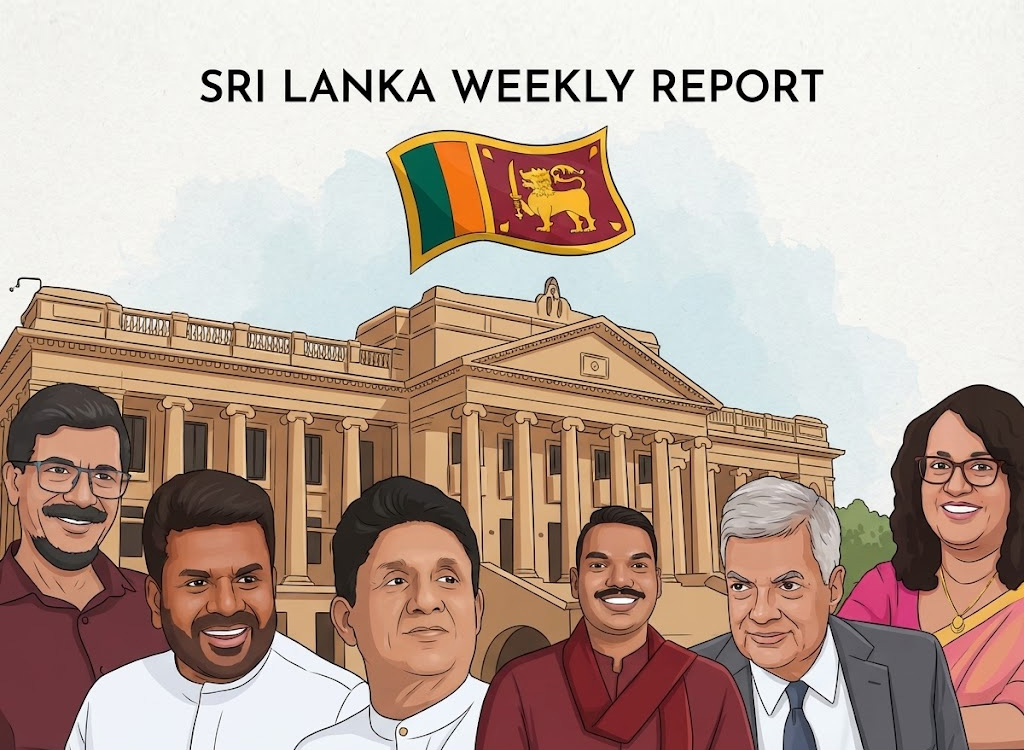
What happened. What mattered. What comes next
THE WEEK IN ONE MINUTE
Sri Lanka’s political and economic recovery entered an important week, marked by Parliament’s approval of the 22nd Constitutional Amendment (22A), a landmark verdict in the Easter Sunday attacks case, and the publication of a proposed replacement for the Prevention of Terrorism Act (PTA).
The economy presented a mixed picture. Fitch upgraded Sri Lanka’s sovereign rating to B- with a Stable Outlook, exports exceeded US$12 billion during the first eight months, and tourism earnings improved. Yet inflation rose to 8.1%, multilateral financing disbursements lagged, and negotiations with the IMF remained incomplete.
Meanwhile, a proposed Rs. 4.99 trillion Appropriation Bill opened the road to Budget 2027, while mounting health, employment and climate-related pressures underscored the social costs of recovery.
The week also brought developments in the Lasantha Wickrematunge assassination, the protection of migrant workers, and Sri Lanka’s expanding diplomatic and economic engagements.
- POLITICS & GOVERNANCE
The 22nd Amendment clears Parliament
The Supreme Court determined that 22A did not require a referendum under Article 83, a decision communicated to Parliament by Speaker Jagath Wickramaratne. Parliament subsequently approved the Bill at its second and third readings by 158 votes to 63, securing the required two-thirds majority.
The SJB intensified its opposition through a massive protest outside Parliament on September 24 despite heavy rain, followed by opposition MPs wearing black during the September 25 debate.
What mattered: The amendment’s passage, despite extensive objections from the clergy, legal community and opposition, represented a significant constitutional victory for the Government. The Supreme Court’s determination on the referendum question settled a key procedural obstacle but did not resolve the wider controversy over judicial independence and institutional safeguards.
Anti-corruption legislation under scrutiny
The Supreme Court cleared most provisions of the Anti-Corruption Act Amendment Bill but ruled that Clause 17 requires both a special parliamentary majority and a referendum. The IMF separately expressed concern that certain proposed amendments could weaken governance safeguards established under the landmark 2023 legislation.
The FCID also arrested a person accused of fraudulently transferring Rs.24.8 billion in foreign currency through five shell companies without importing goods.
Counterterrorism legislation and accountability
The Government gazetted the Protection of the State from Terrorism Bill, proposing to repeal the Prevention of Terrorism Act (PTA), which has been in force for more than four decades. The proposed framework will be closely scrutinised for its implications for civil liberties, human rights and Sri Lanka’s GSP+ trade concession with the EU.
Other governance developments
The Cabinet approved publication of a proposed Sri Lanka Cricket Bill to establish a statutory framework for the sport’s governance, powers and accountability.
Three new High Court judges – Perumal Sivakumar, Anandi Kanagaratnam and Lalith Kannangara – were appointed.
Parliament’s Committee on High Posts, chaired by Prime Minister Harini Amarasuriya, approved Anzul Banu Jhan as Ambassador to the Philippines, Chandana Rohana Kumara Ambagolla as High Commissioner to Canada, and Nusith Kumarathunga as Chairman of Sri Lanka Insurance Corporation.
2. ECONOMY, IMF & BUSINESS
IMF negotiations and the 2027 Budget
The IMF concluded its latest mission, led by Evan Papageorgiou, describing discussions on the Seventh EFF Review and 2026 Article IV Consultation as productive, but insufficient for a staff-level agreement. Negotiations will continue in the coming weeks.
Leader of the House, Minister Bimal Ratnayake says the government plans to complete Sri Lanka’s current IMF programme when the four-year EFF arrangement ends in March 2027 and will not enter another such programme, while maintaining normal engagement with the IMF thereafter.
Ratnayake also said the Government is considering further PAYE tax relief in the upcoming Budget, acknowledging the burden on professionals. He said relief must be balanced against IMF commitments and fiscal constraints. He also acknowledged the high VAT burden but said any reduction would depend on economic conditions.
The Government gazetted the 2027 Appropriation Bill, estimating expenditure at Rs.4.993 trillion. Including expenditure already charged to the Consolidated Fund under existing legislation, the total approaches Rs.9.92 trillion. The Bill’s first reading is scheduled for October 7.
Harsha de Silva, Chair of the Committee on Public Finance (COPF), said the Government must reach an understanding with the IMF on its fiscal framework before presenting the Budget.
Opposition Leader Sajith Premadasa also met IMF representatives to discuss reforms, the economic outlook and arrangements beyond the existing programme, scheduled to end in March 2027. The Seventh Review is expected in October 2026, followed by the Eighth Review in March 2027.
CIABOC Director General Ranga Dissanayake told the IMF that Sri Lanka’s 2022 economic collapse reflected not merely debt and economic mismanagement but also governance failures and deficiencies in integrity.
The IMF also expressed concern that proposed anti-corruption amendments could weaken governance safeguards established in 2023 and called for structural reforms, reduced bureaucratic obstacles and carefully designed tax concessions to attract investment.
Recovery, inflation and fiscal pressures
Fitch Ratings upgraded Sri Lanka’s Long-Term Issuer Default Ratings from CCC+ to B- with a Stable Outlook. Central Bank Governor Nandalal Weerasinghe described the upgrade as recognition of progress in stabilisation and reforms.
However, NCPI inflation accelerated to 8.1% year-on-year in August, driven largely by food prices.
Tourism revenue rose 2.1% year-on-year to US$264.4 million, its first monthly increase in ten months even though actual visitor numbers dropped marginally year on year.
The President declared that fuel prices would continue to be cushioned through subsidies despite rising international oil prices. The Government is considering further assistance ahead of a possible October 1 price adjustment. Parliament received a supplementary estimate of Rs.17.213 billion for electricity subsidies.
A new Department of Inland Revenue requirement, effective November 1, will make TIN certificates mandatory for specified transactions, including opening bank or financial institution accounts, building-plan approvals and vehicle registration or licensing.
The Central Bank issued revised large-exposure rules for licensed banks on September 24, strengthening controls against excessive concentration of banking risk.
Trade, investment and financing
Exports reached US$12.01 billion during January-August, up 4.26% year-on-year. Merchandise exports rose 3.63% to US$9.41 billion, while services exports increased 6.59% to US$2.60 billion.
However, ADB disbursements during the first half amounted to only 5.7% of planned 2026 releases, despite the Bank accounting for 31.5% of projected multilateral disbursements. COPF Chair Harsha de Silva highlighted concerns over project implementation and capital expenditure.
An IPS study identified opportunities in high-value agriculture and agro-processing.
The Securities and Exchange Commission recovered a record Rs.207 million through enforcement in 2025.
The NMRA published approved medicine price revisions reflecting currency depreciation.
Other business developments
The Government approved a contract with China Petroleum Pipeline Engineering Company for an aviation fuel storage complex and pipeline to Bandaranaike International Airport.
Sri Lanka and the UAE discussed the trilateral India-Sri Lanka-UAE initiative to develop Trincomalee as a regional energy hub, building on the 2025 memorandum of understanding.
RCEP accession also advanced after trade ministers endorsed an ad hoc working group to progress discussions with Sri Lanka, Bangladesh, Chile and Hong Kong.
Cabinet approved a €4.93 million contract for five million pre-printed NIC cards from Germany’s Muhlbauer ID Services. It also approved operating Dr Neville Fernando Hospital as a state-owned enterprise managed by the Air Force under a hybrid model.
3. LAW, JUSTICE & SECURITY
Easter Sunday verdict
The Permanent High Court Trial-at-Bar convicted 15 of 24 accused in a case involving more than 23,270 charges relating to the 2019 attacks. Nine were acquitted. The convicted received sentences ranging from 200 to 260 years of rigorous imprisonment, and their movable and immovable property was ordered confiscated.
The verdict represents a major development in criminal proceedings arising from the attacks, although wider questions concerning accountability and the circumstances surrounding the tragedy remain part of the public debate.
The Attorney General also requested a three-judge Trial-at-Bar to hear the case concerning the 2022 attack on the Gota Go Gama protest site.
Other investigations
Former SIS Director Suresh Salley will remain at the National Hospital until September 28 on medical-board advice.
Namal Rajapaksa was further remanded until September 30 in the Airbus-related money-laundering investigation. CIABOC sought warrants for two former Indian Krish Group directors over an alleged Rs70 million bribe, while investigators were authorised to record a statement from Namal in prison. Former Krish Director Janaki Siriwardena was remanded until October 6.
Legal developments
BBS General Secretary Ven. Galagoda Aththe Gnanasara Thero sought a fresh presidential pardon after the Supreme Court invalidated his earlier pardon by former President Maithripala Sirisena.
The Government presented legislation to replace existing dog-control laws with a unified framework covering rabies prevention, vaccination, registration, stray-dog management and commercial breeding. The proposed Elimination of Rabies and Registration of Dogs Bill could affect households, breeders and local authorities nationwide.
The Government’s proposed cricket legislation, approved for publication by Cabinet, seeks a statutory framework for Sri Lanka Cricket’s governance, transparency and accountability.
The Defence Ministry’s Cyber Command completed a cyber-awareness programme for frontline officials of the Ministry of Women and Child Affairs in Kurunegala on September 24.
5. HUMAN RIGHTS, HEALTH & SOCIAL AFFAIRS
Pardon for Anojan
Saudi Arabia’s reported escalation of Sri Lankan migrant worker Sivarasa Anojan’s sentence from five years to death prompted urgent diplomatic and legal intervention. Foreign Minister Vijitha Herath addressed Parliament on September 22 as the Government awaited formal confirmation of the judgment and pursued a pardon.
Sri Lanka is preparing parliamentary and presidential delegations: Faiszer Musthapha PC and Upul Kumarapperuma PC met former Maldivian President Mohamed Nasheed, who offered humanitarian assistance. The lawyers are expected to travel to Saudi Arabia at their own expense to pursue available legal remedies.
Other developments
Health Secretary Dr. Anil Jasinghe warned that non-communicable diseases account for 80% of deaths, with poorly controlled hypertension and diabetes increasing pressure on healthcare.
Health Minister Nalinda Jayatissa reported that 585 of 618 essential medicines were available, leaving shortages of 33.
The Labour Ministry estimates that El Niño-related drought has deprived more than 78,000 people of livelihoods, but most are outside formal employment and beyond existing assistance mechanisms.
Highly educated youth unemployment has reached approximately 43%, according to an IMF analysis, highlighting the disconnect between education and employment.
The Government plans to declare 20 additional forest reserves across Anuradhapura, Nuwara Eliya, Kegalle, Badulla, Vavuniya and Ampara districts.
6. FOREIGN AFFAIRS
Foreign Minister Vijitha Herath departed for New York on September 26 to address the 81st UN General Assembly on September 28.
A European Parliament delegation led by Sven Simon held discussions with the Speaker, Deputy Speaker, government and opposition MPs on democratic governance, constitutional reform, human rights, parliamentary cooperation and GSP+.
Sri Lanka condemned the use of cluster munitions at a UN review conference, calling for stockpile-holding nations to halt production and transfers.
China and Sri Lanka prepare to mark 70 years of diplomatic relations and 75 years of the Rubber-Rice Pact in 2027. Ambassador Wei Huaxiang reaffirmed Beijing’s commitment to strengthening strategic cooperation.
Sri Lanka advanced towards possible RCEP membership following the September 21 ministerial meeting in Manila, which established machinery to discuss accession with Sri Lanka, Bangladesh, Chile and Hong Kong.
The UAE and Sri Lanka discussed the trilateral initiative with India to develop Trincomalee as a regional energy hub, building on the April 2025 memorandum aimed at energy security, affordable supplies and potential export earnings.
7. MEDIA, ACCOUNTABILITY & SPORTS
The Sinhala edition of Raine Wickrematunge’s biography of Lasantha Wickrematunge, Unbowed & Unafraid, was launched on September 25. Lasantha’s 2009 killing remains unresolved, despite successive governments’ promises of independent investigations and justice.
The launch renewed attention to press freedom, accountability and the unresolved question of who killed the founding editor of The Sunday Leader. His killers remain at large.
Sri Lanka won silver in the 2026 Asian Games women’s cricket competition. Australia’s women will tour Sri Lanka for an ODI series beginning December 15 at Dambulla.
THE DEEPER STORY
The week exposed the tension between Sri Lanka’s improving international financial standing and its unfinished institutional recovery. Fitch’s upgrade and expanding exports provide evidence of economic stabilisation, yet the IMF negotiations, low development-financing utilisation, inflation and subsidy pressures demonstrate that stabilisation remains conditional on implementation.
The passage of 22A, the proposed anti-corruption changes and the new counterterrorism Bill place constitutional accountability and institutional independence at the center of the political debate. Meanwhile, the Easter Sunday verdict and continuing investigations into major financial scandals illustrate the distance between judicial outcomes, public accountability and the broader demand for justice.
The 2027 Budget, the post-IMF economic framework and the implementation of governance reforms will therefore be critical in determining whether the recovery translates into durable economic security, stronger institutions and tangible improvements in public confidence.
The coming week will also bring continued scrutiny of 22A’s implementation, the proposed anti-corruption and counterterrorism legislation, and the Government’s capacity to translate improving macroeconomic indicators into effective public spending and institutional reform.
THE WEEK IN NUMBERS
| Indicator | Figure |
| Fitch sovereign rating | B- / Stable |
| January–August exports | US$12.01bn |
| August inflation (NCPI) | 8.1% |
| August tourism earnings | US$264.4m |
| 2027 Appropriation Bill | Rs4.99tn |
| Broader expenditure including statutory charges | Rs9.92tn |
| Essential medicines available | 585 of 618 |
| People losing livelihoods due to dry weather | 78,000+ |
| Easter case convictions | 15 of 24 accused |
| ADB first-half disbursement against expected 2026 total | 5.7% |
THE WEEK AHEAD
- September 28: Foreign Minister Vijitha Herath addresses the UN General Assembly; developments expected in the Sivarasa Anojan case.
- September 29: Namal Rajapaksa’s remand proceedings (case filed by Commission to Investigate Allegations of Bribery or Corruption).
- September 30: Namal Rajapaksa’s remand proceedings (case filed by the Criminal Investigations Department); Court of Appeal ruling on the Dilith Jayaweera writ application.
- September 30: Case against former President Ranil Wickremesinghe over the alleged misuse of public funds during a visit to the UK in 2023.
- October 1: Possible fuel-price adjustment, with the Government considering subsidies.
- October 2: Court appearance of two former Krish Group directors in the bribery investigation.
- October 6: Further proceedings involving Former Krish Director Janaki Siriwardena.
- October 7: First reading of the 2027 Appropriation Bill.
- October: Expected IMF Seventh Review and continued negotiations on the fiscal framework.
- Coming weeks: Scrutiny of the proposed anti-terrorism and cricket legislation, RCEP accession discussions, and implementation of economic and institutional reforms.







Leave a comment