
By The Pulseline News Desk
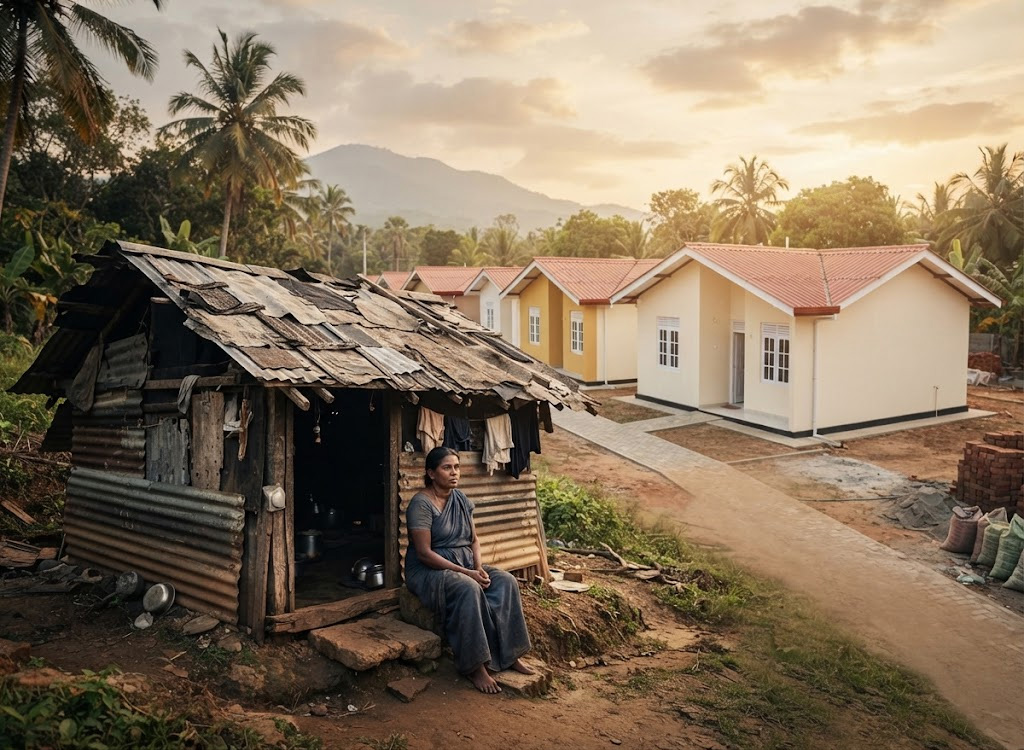
Around 600,000 people in Sri Lanka still lack safe or semi-permanent housing, highlighting a housing deficit that remains largely hidden behind the country’s overall housing-unit statistics, Housing, Construction and Water Supply Minister, Susil Ranasinghe said.
Ranasinghe has told the media that the country’s housing shortage could not be assessed simply by comparing the number of households with the number of houses.
Data compiled by the Department of Census and Statistics in December 2024 shows that Sri Lanka has approximately 6.1 million households, compared with around 6 million housing units.
However, the Minister has said these figures do not provide a complete picture of the country’s actual housing needs.
Some households own more than one house, while a portion of the existing housing stock is either unsuitable for living or does not meet the basic requirements of safe and permanent housing.
As a result, the Government estimates that hundreds of thousands of people continue to live in inadequate housing conditions.
31,000 houses in Government programme
Against this backdrop, the Government has launched a programme aimed at providing 31,000 houses to address the housing needs of vulnerable and inadequately housed families.
The first phase covers 19,000 houses, which will either be newly constructed or renovated.
Of these, approximately 12,000 houses will be constructed entirely with Government funding, while the remainder will be supported through concessionary loan schemes.
Ranasinghe has said work on around 20,000 houses is currently at different stages of construction or completion, with some projects expected to be completed next year.
The programme is therefore intended not merely to increase the number of housing units, but to improve the quality and habitability of existing housing while providing new homes where necessary.
More than 5,000 houses to open next week
A significant milestone in the programme is expected on October 5, when more than 5,000 houses are scheduled to be officially opened, according to the Minister.
The openings are expected to provide an early indication of the Government’s progress in translating its housing programme into completed homes for families currently living in inadequate conditions.
Housing gap extends beyond flagship programme
Ranasinghe has also stressed that the 31,000-houses programme represents only one component of the Government’s broader housing assistance.
The figure does not include housing loan concessions provided to Government officials and public servants, nor does it cover a separate housing assistance loan scheme for Sri Lankans employed overseas.
This distinction is important because the number of households requiring housing assistance is substantially broader than the number of houses being constructed directly under the flagship programme.
With roughly 6 million housing units already recorded against 6.1 million households, the issue is increasingly one of housing quality, accessibility and distribution rather than simply the number of structures.
The Government now faces the challenge of ensuring that new construction and renovations reach those living in unsafe or temporary conditions, while also preventing the housing deficit from widening as household numbers and living costs increase.
The estimated 600,000 people without safe or semi-permanent housing consequently places the focus on a less visible aspect of Sri Lanka’s post-crisis recovery, which is whether economic recovery is translating into basic improvements in living conditions for households still struggling to secure adequate shelter.











Leave a comment