
By The Pulseline News Desk
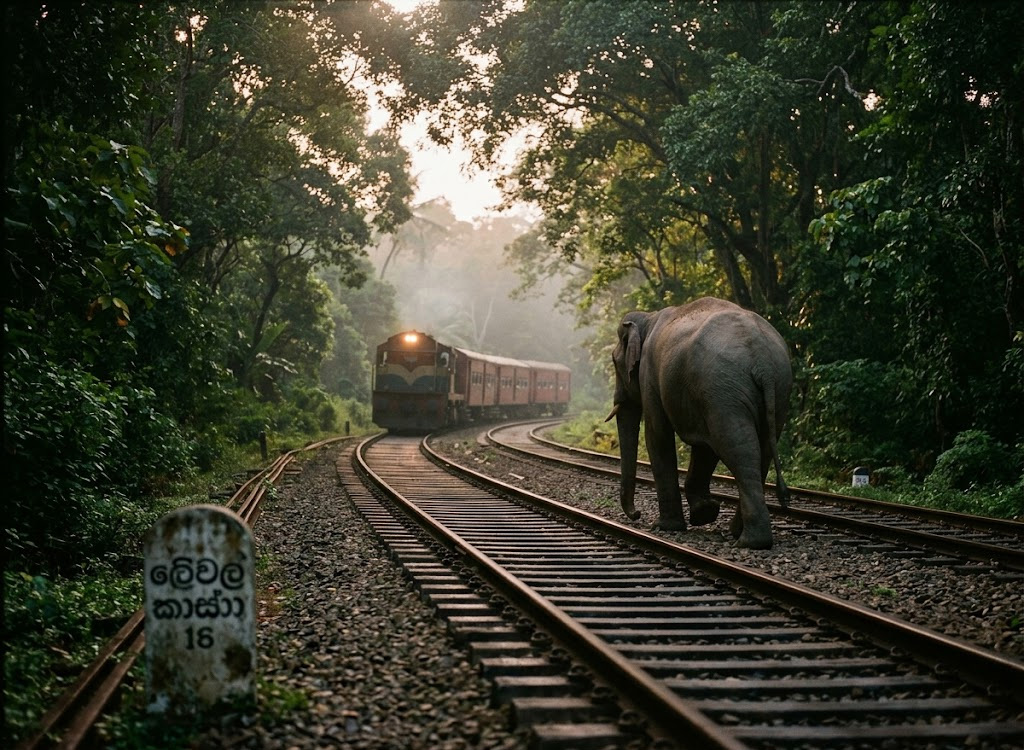
The Court of Appeal has reportedly directed wildlife authorities and the Central Environmental Authority (CEA) to ensure that an Environmental Impact Assessment (EIA) is submitted in relation to railway operations across the Northern, Eastern, North Central and North Western Provinces, with measures to prevent train-elephant collisions.
In a judgment delivered recently by Justice Frank Gunawardhana, the Court has issued a writ of mandamus directing the Acting Director General of Wildlife and/or the CEA to require the General Manager of Railways to submit the assessment, reflecting mitigation measures to prevent elephants from being killed or injured by trains.
The ruling has also directed the Department of Wildlife Conservation to prepare a management plan for national reserves and established a framework for urgent action to address railway stretches identified as high-risk areas for elephant-train collisions.
The Court has ordered the appointment of an interim committee comprising a nominee of the Attorney General, representatives of civil society organisations and elephant experts to formulate an emergency framework to identify high-risk railway sections and introduce designated “go slow” zones with specified speed limits.
The committee was also tasked with recommending appropriate disciplinary action and prosecutions against locomotive drivers found to have driven recklessly at excessive speeds despite the presence of elephant crossings, resulting in the deaths or injuries of elephants.
The judgment has further directed that railway officials be sensitised to the need to minimise elephant-train collisions and recommended the adoption of both technology-based and non-technology-based preventive and mitigation measures.
The respondents are also required to report periodically to the Court on the implementation of the directions.
Public interest petition following fatal collision
The judgment was delivered in response to public interest litigation filed by the Centre for Eco-Cultural Studies, which also represented “Elephant X” (Elephas maximus maximus), an elephant residing in the Gal Oya and Minneriya areas, through a next friend.
The petition has followed the collision involving the Colombo-bound Meenagaya train travelling from Batticaloa and a herd of elephants on 25 April 2025. The incident had killed six elephants and severely injured other members of the herd, including the second petitioner, with several elephants subsequently dying from their injuries.
The petition has brought the recurring problem of elephant-train collisions before the Court, seeking measures to protect wildlife and prevent further deaths.
In issuing its directions, the Court has invoked provisions of the Fauna and Flora Protection Ordinance and the National Environmental Act, among other legal provisions.
Court acknowledges question of animal rights
An important aspect of the judgment was the Court’s consideration of whether an elephant could seek legal protection through proceedings before a court.
While acknowledging that a question remained as to whether an elephant could have its rights declared by a court of law, the Bench has recognised that the rights of animals, including the right to life, had been acknowledged in certain jurisdictions.
The Court has observed that such recognition existed even though animals could not personally appear before a court and lodge complaints.
The proceedings have therefore raised questions not only about the responsibilities of railway and wildlife authorities but also about the extent to which the law could protect animals from preventable harm.
The directions seek to address the problem through environmental assessments, railway speed controls, accountability for reckless driving and coordinated action by relevant authorities.
With the Court requiring periodic progress reports, the implementation of these measures will be central to determining whether the ruling translates into effective safeguards for elephants along Sri Lanka’s railway network.











Leave a comment