
By The Pulseline News Desk
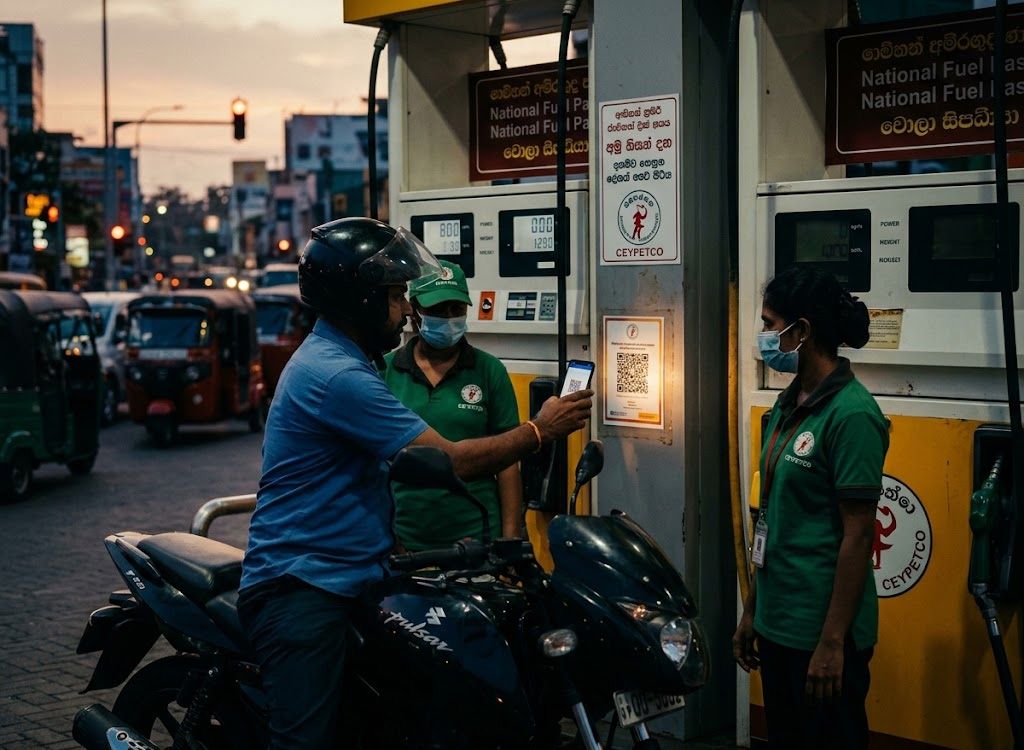
The Government has decided to continue Sri Lanka’s QR-based fuel distribution system as the unresolved conflict in the Middle East and continuing instability around the Strait of Hormuz keep global oil markets exposed to sudden price and supply shocks.
Cabinet Spokesperson, Minister Nalinda Jayatissa has said the Government had no immediate plans to discontinue the QR system, despite some reduction in domestic fuel consumption.
Speaking at the post-Cabinet media briefing, Jayatissa has said the international oil crisis had not yet been resolved and that Sri Lanka needed to maintain mechanisms capable of managing fuel supplies and protecting consumers from potential disruptions.
“The oil crisis has not yet been resolved. As a country, we are using this system to maintain daily life as much as possible without disruption,” he has said.
According to the Minister, developments in the Middle East, particularly the continuing instability surrounding the Strait of Hormuz, were having an impact on international oil prices.
The resulting fluctuations in crude oil prices have created an uncertain environment for countries such as Sri Lanka, which remains heavily dependent on imported petroleum products to meet domestic energy requirements.
Managing supply amid uncertainty
The decision to retain the QR system suggests that the Government is prioritising supply management and preparedness over an immediate return to unrestricted fuel distribution.
Although fuel consumption has declined to some extent, Jayatissa has indicated that the Government considers the existing system necessary to manage demand and ensure that available stocks can be distributed without major disruption.
The QR mechanism was introduced during Sri Lanka’s 2022 fuel crisis, when the country faced severe foreign exchange shortages, depleted fuel stocks and unprecedented queues at filling stations.
The system was designed to regulate fuel distribution by linking allocations to vehicle registration numbers and limiting the quantity of fuel that could be obtained during specified periods.
While the economic circumstances have since improved considerably, the Government appears reluctant to completely abandon a mechanism that could be used to manage supplies should external conditions deteriorate.
Hormuz remains a major concern
The Government’s continued reference to the Strait of Hormuz highlights the importance of developments in the region to Sri Lanka’s energy security.
The waterway is one of the world’s most important routes for oil and gas shipments. Any significant disruption to shipping through the Strait can affect international crude supplies, transportation costs and insurance premiums, potentially pushing up prices even in countries far removed from the Middle East.
For an import-dependent economy such as Sri Lanka, higher global petroleum prices can quickly translate into increased foreign exchange requirements for fuel imports and greater pressure on domestic energy prices.
The impact can also extend beyond petrol and diesel. Higher energy costs can increase transportation, electricity generation and production expenses, creating broader inflationary pressures across the economy.
Sri Lanka is therefore closely exposed to developments in international energy markets even when domestic fuel stocks remain adequate.
A more cautious approach
The Government’s decision also reflects a more cautious approach to fuel management following the shortages experienced during the 2022 economic crisis.
The country has since rebuilt its foreign exchange reserves and improved the availability of essential imports. However, fuel remains one of the largest recurring import requirements, making international oil prices and the exchange rate important factors in the country’s external position.
Maintaining the QR system gives authorities an additional tool to manage consumption if global prices rise sharply or supply disruptions emerge.
At the same time, the continuation of the system indicates that the Government does not yet consider international conditions sufficiently stable to return entirely to normal fuel distribution arrangements.
Jayatissa has stressed that the objective was not to disrupt daily economic activity but to ensure that it could continue with minimum disruption despite external risks.
Consumers await return to normality
For motorists and other fuel consumers, the continuation of the QR system means that fuel access will remain subject to the existing allocation mechanism until the Government determines that the system is no longer necessary.
The policy could also become an important test of how the Government balances economic normalisation with external risk management.
Removing the QR system could provide greater convenience for consumers and signal confidence in the stability of fuel supplies. Retaining it, however, provides the Government with greater control over demand in the event of an international supply shock.
The immediate challenge is therefore to maintain adequate fuel stocks without unnecessarily restricting economic activity, while ensuring that a sudden increase in global prices does not place renewed pressure on Sri Lanka’s foreign exchange position.
For now, the Government’s message is that the fuel situation is stable enough to support normal economic activity, but not sufficiently insulated from international shocks to justify abandoning the QR system.
With the Middle East crisis continuing and uncertainty surrounding the Strait of Hormuz persisting, the Government appears intent on keeping the distribution mechanism in place as a precaution until conditions in global oil markets become more predictable.









Leave a comment