
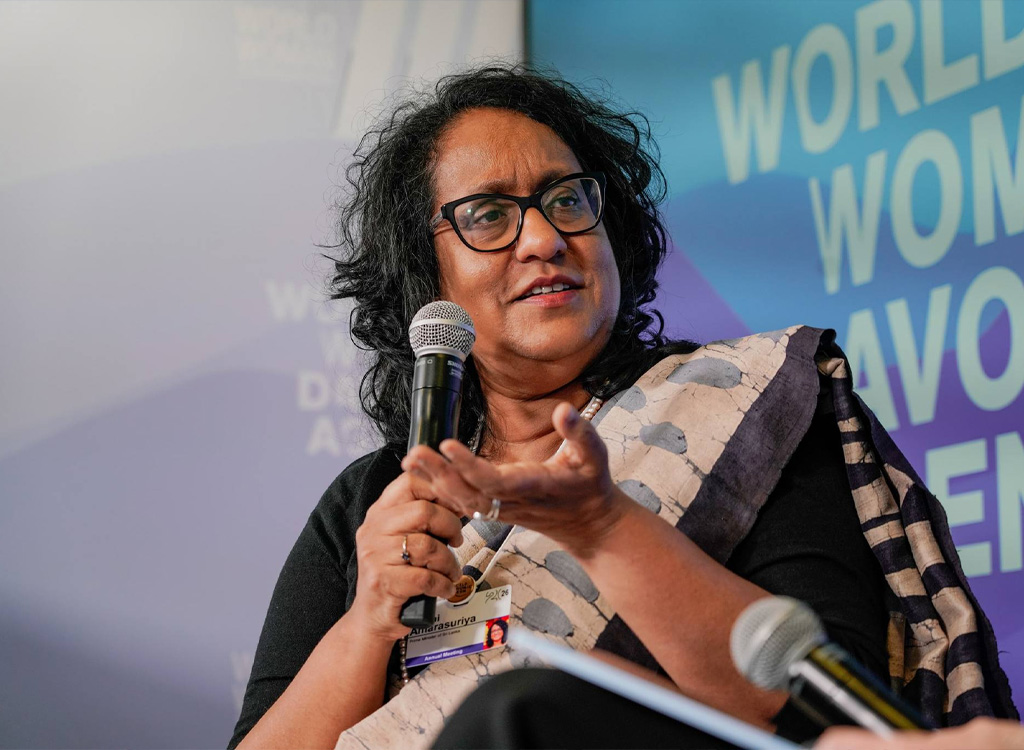
Sri Lankan Prime Minister Harini Amarasuriya notes that contributions of women continue to be systematically undervalued, particularly in unpaid care work, informal labour, and agriculture sectors, despite women increasingly asserting agency in political, economic, and social spheres across the world.
“The exclusion of women from decision-making is not incidental; it is structurally maintained through gendered power hierarchies. Addressing these barriers is about transforming institutions and power structures to create enabling environments in which women can lead with confidence,” Prime Minister Amarasuriya noted while addressing the World Woman Davos Agenda 2026 at World Woman House, held on the sidelines of the 56th Annual Meeting of the World Economic Forum in Davos-Klosters, Switzerland. The event was a high-level forum organized under the theme “Women Leading the Changing Global Order.”
“From a political standpoint, the exclusion of women from decision-making is not incidental; it is structurally maintained through gendered power hierarchies. Attacks on women in leadership, particularly in politics, through harassment, character assassination, and systemic marginalization, often force capable women, including those aspiring to leadership, to withdraw or refrain from participation, thereby reinforcing entrenched patriarchal structures,” she noted.
The Prime Minister went on to note that addressing these barriers is not about protection but about transforming institutions and power structures to create enabling environments in which women can exercise leadership with autonomy, authority, and confidence.
“Sri Lanka demonstrates what is possible when political commitment aligns with the resilience of its people. Under our current inclusive government, historic strides have been made in political representation. For the first time, 20 women have been elected to Parliament. This commitment is reflected not only in vision; it signals a shift toward more inclusive governance,” she added.
Amarasuriya further stated that leadership is not merely about occupying seats at existing tables, but about restructuring systems themselves, while reaffirming Sri Lanka’s commitment to feminist, intersectional leadership. She also called on global actors to ensure that women and marginalised communities are not only participants, but principal architects of the policies shaping the future global order.









Leave a comment