
By The Pulseline News Desk
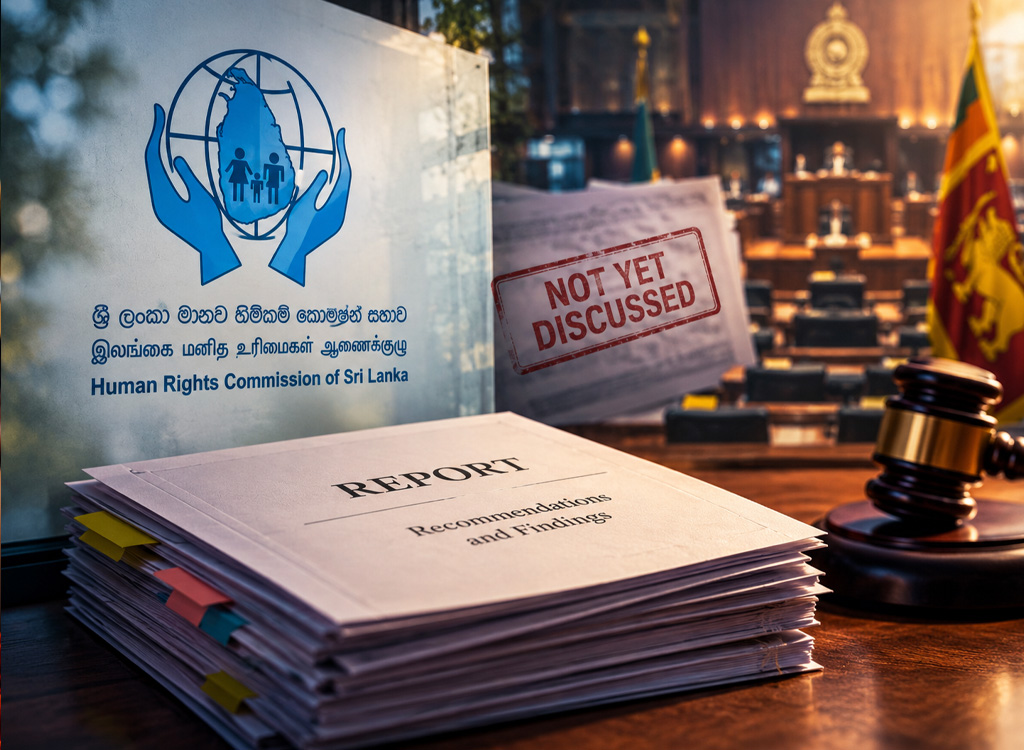
The Human Rights Commission of Sri Lanka (HRCSL) has raised concerns over the failure to implement its recommendations, revealing that several reports submitted to the President on non-compliance by public institutions have yet to be discussed in Parliament.
Although the President has the authority to refer such reports to Parliament for discussion, none of the reports submitted by the Commission in recent times has been taken up for debate, according to HRCSL Member and Commissioner, attorney Nimal G. Punchihewa.
Punchihewa has told the media that the Commission was required by law to inform the President when public institutions failed to implement its recommendations, leaving the next step to be taken through the parliamentary process.
“Under the law, if an institution does not implement our recommendations, we have to inform the President through a report. The President can then submit it to Parliament, where the matter should be discussed,” he has said.
However, despite the Commission having submitted several such reports, Punchihewa has noted that the HRCSL had not seen any of them being taken up for discussion in Parliament.
The situation has reportedly renewed attention on the enforcement limitations faced by the national human rights watchdog, particularly when public institutions fail to act on its findings and recommendations.
The HRCSL has also called for amendments to the Human Rights Commission of Sri Lanka Act, No. 21 of 1996, seeking stronger legal powers to ensure compliance with its recommendations.
Punchihewa has said the existing law allowed the Commission to act when individuals summoned before it failed to appear but did not provide an equivalent mechanism to address the failure of institutions to implement its recommendations. “If someone summoned by the HRCSL fails to appear before it, we have the power under the Act to treat that as contempt of court and proceed accordingly,” he has said.
The Commission has proposed amending the Act to allow the failure to implement its recommendations to be dealt with in a similar manner. However, Punchihewa has said none of the proposed amendments had been implemented.
The issue raises questions about the effectiveness of the existing framework for ensuring accountability when public institutions disregard recommendations made by an independent body mandated to protect fundamental rights.
The HRCSL is responsible for investigating alleged violations or imminent violations of fundamental rights, facilitating the resolution of complaints through conciliation and mediation, and advising the Government on legislation and administrative practices affecting human rights.
It is also mandated to recommend changes to national laws and practices to bring them into line with international human rights standards.
While these functions enable the Commission to investigate complaints and recommend corrective action, the concerns raised by Punchihewa highlight the challenges it faces in ensuring that its recommendations translate into action.
The absence of parliamentary discussions on reports concerning institutional non-compliance, alongside the lack of progress on proposed amendments to strengthen the Commission’s powers, leaves questions about the mechanisms available to address failures to implement its recommendations.









Leave a comment