
Dr Manoj Jinadasa
The greatest paradox of contemporary politics is that citizens can mobilise faster than ever before, challenge powerful governments through digital networks, and bring long-standing political establishments to the brink of collapse — yet still struggle to build democratic institutions capable of delivering lasting change. A generation that can organise a protest through a smartphone may succeed in removing a political leader but transforming the political system that enabled that leader to exercise power is a far more complex task.
This tension lies at the heart of The Youthquake: Emergence of the Fifth Estate vs The Captured Fourth in Asia, a timely contribution associated with Dr Ranga Kalansooriya and his co-authors and contributors. The book invites readers to examine the changing relationship between young citizens, digital communication, journalism, and political authority across Asia. More importantly, it raises a question that extends beyond the continent: when digitally connected citizens challenge established power, what happens after the streets fall silent?
From political spectators to digital citizens
For much of modern political history, citizens have depended on established institutions to interpret public affairs. Political parties, newspapers, broadcasters, and other intermediaries have helped determine which issues receive public attention and how political events are understood. Professional journalism, often described as the Fourth Estate, has traditionally played a critical watchdog role by investigating abuses of power and holding governments accountable.
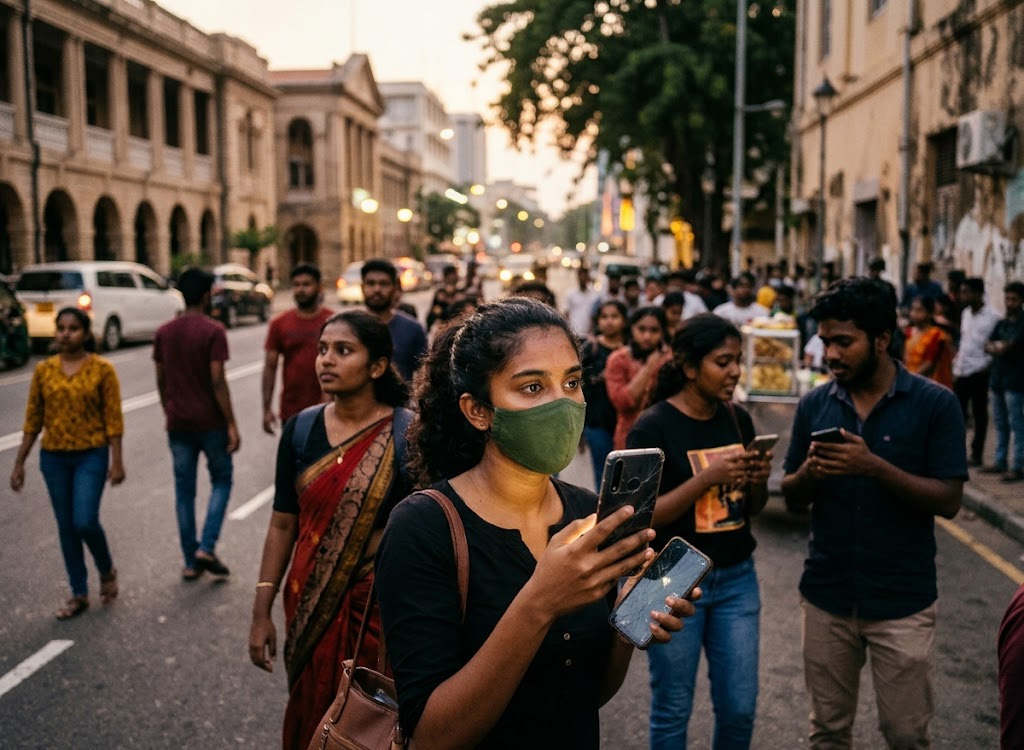
However, the expansion of digital platforms has altered this relationship. Citizens can now record events, circulate evidence, challenge official statements, and connect with people beyond their immediate communities. Young people, in particular, can use social media to turn individual grievances into collective demands without waiting for established political organisations to provide leadership.
William H. Dutton’s concept of the Fifth Estate offers a useful framework for understanding this development. In his 2009 work, “The Fifth Estate Emerging through the Network of Networks”, Dutton examined how networked individuals could acquire new capacities to monitor institutions and influence public affairs. The significance of this argument is not simply that more people can publish information. It is that digital networks can redistribute some of the communicative power traditionally concentrated in established institutions.
Yet this redistribution should not be confused with the disappearance of power. Digital platforms have their own owners, commercial priorities, algorithms, and systems of content moderation. Visibility is unevenly distributed, while misinformation and political manipulation can circulate alongside credible evidence. The Fifth Estate therefore creates new possibilities for democratic participation without automatically guaranteeing democratic outcomes.
Asia’s youth movements and the crisis of political legitimacy
The Arab Spring demonstrated how digital communication could help people share information, coordinate collective action, and challenge entrenched political authority. Subsequent movements across Asia have revealed both the strength and the limitations of networked mobilisation.
Sri Lanka’s 2022 Aragalaya provides a particularly important example. Economic hardship, public frustration, and a profound crisis of political confidence converged in a movement that used digital communication to mobilise citizens and circulate alternative accounts of the country’s political crisis. The movement helped make public dissatisfaction visible on an extraordinary scale and contributed to a decisive political turning point.
Bangladesh’s 2024 uprising similarly demonstrated how youth-led mobilisation could expand beyond an initial grievance and develop into a wider challenge to political authority. Nepal’s youth-led protests in 2025 also drew attention to the relationship between generational frustration, political accountability, and demands for institutional change.
These experiences should not be treated as identical. Each emerged from a particular political history, economic situation, social structure, and institutional environment. Nevertheless, they illuminate a shared problem: digital communication can accelerate political mobilisation, but it cannot independently resolve the structural causes of public dissatisfaction.
Manuel Castells, in Networks of Outrage and Hope: Social Movements in the Internet Age (2012), explains how communication networks can connect personal anger with collective action. Zeynep Tufekci’s Twitter and Tear Gas: The Power and Fragility of Networked Protest (2017) further examines how digitally organised movements can become powerful quickly while encountering difficulties in developing durable organisational capacity.
Together, these perspectives help explain why the success of a protest should not be measured solely by the size of its crowds, the reach of its hashtags, or the departure of a political leader. The deeper test is whether mobilisation produces transparent governance, stronger public institutions, accountable political leadership, and meaningful opportunities for citizens to influence decisions.
When the Fourth Estate is captured
The book’s contrast between the emerging Fifth Estate and the captured Fourth Estate raises another fundamental issue: what happens when journalism loses public confidence?
A healthy media system does more than report political events. It investigates official conduct, verifies claims, gives space to competing perspectives, and enables citizens to understand the consequences of public decisions. When media organisations become excessively dependent on political patronage, ownership interests, commercial pressures, or partisan loyalties, their watchdog function can be weakened.
However, the answer is not to assume that digital citizens can replace professional journalism altogether. Citizen-generated information can reveal events that established news organisations overlook, but verification, context, legal accountability, and sustained investigation remain essential. The strongest democratic communication environment is therefore not one in which the Fifth Estate defeats the Fourth Estate. It is one in which independent journalism and networked citizens scrutinise power together.
This distinction matters because digital participation can also be manipulated. Political actors may use online networks to manufacture public enthusiasm, spread misleading narratives, target opponents, or transform complex policy questions into emotionally charged divisions. The same communication infrastructure that supports civic accountability can also facilitate propaganda.
The central challenge is consequently not to celebrate digital technology uncritically, but to examine who controls communication, whose voices become visible, whose interests are served, and whether public debate can lead to accountable political decisions.
The difference between mobilisation and transformation
Three forms of power help clarify what happens during and after a youthquake.
Communicative power is the capacity to make experiences, grievances, and demands publicly visible. Digital platforms can expand this capacity by allowing citizens to challenge official narratives and share evidence.
Mobilising power is the ability to convert shared grievances into collective action. Online networks can help people coordinate demonstrations, sustain solidarity, and connect previously isolated communities.
Institutional power, however, concerns the capacity to change laws, policies, administrative practices, political accountability, and the distribution of resources. It requires more than visibility and collective anger. It depends on durable institutions, political negotiation, legal safeguards, public oversight, and sustained civic engagement.
A movement may possess considerable communicative and mobilising power without developing an equivalent capacity to influence institutions. This gap can leave the public disappointed when political change fails to produce improvements in everyday life.
The challenge is especially significant when citizens unite against a political establishment but hold different expectations about what should replace it. Opposition to corruption or economic mismanagement may bring diverse groups together, but agreement on the next political and economic settlement is far more difficult.
Political dissatisfaction has no fixed ideological direction. It may support pluralism, social justice, and democratic renewal, but it can also be channelled towards exclusionary nationalism, populism, or new forms of authoritarian leadership. A movement’s democratic significance must therefore be judged by its commitments to rights, accountability, inclusion, and the rule of law — not simply by the age of its participants or the popularity of its online campaigns.
Rebuilding trust through communication
The future of democratic communication depends on whether political institutions learn to treat citizens as participants rather than audiences to be managed. Public communication cannot be reduced to slogans, carefully staged announcements, or reputation management after a crisis. Governments must explain decisions, disclose relevant information, respond to criticism, and create credible mechanisms through which citizens can influence public policy.
This principle also applies to political parties, media organisations, universities, and civil society. Trust is not created merely by increasing the volume of communication. It emerges when institutions demonstrate consistency between what they say and what they do.
The relationship between public relations and democratic governance is particularly important here. Responsible public relations should support dialogue, responsiveness, and accountability rather than function solely as an instrument for protecting institutional reputations. Communication becomes democratically meaningful when it allows institutions to be questioned and requires them to respond.
For young citizens, the task is equally demanding. Sustained democratic participation requires more than online visibility. It calls for media literacy, critical evaluation of information, respect for pluralism, organisational capacity, and continued engagement with the institutions that shape public life.
The real meaning of a youthquake
The importance of The Youthquake lies in the questions it encourages readers to ask about the relationship between digital networks, political journalism, and civic power. Its Asian perspective offers a valuable starting point for considering how younger generations are challenging established political arrangements in societies with different histories and institutional conditions.
The wider lesson is that a youthquake should not be understood simply as a generational revolt or a dramatic moment of political disruption. It is a test of whether public participation can be converted into a more accountable democratic order.
Digital networks can open spaces for dissent, expose failures, and make collective action possible at unprecedented speed. But democratic renewal requires institutions that protect rights, distribute power fairly, investigate wrongdoing, and respond to public demands. It also requires independent journalism capable of resisting both political capture and the commercial pressures that distort public debate.
The ultimate question is not whether digital citizens can challenge political power. Recent movements have shown that they can. The more difficult question is whether they can help build institutions that remain accountable after the excitement of mobilisation has passed.
A revolution may change who occupies the seat of power. A democratic transformation must change how power is exercised, scrutinised, and held accountable. That is the unfinished task confronting the youthquake generation — and the standard by which its political legacy will eventually be judged.
(The writer is a Senior Lecturer and Head, Department of Mass Communication Faculty of Social Sciences, University of Kelaniya, Sri Lanka)
Disclaimer: The views and opinions expressed in this article are those of the writer and do not necessarily reflect the official position of this publication.













Leave a comment