
By The Pulseline News Desk
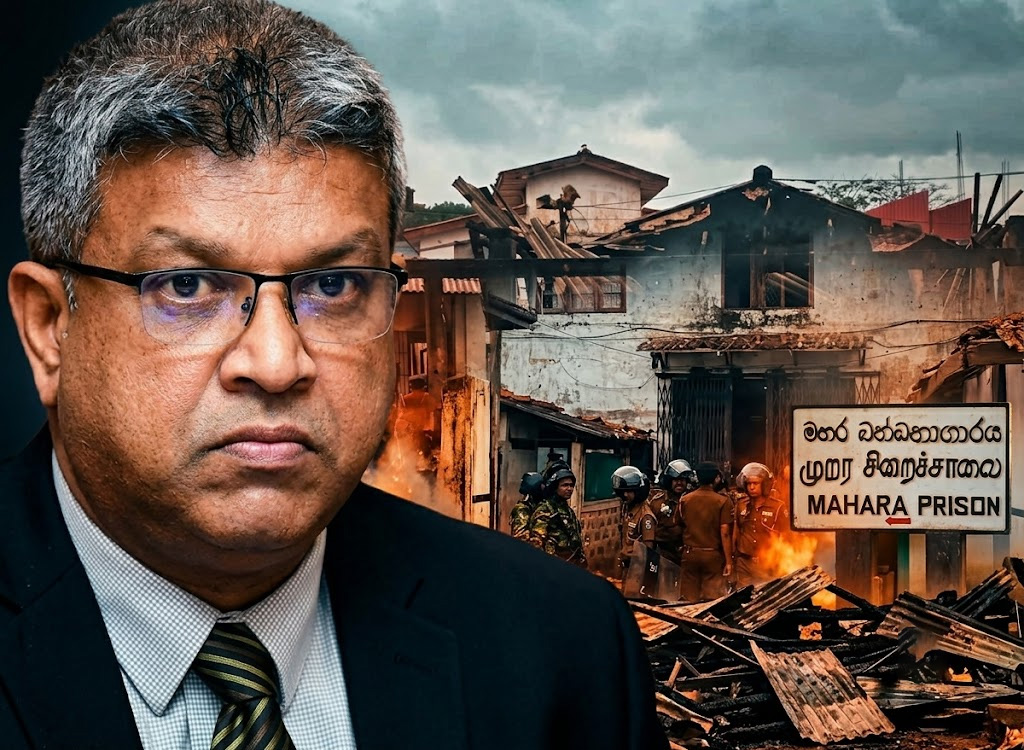
Justice Minister Harshana Nanayakkara has alleged that the recent unrest at Mahara Prison was not merely a prison riot but an organised attempt to cripple the administration of one of the country’s largest correctional facilities.
Making a special statement in Parliament, the Minister said the scale and nature of the destruction pointed to deliberate sabotage rather than a spontaneous clash among inmates.
According to Nanayakkara, prisoners intentionally targeted key operational facilities, setting fire to the prison kitchen, cafeteria, infirmary and administrative offices, including the main jailor’s office.
“This shows they had a clear intention. This has never happened before. It is evident that there was an organised attempt to sabotage the administration of the Mahara Prison,” he said.
The Minister outlined the sequence of events, stating that the disturbance began on August 1 when three inmates climbed onto the prison roof in protest. After negotiations failed, nearly 1,000 inmates reportedly joined the protest, escalating the situation into a large-scale riot. Prisoners then attacked the main entrance with stones, prompting authorities to deploy tear gas and rubber bullets to regain control.
By the time security forces intervened, several prison buildings had been extensively damaged. On August 2, officers from the Police Special Task Force (STF), together with prison officials, succeeded in restoring order and returning inmates to their cells.
One inmate was killed during the unrest while eight others sustained injuries and were admitted to hospital. The Minister noted that no prison officers were killed or injured in the incident.
Drawing a distinction between the recent disturbances at Negombo Prison and the violence at Mahara, Nanayakkara said the former primarily involved clashes among inmates, whereas the Mahara unrest was a direct attack on the prison administration itself.
He questioned how such a large number of inmates had mobilised within a short period, suggesting that investigators were examining whether there had been external influence or a coordinated conspiracy behind the violence.
“The intention was to make the Mahara Prison inoperable. We are investigating this. If there are any conspirators, we will take the necessary action against them,” he told Parliament.
The Justice Minister said the situation at Mahara has now been fully brought under control and that the government is considering additional security and administrative measures to prevent similar incidents from spreading to other prisons.
The latest unrest has renewed attention on Sri Lanka’s prison system, which has long struggled with overcrowding, security challenges and ageing infrastructure. While the government insists the Mahara violence was a calculated act of sabotage, investigations are continuing to determine who, if anyone, orchestrated the attack.













Leave a comment