
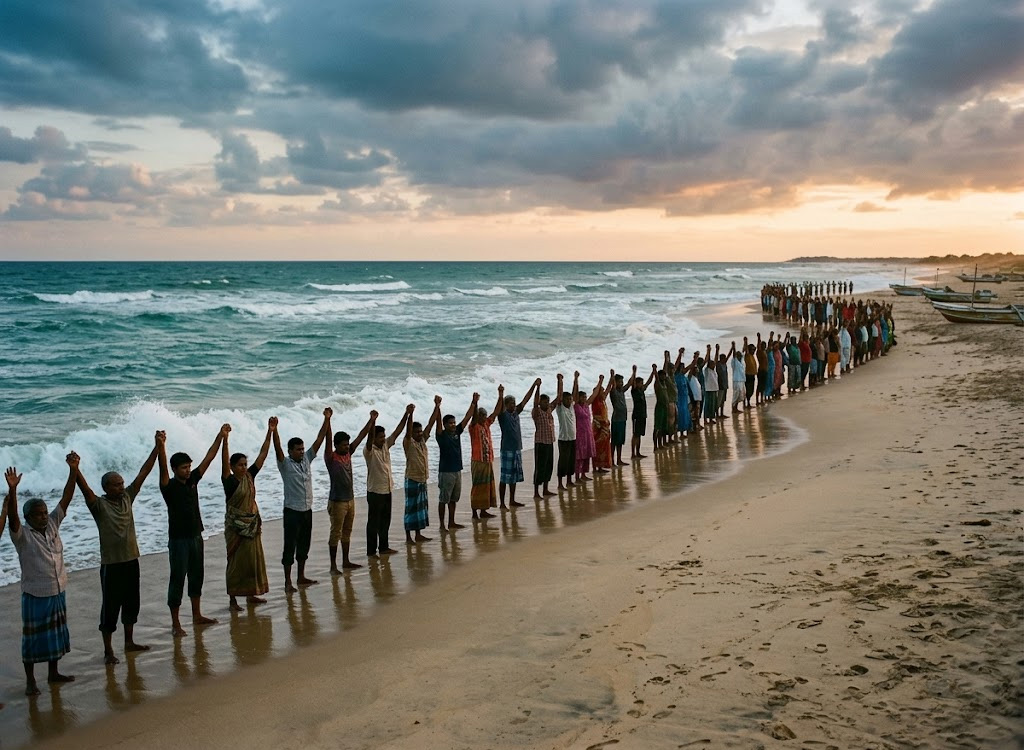
Greenpeace South Asia initiative brings together communities from six countries and the Pacific to connect local environmental concerns with the global climate crisis
By The Pulseline News Desk
A human art installation at Keeri Beach in Mannar has reportedly brought together climate-affected communities from across Asia, Africa and the Pacific, using collective artistic expression to demand stronger climate action and greater accountability for environmental damage.
The event has reportedly brought together local residents, environmental activists, university representatives and participants from Senegal, the Philippines, Bangladesh, India, Papua New Guinea and the Pacific region, highlighting the shared challenges facing communities increasingly exposed to climate-related impacts.
Organised as part of a climate campaign led by Greenpeace South Asia, the installation has sought to connect the experiences of communities on the frontlines of environmental change with wider scientific discussions and international calls for climate accountability.
The gathering has also highlighted the vulnerability of coastal communities whose livelihoods depend on the ocean, with participants sharing concerns about environmental degradation and changes affecting marine resources.
Art as a call for climate accountability
Cherika Ranasinghe, a Greenpeace South Asia campaigner and one of the event organisers, has been quoted in the local media saying that the organisation had been working on climate action in Mannar for approximately a year.
The campaign focuses on three main areas: gathering evidence of climate-related impacts in Mannar, connecting community-level observations with scientific knowledge, and advancing climate accountability.
The human art installation has formed part of efforts to document and communicate environmental concerns through the participation of affected communities, making their experiences more visible to wider audiences.
Similar activities are being conducted in Sri Lanka and India, linking local environmental experiences with regional and international climate discussions.
The installation was led by Indian artist Subodh Kerkar and his team, who had used the human body and collective participation as a medium to communicate the relationship between people and the natural environment.
Kerkar has described art as “a protest and a prayer”, emphasising that opposition to environmental destruction need not be driven by hatred.
Associated with Greenpeace for nearly two years, the artist has used creative expression to raise awareness of pollution and environmental issues.
At Keeri Beach, participants have stood together along the shore, holding hands and raising their arms in a collective gesture symbolising protection, unity and love for the ocean.
The installation has sought to convey that the ocean is not separate from human life but is fundamental to the survival and wellbeing of coastal communities and humanity at large.
Science meets lived experience
Beyond the visual presentation, an open discussion has brought together environmental experts, university students, community representatives and people experiencing environmental changes in their daily lives.
The discussion has connected the installation’s message with scientific perspectives on the ocean’s role in maintaining ecological balance and regulating the global climate.
Senior Lecturer Dr S. Wijeyamohan of the Department of Bio-Science, Faculty of Applied Science, University of Vavuniya, has emphasised the fundamental relationship between human life and the ocean.
He has highlighted the ocean’s role in absorbing heat and carbon dioxide from the atmosphere, helping regulate global temperatures and mitigate the effects of climate change.
However, he has cautioned against treating this natural capacity as unlimited, stressing the need to recognise humanity’s responsibility to protect the marine environment.
The discussion has underscored the importance of combining scientific evidence with the experiences of communities whose livelihoods and daily lives are directly connected to coastal ecosystems.
Representatives of Save a Life and the Organisation of People for Engagement and Enterprise (OPEnE) have also contributed perspectives on environmental challenges, community experiences and local action.
Their participation has highlighted the role of community organisations in translating environmental awareness into practical engagement and collective responsibility.
Fisherman reports sharp decline in catches
The economic consequences of environmental change emerged through the testimony of a fisherman from Pesalai, Mannar, who has worked in the fishing industry for nearly 30 years.
He has reported a substantial decline in his catches, recalling that he previously brought in around 300–400 kilograms of fish, compared with approximately 30–40 kilograms more recently.
His account has illustrated the concerns of fishing communities whose livelihoods depend on the availability of marine resources.
While a decline in individual catches does not, by itself, establish climate change as the cause, such experiences highlight the importance of investigating changes in marine ecosystems and their effects on coastal livelihoods.
For communities dependent on fishing, declining catches can translate into reduced incomes and greater economic uncertainty, reinforcing the need for evidence-based responses to environmental pressures.
The testimony also demonstrated why community observations are an important component of environmental research, particularly when combined with scientific data that can help identify the causes and extent of changes in marine resources.
Local struggles, global connections
The event has also featured a news conference with participants from Africa, the Philippines, India, Bangladesh, Papua New Guinea, the Pacific region and Mannar.
Participants have shared experiences of climate-related challenges affecting their respective communities, placing concerns of Sri Lanka’s coastal populations within a broader international context.
Although the environmental pressures experienced by individual communities may differ, the gathering has highlighted common concerns over the protection of natural resources, the sustainability of livelihoods and the need for those responsible for environmental harm to be held accountable.
By bringing together communities across national boundaries, the initiative has sought to demonstrate how local experiences can contribute to a wider understanding of the climate crisis.
The gathering has also provided a platform for communities to communicate their concerns directly, rather than relying solely on institutional or scientific accounts of environmental change.
From awareness to action
The Keeri Beach installation has used art to bring attention to a challenge that extends beyond environmental awareness: ensuring that the experiences of climate-affected communities inform decisions on protecting ecosystems and addressing climate-related risks.
For Mannar’s fishing communities, the health of the ocean is inseparable from economic security and everyday survival. For participants from other countries, the gathering has offered an opportunity to share experiences and connect local concerns with a wider call for environmental responsibility.
The central message emerging from the event was that effective climate action requires more than awareness. It demands credible evidence, meaningful community participation and accountability for decisions and activities that contribute to environmental damage.
At Keeri Beach, the collective gesture of people standing together along the shoreline served as a reminder that protecting the ocean is both a shared responsibility and a matter of human survival.











Leave a comment