
Government seeks Attorney General’s advice amid fuel queues; private tanker owners seek at least 20% transport charge increase
By The Pulseline News Desk
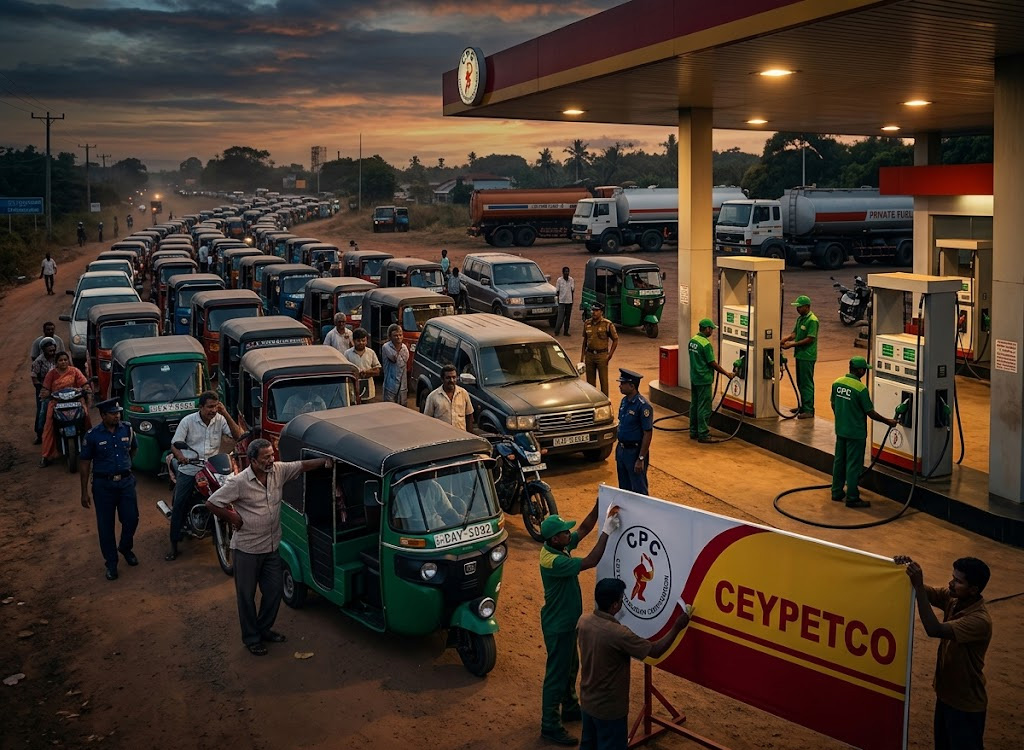
The Ceylon Petroleum Corporation (CPC) plans to open 75 new fuel stations in the coming weeks as a dispute with private fuel distributors over pricing and operating costs disrupts supplies and triggers queues at filling stations in several parts of the country.
The move is aimed at expanding the State-owned distributor’s presence, particularly in areas where private operators dominate the market, as the Government seeks to prevent supply restrictions from inconveniencing consumers.
CPC Chairman D.J. Rajakaruna has told the media that authorisation had been granted to open the new stations, with further expansion possible depending on demand.
“In areas where only the private companies operate, there are long queues, as these companies have limited the issuing of both petrol and diesel. We will take any measure to stop the people from being inconvenienced,” he has said.
Energy, Ports and Civil Aviation Minister Anura Karunathilake has said the Government intended to challenge the dominance of private operators in outstation areas by enabling CPC-run stations to operate alongside them.
He has said the existing market structure had left consumers vulnerable to supply disruptions where private companies were the principal fuel distributors.
Private operators accused of restricting supplies
The Government’s decision comes amid reports of long queues at filling stations last week, with some outlets temporarily closing their shutters as the dispute over fuel pricing and operating costs intensified.
Of the 1,440 fuel stations operating island-wide, CPC’s Ceypetco network accounts for 887. The remaining outlets are operated by Lanka IOC, which has 273 stations; Sinopec Energy Lanka, with 150; and RM Park, with 130.
Despite the number of private-sector outlets, CPC handles more than 80% of the country’s diesel distribution and supply, underlining the State corporation’s central role in maintaining fuel availability.
Minister Karunathilake has alleged that certain private fuel companies had sufficient stocks but were restricting distribution while keeping their prices close to those announced by the CPC.
He has said the companies were permitted under their agreements to adjust prices to reflect their operating costs under the applicable fuel pricing formula. However, they had not fully exercised that option. “They have adequate stocks but are not issuing at the optimum level, which has led to the queues,” he has said.
The Minister has warned that the Government would not allow distributors to deliberately restrict supplies to pressure the authorities into approving higher prices.
He has said the Government would take legal action if supply restrictions continued, stressing that protecting consumers and ensuring uninterrupted fuel availability remained priorities.
While the Government recognised the need to support investors, it would not permit multinational companies or fuel distributors to exert what he described as unjustified pressure to secure price increases.
Government seeks legal advice
To resolve the dispute, the Government has decided to seek legal advice on the powers available to the Energy Ministry under the Ceylon Petroleum Corporation Act and the contractual agreements governing private fuel distributors.
Karunathilake has said the Ministry had already sought the Attorney General’s (AG’s) advice on the matter.
The Government is examining the legal options available to address supply restrictions while determining the extent to which it can intervene in the operations of private distributors.
The dispute highlights the challenge of balancing private-sector operating costs and contractual pricing arrangements against the Government’s responsibility to maintain an uninterrupted supply of an essential commodity.
The planned expansion of CPC stations is expected to strengthen the State distributor’s presence in areas where consumers have limited alternatives, although the impact will depend on how quickly the new outlets can be established and brought into operation.
Tanker owners seek 20% transport charge increase
The dispute is also unfolding against demands from the Ceylon Petroleum Private Tanker Owners’ Association for higher fuel transportation charges to reflect rising operating costs.
Association Chairman A.M.H. Adhikari has said the industry expected a minimum 20% increase in transport charges.
He has said the revision should account for the costs of diesel, tyres, batteries, vehicle maintenance and employee wages.
Higher transportation charges could add to the operating costs faced by fuel distributors, potentially intensifying pressure for adjustments to the prices charged at filling stations.
However, the Government has maintained that private suppliers already have the option of pricing fuel according to their costs under the applicable arrangements and should not restrict supplies to force a change in pricing policy.
Market competition and consumer protection
The planned opening of 75 CPC stations signals the Government’s intention to use the State-owned network to counter supply disruptions and reduce consumers’ dependence on private operators in underserved areas.
The immediate challenge, however, is to restore normal distribution while resolving the legal and commercial disagreements over fuel pricing and transportation costs.
With queues reported at some filling stations, the Government faces pressure to ensure that disagreements between distributors and the authorities do not translate into prolonged inconvenience for motorists and businesses.












Leave a comment