
By The Pulseline News Desk
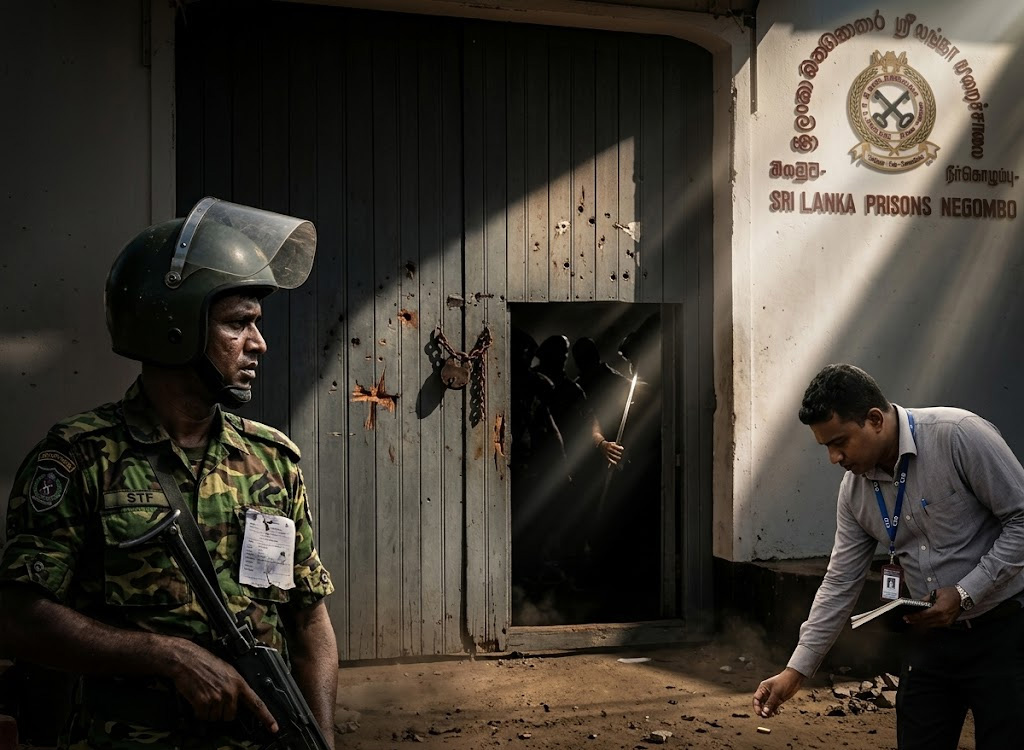
The investigation into one of Sri Lanka’s deadliest prison violence in recent history has entered a new phase, with four inmates now formally identified as suspects over the clashes at Negombo Prison that claimed 32 lives earlier this month.
The four suspects were produced before the Negombo Magistrate’s Court on Monday (27) and remanded until August 7, even as investigators continued to piece together the events that unfolded over two days of bloodshed on July 5 and 6.
According to information presented to court, the Criminal Investigation Department (CID) had identified the suspects as Supun Madhusankha alias Heenatiyana Supun, Ashan Fernando alias Kalu Malli, Sameera Sampath alias Baba, and Shane Dilan Silva. Investigators have said they were identified by fellow inmates and requested that they be subjected to an identification parade.
The court proceedings, however, had underscored that while attention has turned to the alleged instigators of the violence inside the prison, serious questions remain over the use of lethal force by security personnel during the operation to regain control.
The clashes between rival inmate groups left 10 prison officers and 22 inmates dead, while more than 100 people were injured. The scale of the casualties has made the incident one of the worst prison tragedies in Sri Lanka’s history and prompted a sweeping criminal investigation involving multiple law enforcement agencies.
CID investigators had disclosed that 301 firearms had been deployed by Special Task Force (STF) personnel responding to the unrest, while prison officers were armed with a further 70 firearms. Investigators have so far recorded statements from 1,395 individuals, including prison officials, inmates, STF personnel, police officers and civilians, illustrating the unprecedented scale of the inquiry.
All firearms and ammunition seized after the incident have been forwarded to the Government Analyst for forensic examination, while investigators said more than a thousand statements have been collected and 28 witnesses have already testified before court.
Yet the proceedings also highlighted the growing calls for accountability over how the prison operation was conducted.
Appearing for the Citizens’ Organisation of the People’s Struggle and the family of deceased inmate Mohamed Nizam, President’s Counsel Maithri Gunaratne had argued that the majority of inmates had died from gunshot wounds rather than injuries sustained during the clashes themselves. He had urged investigators to identify not only those responsible for the violence inside the prison but also those who had authorised the use of firearms.
Gunaratne had drawn attention to the human cost of the tragedy, telling court that Nizam had left behind seven children, including an infant just two months old.
The CID had maintained that the investigation was being conducted comprehensively and that forensic analysis would play a key role in determining responsibility.
The Magistrate has now directed the Negombo Prison Superintendent to produce details of medical examinations conducted on inmates, a move that could provide further evidence regarding injuries sustained during the violence and the response that followed.
The four inmate suspects are also due to be presented for an identification parade as investigators continue to examine whether the prison violence was a spontaneous confrontation between rival groups or part of a more organised sequence of events.
As the criminal investigation gathers momentum, the focus is increasingly broadening beyond identifying those who had allegedly triggered the clashes. The forensic findings, ballistic examinations and testimony from hundreds of witnesses are expected to determine whether responsibility lies solely with the inmates involved or extends to decisions taken during the security operation itself.
With 32 lives lost and dozens more injured, the Negombo Prison violence has evolved into more than a criminal investigation. It is also becoming a test of whether Sri Lanka’s justice system can deliver accountability for one of the country’s worst custodial tragedies, regardless of where that responsibility ultimately falls.













Leave a comment