
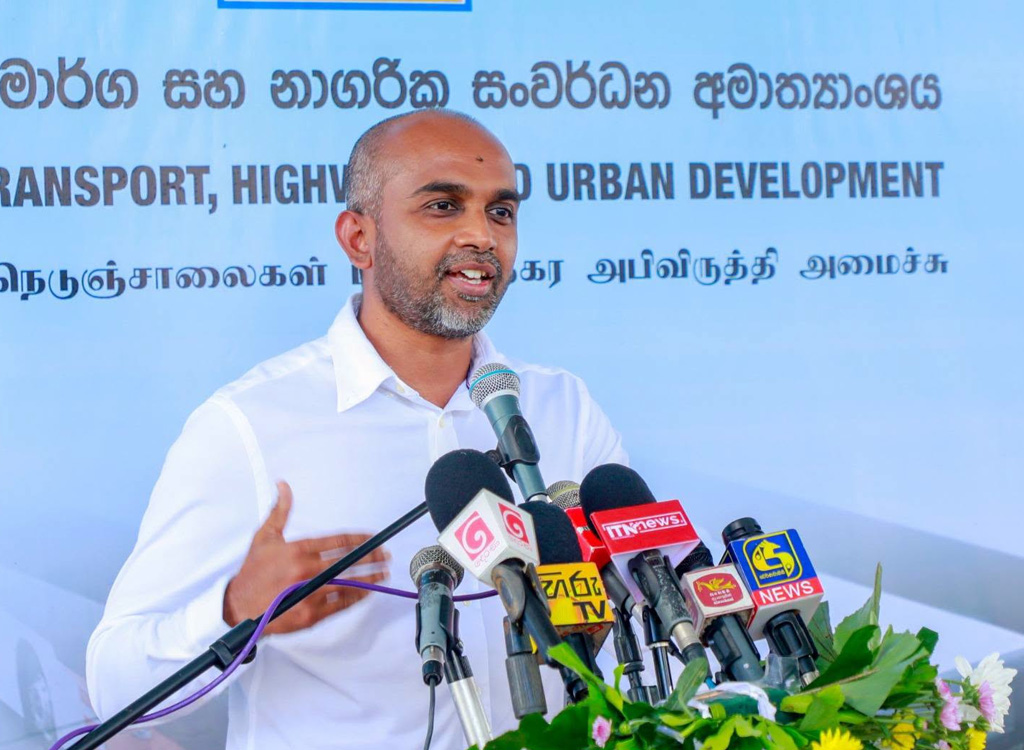
By The Pulseline News Desk
The National People’s Power (NPP) Government may control Parliament and the executive, but Deputy Minister Prasanna Gunasena says the party has yet to secure what he describes as the more difficult prize — state power.
Addressing an NPP rally, Gunasena has sought to explain why the ruling party continues to mobilise supporters despite holding a 159-seat parliamentary majority, controlling the presidency and having secured power at the local government level.
“Why are we doing so? What kind of power have we received? We have only received governing power. There is another part called state power,” he has said.
His remarks offer an insight into how the NPP views the transformation of the Sri Lankan state — and why the party believes political victory at elections does not automatically translate into control over the machinery through which Government decisions are implemented.
Government power versus state power
Gunasena has described governing power as the authority obtained through elections, while defining state power as the ability to advance through the administrative and institutional structures of the State.
“State power is where you progress through the state system. For example, government projects are conducted through state power,” he has said.
He has argued that gaining this form of power cannot happen overnight.
“State power is not something you can obtain in a day. It takes time to secure state power. This is the administrative era,” he has said.
The distinction is politically significant.
Winning elections gives a government the authority to formulate policy and make decisions. But implementing those policies requires the cooperation and functioning of ministries, departments, provincial and local institutions and the wider public administration.
For a party seeking to fundamentally change how the State operates, controlling these institutional processes is therefore a longer-term undertaking.
From electoral victory to institutional transformation
The NPP’s argument effectively shifts the focus from who holds political office to how the State functions.
Gunasena has suggested that the party’s continued rallies are part of a broader political mobilisation aimed at sustaining public support while the Government works to transform the administrative system.
“This is the first time in world history where both government and state power are being secured through a democratic manner. There is no precedent to learn from,” he has claimed.
He has contrasted the NPP’s approach with the events of 1988/89, when, according to him, attempts were made to seize both government and state power through violence.
The comparison reflects the NPP’s broader effort to present its rise to power as a democratic alternative to Sri Lanka’s earlier revolutionary politics.
Why the rallies continue
The Deputy Minister’s comments also provide a political explanation for the NPP’s continued grassroots mobilisation despite its commanding electoral position.
Ordinarily, a party with a large parliamentary majority and control of the executive would have little immediate electoral incentive to maintain large-scale political rallies.
The NPP, however, appears to regard mobilisation as part of the process of consolidating its political project.
Gunasena has said it was important to demonstrate internationally that the NPP had obtained power democratically and was attempting to develop the country through that mandate.
In this interpretation, rallies are not simply about winning another election. They are intended to maintain the connection between the Government and its political base while reinforcing the narrative of a broader transformation of the State.
The bigger challenge
The real test for the NPP, however, will be whether its political mandate can translate into measurable changes in the functioning of the public sector.
Changing administrative culture, improving the delivery of public services, reducing inefficiency and ensuring that Government projects are implemented effectively are considerably more difficult than securing an electoral majority.
That is where Gunasena’s distinction between governing power and state power becomes important.
The NPP has already demonstrated that it can win elections and command political authority. Its next challenge is to demonstrate that this authority can be translated into an effective, accountable and responsive State.
For the ruling party, therefore, the political project did not end with electoral victory.
The election, in its own telling, delivered the Government. The harder task is now to transform the machinery of the State.










Leave a comment