
By The Pulseline News Desk
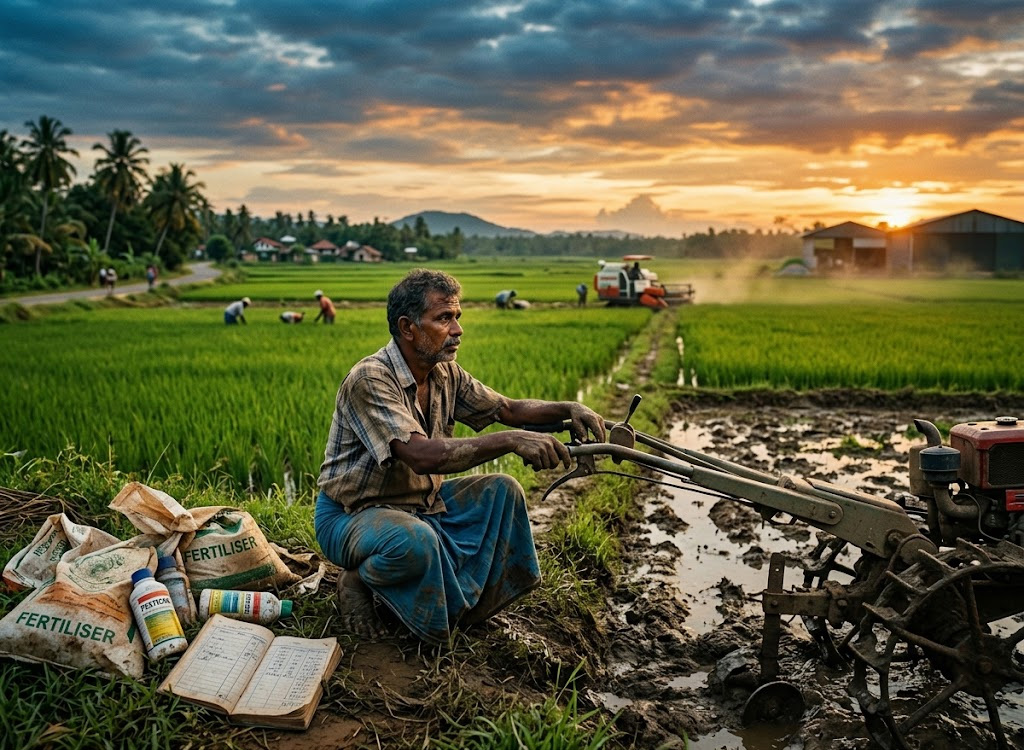
Paddy farmers in the country are entering another cultivation season facing a familiar but increasingly costly dilemma: production expenses are rising faster than the returns they can expect from their harvest.
The Janatha Aragalaya Alliance, representing the Frontline Socialist Party (FSP), has warned that unless the Government takes stronger measures to control agricultural input costs and guarantee a fair price for paddy, farmers could face mounting economic pressure.
Speaking at a media briefing, FSP Propaganda Secretary and Janatha Aragalaya Alliance National Executive Council member Duminda Nagamuwa has said the economic difficulties confronting farmers during the current cultivation season required the direct attention of policymakers.
According to calculations presented by the party, the cost of cultivating an acre of paddy has increased by approximately Rs. 24,890 compared with the previous season.
The increase has been attributed to higher prices for key agricultural inputs, including fertiliser, seed paddy, pesticides, machinery and hired labour.
Among the increases highlighted by the party were an additional Rs. 2,500 for 100 kg of urea, Rs. 2,400 for 25 kg of MOP fertiliser and Rs. 610 for 12 kg of TSP fertiliser.
Farmers are also facing an additional cost of around Rs. 1,000 for seed paddy and approximately Rs. 3,150 for herbicides and pesticides.
Meanwhile, tractor hire and harvesting machinery costs have each reportedly increased by around Rs. 5,000, further adding to the financial burden on cultivators.
For farmers operating on narrow profit margins, these increases are significant. Higher production costs mean that even a reasonable harvest may not necessarily translate into a reasonable income if paddy prices fail to rise accordingly.
The price problem
The Government’s announcement of a guaranteed price for paddy is intended to provide farmers with some protection from market fluctuations. However, the FSP has argued that the effectiveness of such a policy depends largely on the Government’s ability to actually purchase sufficient quantities of paddy directly from farmers.
One of the major obstacles, according to the party, is the limited storage capacity available to the Government.
With Government-owned storage facilities accounting for only a limited share of the country’s overall paddy storage capacity, large private-sector rice millers continue to wield considerable influence over the market.
This creates a difficult situation for farmers at harvest time.
When Government purchasing is limited or delayed, farmers who need immediate cash may have little choice but to sell their harvest to private buyers, even when the price offered is below the Government’s announced guaranteed price.
The difference between the price announced on paper and the price a farmer can actually obtain at the farm gate therefore remains a critical issue.
Farmers under pressure
Fluctuations between the prices offered for dry and wet paddy add another layer of uncertainty.
Farmers who lack adequate drying and storage facilities are particularly vulnerable because they may be compelled to sell wet paddy immediately after harvesting rather than wait for more favourable market conditions.
This gives buyers with greater storage and processing capacity an advantage in determining market prices.
Nagamuwa has argued that stronger Government intervention is therefore necessary to prevent farmers from bearing the full burden of market fluctuations.
The issue extends beyond farmers themselves.
Paddy prices form an important part of Sri Lanka’s food economy, with changes in the price farmers receive eventually influencing rice prices paid by consumers.
A balancing act for the Government
The Government faces a difficult policy balancing act.
If paddy prices are kept too low, farmers could lose the incentive or financial capacity to continue cultivation. If rice prices rise excessively, consumers — particularly low- and middle-income households — face greater pressure on household budgets.
The challenge is therefore not simply to announce a guaranteed paddy price, but to establish a purchasing and distribution system capable of making that price meaningful at the farm level.
The FSP has called for measures to reduce agricultural input costs while expanding the Paddy Marketing Board’s (PMB’s) capacity to purchase paddy directly from farmers.
Such measures, it has argued, would help address the two sides of the problem: ensuring farmers receive a reasonable return while preventing excessive increases in the retail price of rice.
For Sri Lanka, the issue is ultimately about more than the economics of one cultivation season.
A sustainable paddy sector requires farmers to be able to cover their production costs, earn a reasonable livelihood and have confidence that their harvest will have a reliable market.
Without that assurance, rising input costs could gradually make cultivation less viable for farmers — creating consequences that could eventually extend from the paddy field to the household kitchen.












Leave a comment