
By The Pulseline News Desk
Sri Lanka’s carbon market remains in regulatory limbo, with a national carbon credit registry still under development as the Government finalises its policy on carbon trading.
The delay is raising concerns over oversight of voluntary carbon transactions, potential double-counting of emission reductions and the ability of local projects to fully capitalise on the growing international carbon market.
Kumudini Vidyalankara, Director of Environment Planning and Economics at the Ministry of Environment, has reportedly said the registry was being developed alongside a draft carbon trading policy and implementation guidelines.
Speaking at a recent webinar organised by the Sri Lanka Energy Managers Association (SLEMA), she has said the Government was yet to determine its policy on carbon trading, with several mechanisms requiring clarification and approval.
“The carbon registry is in the process of being developed,” Vidyalankara has said.
The regulatory gap
Sri Lankan projects can sell credits in voluntary carbon markets overseas, but additional Government authorisation is required when credits are intended for Other International Mitigation Purposes (OIMP), including CORSIA, or to support Sri Lanka’s Nationally Determined Contributions (NDCs).
Credits used for corporate climate commitments or marketing purposes can generally be sold without that authorisation, according to Vidyalankara.
The absence of a functioning national registry, however, creates a tracking challenge.
Harsha Wickramasinghe, a former SLEMA President, has said he had encountered carbon credit transactions taking place without the knowledge of the Environment Ministry.
“The buyers are happy, the sellers are happy and the Government is unaware. So we have a problem there,” he has said.
The concern is that without proper registration and tracking, the same emissions reduction could potentially be claimed by more than one party.
Vidyalankara has pointed to Thailand, where even voluntary carbon projects are required to report registrations and transfers. She has said similar reporting requirements are included in Sri Lanka’s proposed framework.
Uncertainty over project limits
Another unresolved issue concerns the limits imposed on carbon credits from certain project categories.
In September 2024, the Government had approved a positive list of project areas eligible for consideration under Article 6 of the Paris Agreement. The framework placed limits on the proportion of emission reductions that could be credited from selected projects, including renewable energy developments, with caps of 50% or 25%, depending on the category.
Whether these parameters will remain under the new Government’s carbon-trading policy remains to be determined.
That uncertainty is particularly relevant to renewable energy developers, for whom carbon revenue can provide an additional income stream and improve project economics.
Reports that the Government has also restricted private-sector carbon credit sales and prevented renewable energy developers from entering into carbon credit agreements with third parties under standardised power purchase agreements have added to industry concerns.
Missed economic opportunity?
The regulatory uncertainty comes as international demand for credible carbon credits continues to grow.
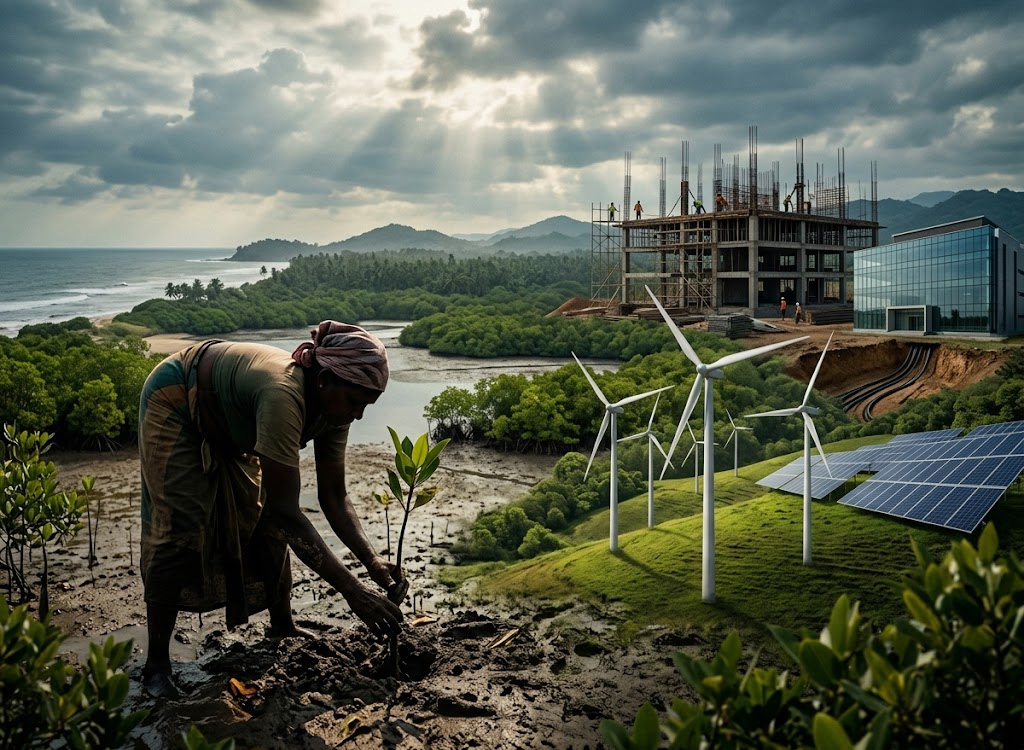
The UNDP has urged Sri Lanka to urgently operationalise and regularise its policy position, highlighting the potential for carbon markets to support investment in renewable energy, forestry, waste management and other emissions-reduction projects.
For Sri Lanka, the opportunity is potentially larger than environmental gains alone. A credible carbon market could attract investment and generate foreign-exchange earnings while supporting the country’s climate commitments.
But those benefits depend on a system that can establish who owns credits, how emission reductions are verified, where credits are transferred and how they are counted against national targets.
The Ministry has already prepared the basic components of such a framework. The remaining challenge is for the Government to settle the policy questions and put the regulatory machinery into operation.
Until that happens, Sri Lanka risks having a carbon market with growing commercial interest but insufficient regulatory certainty to unlock its full value.











Leave a comment