
By The Pulseline News Desk
The Government’s renewable energy policy has come under renewed scrutiny following reports that the acceptance of new solar power applications has been suspended, raising questions about Sri Lanka’s commitment to its target of generating 70% of electricity from renewable sources by 2030.
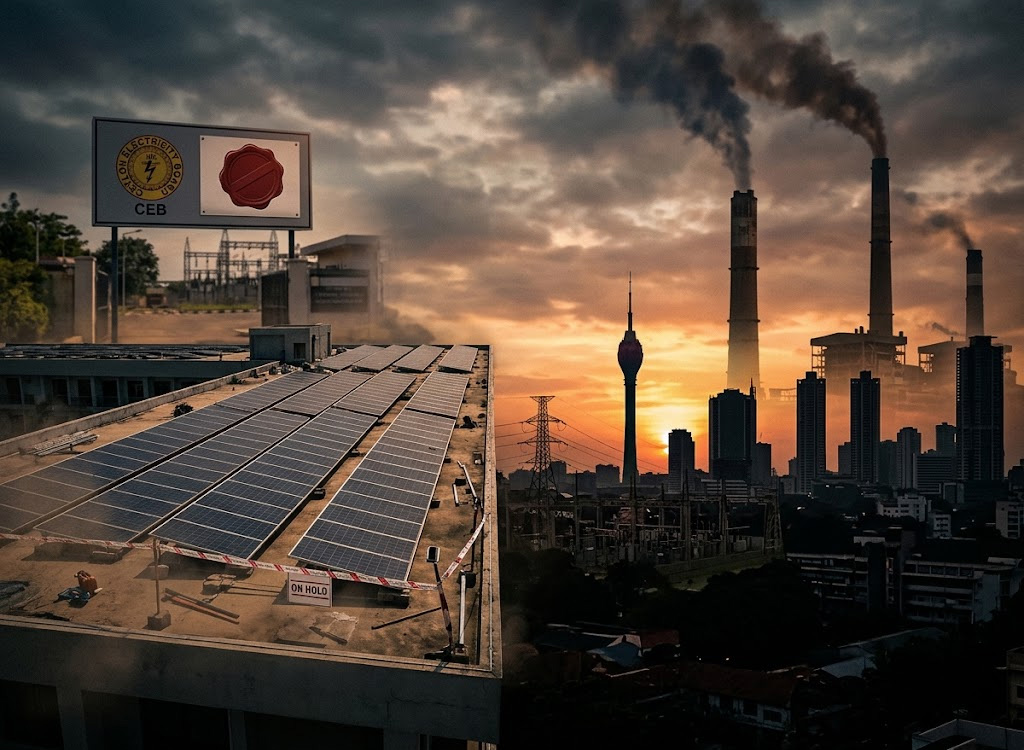
United National Party (UNP) Working Committee member Dinouk Colombage has questioned the Government’s position after drawing attention to a notice issued by the Royal Colombo Golf Club (RCGC), informing members that its proposed rooftop solar project had been put on hold following the reported suspension of new applications.
In a social media post, Colombage has said members of the club had been informed that the Government had notified the RCGC of the suspension of applications for new solar power projects.
The notice, dated November 1, 2026, has stated that the club had previously secured approval at a Special General Meeting to refurbish its roof and install a solar power system.
However, the management has informed members that the project had been placed on hold following the reported suspension, pending further clarification from the relevant authorities.
Questioning the Government’s policy direction, Colombage has recalled that Sri Lanka had set a target of generating 70% of its electricity requirements from renewable energy sources by 2030 under former President Ranil Wickremesinghe.
He has questioned whether the Government had abandoned that commitment, particularly at a time when greater private sector investment is considered important for expanding renewable energy capacity.
The latest development has also brought renewed attention to regulatory changes introduced in September, when the Ministry of Energy moved to discontinue the Net Metering and Net Accounting arrangements for new rooftop solar connections, requiring new agreements to operate under the Net Plus scheme.
The changes followed a directive issued on September 11 and apply to new connections and extensions of existing agreements, while previously approved arrangements remain protected under the existing terms.
The National System Operator (NSO) has separately raised concerns over the rapid expansion of rooftop solar capacity and the technical limitations of the national electricity grid.
According to the NSO, Sri Lanka’s installed solar power capacity had exceeded 3,070 megawatts by September 2026, comprising approximately 2,542 MW of rooftop solar and 534 MW of ground-mounted solar capacity.
Solar power was meeting between 15% and 25% of the country’s daily electricity requirement, depending on weather conditions.
The NSO has said rooftop solar additions envisaged for 2026 had already been exceeded, prompting measures to closely monitor new approvals and capacity additions to safeguard grid stability.
However, the operator has described these measures as temporary rather than a long-term restriction on renewable energy development. It has also clarified that new applications under the Net Plus scheme would continue to be accepted and that zero-export solar connections would not be subject to the same limitations.
The policy changes have nevertheless generated concerns within the renewable energy industry, with industry representatives warning that the discontinuation of the previous rooftop solar arrangements could affect investment incentives, business operations and employment.
Sri Lanka’s renewable energy ambitions require a substantial expansion of solar, wind and other renewable energy sources, alongside investments in battery energy storage and improvements to the national electricity grid.
The Sri Lanka Sustainable Energy Authority has indicated that approximately 600 MW of additional solar capacity needs to be incorporated into the electricity system annually to support the country’s 70% renewable energy target by 2030.
Against this backdrop, the reported suspension affecting the RCGC has raised further questions about the scope of the restrictions and whether they extend beyond the regulatory changes already announced.
While the NSO has maintained that its measures are intended to address immediate grid-management concerns rather than restrict renewable energy development, the latest development has highlighted the need for greater clarity from the authorities on the approval process for new solar projects.
The central issue now is whether the reported suspension represents an additional restriction on solar investments or a misunderstanding of the existing regulatory framework.










Leave a comment