
By The Pulseline News Desk
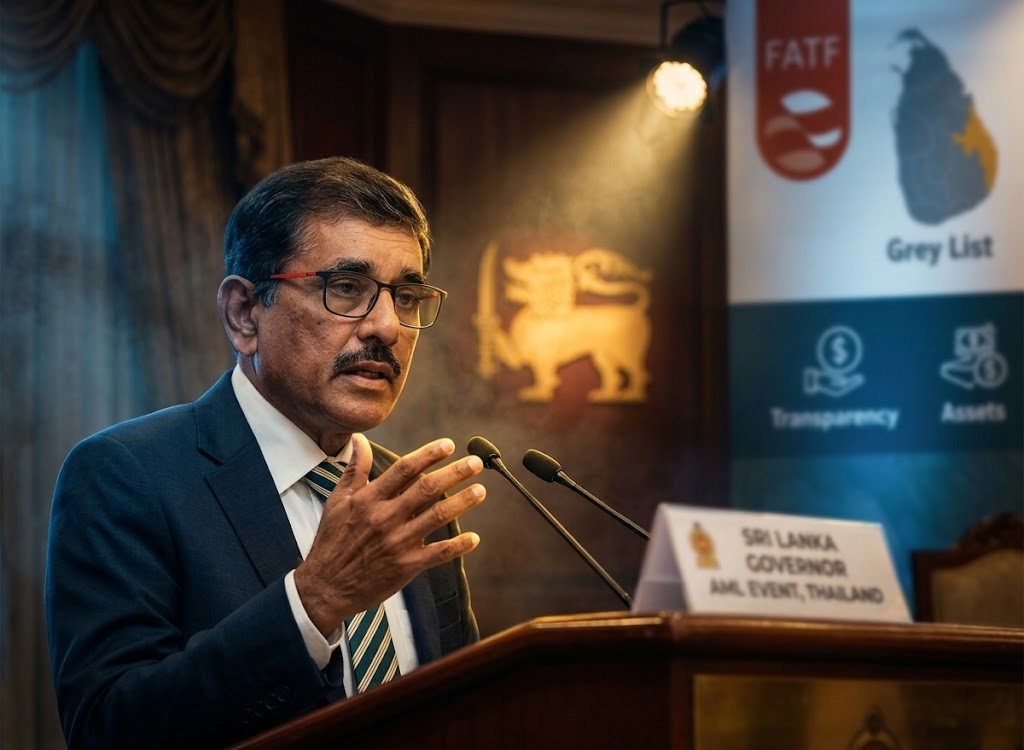
Sri Lanka is confident of avoiding a third placement on the Financial Action Task Force (FATF) grey list as international evaluators begin a crucial assessment of the country’s anti-money laundering and counter-terrorism financing framework, Central Bank Governor Nandalal Weerasinghe has said.
Speaking at an Anti-Money Laundering and Anti-Corruption Thematic Fund event in Thailand on the sidelines of the IMF-World Bank Annual Meetings, Weerasinghe has said Sri Lanka had undertaken extensive legal, regulatory and institutional reforms over several years to address weaknesses identified in its financial governance framework.
The assessment comes at a critical juncture for Sri Lanka, which has previously been grey-listed twice earlier and is seeking to demonstrate that its reforms have translated into effective enforcement and stronger institutional safeguards.
An on-site evaluation by international assessors commenced in Sri Lanka this week and is scheduled to continue for two weeks, marking a crucial stage in determining the effectiveness of the country’s measures to combat money laundering and terrorist financing.
Weerasinghe has said authorities had spent several years preparing for the evaluation, with the primary objective of preventing Sri Lanka from returning to the FATF grey list.
From previous grey listings to comprehensive reforms
Sri Lanka was previously placed on the FATF grey list in 2014–2015 and again in 2017. The country subsequently strengthened its anti-money laundering framework, supported by technical assistance from the International Monetary Fund (IMF), including efforts to improve risk assessment frameworks for licensed banks and finance companies.
These measures helped Sri Lanka address identified deficiencies and exit the grey list by 2019.
However, the current evaluation places renewed attention on the country’s ability to demonstrate compliance with international standards through effective implementation, rather than legislation alone.
A significant milestone in the latest reform process was the IMF’s Governance Diagnostic Assessment conducted in 2023, which identified weaknesses in governance arrangements and anti-corruption mechanisms.
Weerasinghe has noted that Sri Lanka was among the first countries in Asia to publicly release the assessment, enabling government institutions, private sector stakeholders and other interested parties to examine the identified shortcomings and the reforms required to address them.
The findings subsequently informed national risk assessments conducted in 2024 and 2025, which helped guide preparations for the current mutual evaluation.
Legal and institutional changes under scrutiny
Sri Lanka has since introduced a series of legislative and institutional reforms intended to strengthen financial oversight, improve transparency and bring its regulatory framework into closer alignment with FATF recommendations.
Among the key measures cited by the Governor were the establishment of an asset recovery framework through CLIMAC, the enactment and implementation of a new Anti-Corruption Act, and amendments to the Public Finance Act.
Reforms to revenue administration, including the operations of Sri Lanka Customs and the Department of Excise, have also formed part of the broader effort to strengthen financial governance.
Other measures include the National Audit Act and amendments to the Banking Act aimed at improving corporate governance and regulatory oversight within the financial sector.
Amendments to the Companies Act introducing beneficial ownership requirements represent another important component of the reform programme. Such requirements are intended to improve transparency over the individuals who ultimately own or control companies, helping authorities identify potential avenues for money laundering and other financial crimes.
Further amendments enacted in 2026 to the Financial Transactions Reporting Act, the Prevention of Money Laundering Act and the Convention on the Suppression of Terrorist Financing Act were also highlighted as efforts to align Sri Lanka’s legal framework with evolving international standards.
Collectively, these measures are intended to address vulnerabilities across financial institutions, corporate structures, public administration and law enforcement.
Implementation remains the decisive test
Despite the extensive legislative changes, Weerasinghe has acknowledged that passing laws and introducing regulations would not, by themselves, guarantee a successful outcome.
The central challenge is demonstrating that the reforms are being implemented effectively across the institutions responsible for preventing, detecting and prosecuting financial crimes.
“The challenge now is to show that these laws work and that the framework is effective,” he has said.
The evaluation will therefore place considerable importance on evidence of practical implementation, including the ability of authorities to identify and investigate suspicious financial activity, pursue proceeds of crime, enforce regulatory requirements and coordinate across relevant institutions.
For Sri Lanka, the distinction is significant. A comprehensive legal framework must be supported by effective supervision, enforcement capacity and demonstrable results if the country is to establish that its financial system is adequately protected against money laundering and terrorist financing.
The outcome will also provide an indication of whether the reforms introduced since the 2022 economic crisis have strengthened the country’s wider financial governance framework.
Economic implications extend beyond compliance
Avoiding another FATF grey listing is important not only for Sri Lanka’s international standing but also for maintaining confidence among investors, financial institutions and development partners.
A grey-list designation indicates that a jurisdiction has strategic deficiencies in its anti-money laundering and counter-terrorism financing framework and is working with the FATF to address them. Although it does not automatically prohibit international transactions, it can lead to increased scrutiny and additional compliance requirements for financial institutions dealing with that jurisdiction.
For an economy seeking to attract foreign investment, expand exports and strengthen international financial links, demonstrating the effectiveness of its safeguards remains an important priority.
Weerasinghe has expressed confidence that the reforms undertaken, together with support from domestic institutions and international partners, would enable Sri Lanka to navigate the assessment successfully.
With the on-site evaluation now underway, the focus shifts from the adoption of new legislation to the country’s ability to demonstrate measurable results.












Leave a comment