
By The Pulseline News Desk
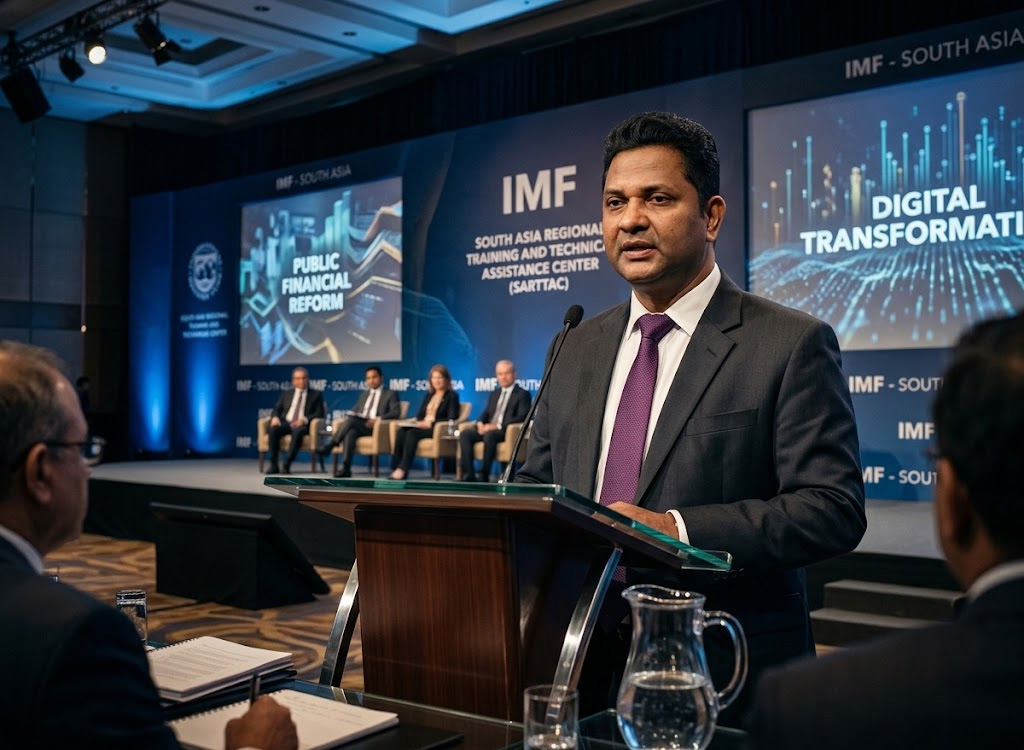
Sri Lanka’s experience in navigating its 2022 economic crisis and implementing public finance reforms offers important lessons for other South Asian countries seeking to strengthen financial governance and accelerate digital transformation, a senior Finance Ministry official has told an International Monetary Fund (IMF) forum.
Director General of Fiscal Policy at the Ministry of Finance, Dr. Kapila Senanayake, has outlined five key lessons from Sri Lanka’s reform journey during an IMF event in Thailand, highlighting the need to address institutional weaknesses, improve data systems and build local expertise before relying on technology to modernise public financial management.
Senanayake has said Sri Lanka’s economic collapse in 2022 had exposed structural weaknesses that had persisted for decades, while creating the political momentum needed to introduce significant reforms, including the Public Financial Management Act.
He has identified using a crisis as an opportunity for change as the first major lesson for countries pursuing public sector reform.
The second, he has said, was the importance of addressing underlying problems before introducing technological solutions. Although digitalisation is often viewed as a quick route to greater efficiency, he has stressed that technology alone cannot compensate for weak administrative processes or inadequate governance.
Institutional reform before digitalisation
Senanayake has emphasised that reliable data and sound data architecture are essential to effective digital public financial management.
Sri Lanka’s efforts to improve fiscal reporting systems and government accounting structures have therefore progressed alongside technological upgrades, with the aim of ensuring that public institutions generate accurate, consistent and useful financial information.
He has also highlighted the importance of less visible reforms, including stronger commitment controls to ensure government expenditure remains within approved budgetary limits.
Such measures are critical to strengthening fiscal discipline, improving expenditure management and preventing public institutions from committing funds beyond authorised allocations.
The fifth lesson, he has said, was the need to invest in institutional capacity and develop domestic expertise rather than rely indefinitely on external technical assistance.
In this regard, Senanayake has commended the IMF’s South Asia Regional Training and Technical Assistance Center (SARTTAC) for supporting Sri Lanka’s public financial management reforms.
He has said more than half of the IMF technical assistance missions received by Sri Lanka since January 2023 had involved SARTTAC, underscoring the centre’s role in strengthening local capacity.
“The broader lesson is that digital public financial management is not simply an IT project. It is an institutional reform process that combines technology, sound governance, effective systems, skilled personnel and strong local ownership,” Senanayake has said.
Tax administration takes phased approach
Addressing a separate question on tax administration and artificial intelligence (AI), Senanayake has said Sri Lanka was prioritising the modernisation and digitalisation of existing tax collection systems rather than attempting an immediate transition to advanced AI-based platforms.
Initiatives announced in recent national budgets, including the introduction of Point-of-Sale (POS) systems and plans to implement electronic invoicing, form part of efforts to improve tax compliance and strengthen government revenue collection.
The Finance Ministry is also working to integrate multiple tax and revenue collection platforms that currently operate independently.
The proposed integration is expected to improve administrative efficiency, strengthen oversight and facilitate better coordination across the revenue collection system.
However, Senanayake has acknowledged that digital transformation requires substantial financial investment, making a phased approach necessary.
Sri Lanka is therefore seeking to advance its tax administration reforms progressively rather than implement multiple complex systems simultaneously.
He has said the country’s Medium-Term Revenue Strategy identifies digitalisation as a central pillar of future tax administration reforms, with technology-driven revenue collection expected to receive further attention in the forthcoming national budget.
Reform agenda extends beyond the crisis
Sri Lanka’s post-crisis reform programme has focused on restoring fiscal stability, strengthening public financial management and improving the mobilisation of government revenue.
The latest remarks highlight how these efforts are increasingly linked to the broader challenge of building a more integrated and digitally enabled public administration.
While digital systems can improve the speed, accuracy and transparency of financial transactions, their effectiveness ultimately depends on the quality of the institutions responsible for implementing and managing them.
For Sri Lanka, the challenge is to translate the reforms introduced since the 2022 economic crisis into a fully integrated tax administration and public financial management system capable of supporting sustainable economic growth.
Senanayake has acknowledged that, despite progress, significant work remains before the country can achieve that objective.
His message to other countries pursuing similar reforms was that successful digital transformation requires more than technology as it demands sound institutional foundations, effective financial controls, reliable data and sustained investment in domestic capacity.











Leave a comment