
By The Pulseline News Desk
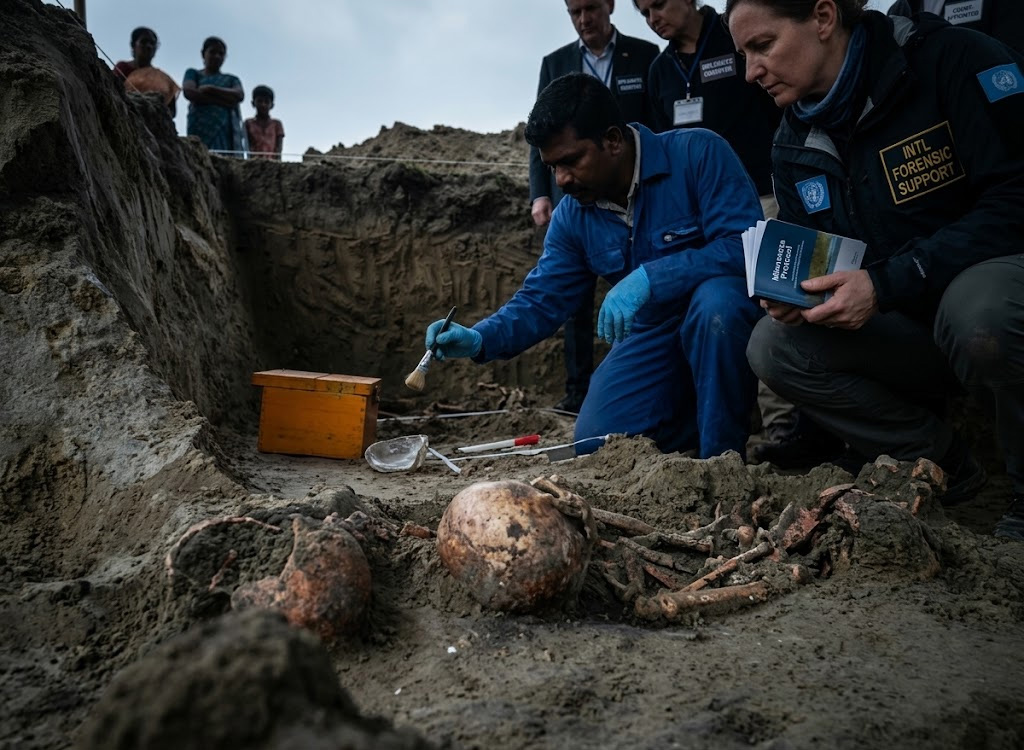
The Office on Missing Persons (OMP) is considering seeking international forensic and technical assistance for the ongoing exhumation of mass graves, following a recommendation by the United Nations (UN) Human Rights Office to strengthen the process through international expertise.
However, OMP Chairman Mahesh Katulanda has told the media that no formal discussions or concrete steps had yet been taken to bring in foreign forensic specialists, stressing that the process remains subject to judicial directions.
“We are only sampling now,” Katulanda has told a weekly English newspaper, explaining that material recovered from the ongoing excavations is currently being processed locally through the Jaffna Magistrate’s Court.
The issue has gained renewed attention following the latest assessment by the Office of the UN High Commissioner for Human Rights (OHCHR) on the human rights situation in Sri Lanka, which called on the Government to obtain international forensic and technical assistance to ensure that mass grave investigations meet recognised international standards.
The UN specifically referred to the Minnesota Protocol on the Investigation of Potentially Unlawful Death, an international framework designed to guide the investigation of potentially unlawful deaths, including the recovery and identification of human remains.
According to the UN assessment, exhumations at the Chemmani-Siththupaththi mass grave site in Jaffna had, by late July, yielded skeletal remains corresponding to more than 400 individuals, including children.
The scale of the findings has placed renewed focus on the need for scientifically robust exhumation procedures, accurate identification of remains and credible investigations into the circumstances surrounding the deaths.
Katulanda has said the OMP was aware of the recommendation to apply international frameworks such as the Minnesota Protocol. However, he has said there were currently no active discussions with foreign experts or institutions regarding their involvement.
He has noted that highly specialised forensic testing was generally carried out in countries with advanced facilities, citing Switzerland, Japan and the US states of Florida and Texas as examples.
Nevertheless, he has stressed that the OMP could not independently initiate such international cooperation without the approval or direction of the Judiciary.
“Everything has to be followed step by step. We are awaiting the court’s directions,” he has said.
Chemmani excavation resumes
The latest developments follow the resumption of excavations at the Chemmani site after a seven-month suspension caused by seasonal rains and funding constraints.
The Jaffna Magistrate’s Court had ordered the digging to resume in April, while also permitting diplomatic observers to monitor the proceedings.
The presence of diplomatic observers has been viewed as an important transparency measure amid continuing calls for credible and independent investigations into mass grave sites linked to Sri Lanka’s long-running conflict.
The Chemmani site has particular historical significance. Earlier excavations in the area in the late 1990s had uncovered human remains, while the latest excavation process has raised fresh questions about the number of people who may have been buried there and the circumstances of their deaths.
The discovery of remains believed to represent hundreds of individuals has also intensified calls from rights groups and families of the missing for the process to go beyond exhumation and identification and lead to credible criminal investigations where evidence of unlawful killings is established.
UN calls for investigations beyond exhumation
The OHCHR has welcomed the progress made at Chemmani but has warned that the exhumation process should be accompanied by impartial criminal investigations.
Its latest assessment has urged the Government to seek international forensic and technical support to ensure that exhumations comply with international standards, including the Minnesota Protocol.
It has also called for investigations into possible command responsibility, indicating that accountability should extend beyond the identification of individual perpetrators where evidence points to responsibility within chains of command.
The recommendation comes as Sri Lanka continues to face international scrutiny over its record on accountability for alleged violations committed during the country’s armed conflict.
For families searching for missing relatives, the scientific handling of remains is particularly critical. Errors in excavation, documentation, preservation or identification can undermine the possibility of establishing the identity of victims and, potentially, the circumstances of their deaths.
The OMP’s position indicates that international assistance remains a possibility, but that any such involvement would depend on the judicial process and directions issued by the courts.
As excavations continue, the challenge for Sri Lankan authorities will be to ensure that the recovery and examination of the remains are conducted with sufficient scientific rigour and transparency to withstand scrutiny both domestically and internationally.









Leave a comment