
New printing machines expected next month as DMT expands motorcycle registration services to five districts
By The Pulseline News Desk
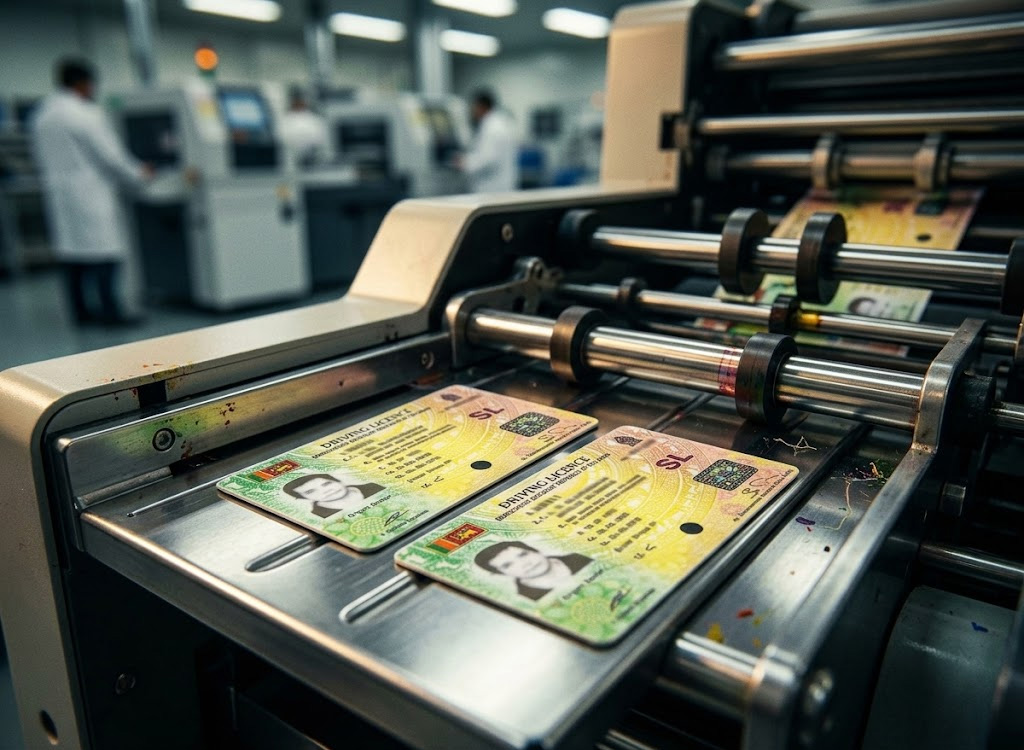
Sri Lanka’s Department of Motor Traffic (DMT) expects to clear its backlog of 634,000 driving licence cards by April 2027, with three new printing machines due to increase production capacity amid continuing concerns over card supplies, procurement and administrative delays.
DMT Commissioner General Air Vice Marshal (Retd.) Thushara Fernando has told an English weekly newspaper that the machines had arrived at the Colombo Port on October 15 and could be operational as early as next month.
The department currently prints approximately 5,000 driving licence cards a day, including new licences and renewals. Of these, around 2,000 are allocated to clearing the backlog, while the remaining 3,000 are used for new applications and renewals.
The additional machines are expected to accelerate production and enable the department to meet its April 2027 target.
However, the continuing shortage of driving licence cards highlights a broader challenge for the DMT: restoring a reliable service after years of disruptions caused by limited printing capacity, difficulties in procuring supplies and changes in operational arrangements.
Card shortage threatens printing operations
Even as the department prepares to increase printing capacity, the availability of blank smart cards remains a concern.
Officials have reportedly informed Parliament that the existing stock of one million cards is expected to be exhausted by January 2027, while the first shipment under a new contract for two million cards is due only by the end of March next year.
To address the anticipated shortfall, the DMT has proposed seeking Cabinet approval to purchase an additional 500,000 cards from the existing supplier.
The timing of these deliveries will be critical to the department’s efforts to clear the backlog. Additional printing capacity alone will not resolve the problem if sufficient supplies of blank cards are unavailable.
Sri Lanka imports unprinted plastic smart cards containing embedded security chips through open public tenders. The cards are subsequently printed locally at DMT’s main office in Werahera and regional centres.
Fernando has explained that the security features required for driving licences make it necessary to obtain specialised products from overseas manufacturers.
The department has also planned to install printing machines at district secretariat offices where it operates, reducing dependence on centralised printing facilities. Existing printing facilities outside Colombo are available in Hambantota, Jaffna, Kurunegala, Anuradhapura and Gampaha.
A backlog years in the making
The current situation has its roots in a series of operational and economic disruptions that affected the country’s driving licence printing system.
In January 2021, printing operations were transferred from a private joint venture to the Sri Lanka Army at Werahera. The economic crisis in 2022 subsequently made it difficult for the department to open letters of credit to import card blanks and printing materials.
The issuance of permanent smart cards was suspended, and temporary one-year paper permits carrying security QR codes were introduced.
According to reports, when the DMT resumed responsibility for printing operations in late 2023, most of the machines had reportedly broken down, leaving only two functioning machines across the island. Limited production capacity and difficulties securing supplies had contributed to the accumulation of pending applications.
The changeover between contractors had also reportedly played a role. According to information obtained by the media, the previous contractor had initiated legal action against the new contractor over quality-related and other concerns.
The dispute has highlighted the risks associated with interruptions to a service that depends on specialised equipment, imported materials and contractual arrangements.
For motorists, the consequences have been prolonged waiting periods for permanent driving licences, despite having completed the necessary application procedures.
Audit raises questions over costs
The financial implications of previous printing arrangements have also come under scrutiny.
An Auditor General’s report has found that the Army had purchased driving licence cards at Rs. 311 each in 2022, while an arrangement with a private company involved a payment of Rs. 576 per card.
The report has estimated that the difference had resulted in an additional cost of approximately Rs. 134.6 million for 507,807 cards printed between September 2023 and July 2024.
The latest purchase price for each driving licence card is understood to be Rs. 214, according to the media.
The differences in reported prices have raised questions about procurement costs and the need for transparent, competitive purchasing arrangements, particularly given the scale of public demand for driving licences.
Ensuring continuity between contractors and maintaining functioning equipment will also be essential to preventing similar disruptions.
Motorcycle registration services extended to five districts
Alongside efforts to address the driving licence backlog, the DMT is expanding access to other services.
From October 19, new motorcycle registration services will be available at district offices in Gampaha, Kurunegala, Anuradhapura, Hambantota and Jaffna.
The service expansion is intended to make registration more accessible to people outside Colombo and reduce the need for applicants to travel to the capital.
The move forms part of a broader effort to decentralise services and bring administrative processes closer to the public.
However, the effectiveness of such measures will depend on whether regional offices have sufficient staff, equipment and operational capacity to handle the additional workload.
Parliamentary inquiry into licence and number plate delays
The continuing difficulties have prompted parliamentary scrutiny.
The Sectoral Oversight Committee on Infrastructure and Strategic Development, chaired by MP S.M. Marikkar, has ordered a comprehensive investigation into delays in issuing driving licences and vehicle number plates.
The committee has called for a report within 45 days, covering the causes of the delays, administrative and technical bottlenecks, procurement procedures and measures needed to prevent a recurrence.
The problem extends beyond driving licences. Approximately 958,651 vehicle registration number plates remain pending, covering applications accumulated between January 1, 2025, and March 9, 2026, according to recent parliamentary reports.
Officials have indicated that the number plate backlog could be cleared within seven to eight months if sufficient production capacity is available.
The committee has called for improvements to equipment, procurement and administrative processes to ensure more reliable delivery of public services.
The parallel backlogs suggest that the challenges facing the DMT are not confined to one category of document but also involve wider questions about production capacity, supply management and the continuity of essential services.
Road safety reforms continue
Meanwhile, Transport Minister Bimal Rathnayake has said the six-month pilot programme for the driving licence penalty points system, which runs until March 31, 2027, is intended to penalise repeat offenders and improve road safety awareness.
The programme introduces a further dimension to driving licence administration, placing greater emphasis on the effective management of licence records and compliance with traffic regulations.
However, the department must first ensure that motorists can obtain their licence cards within a reasonable period while maintaining an uninterrupted supply of the materials required to produce them.
April 2027 deadline faces key tests
DMT’s immediate priority is to increase printing capacity while ensuring that sufficient blank cards are available to sustain operations.
The three new machines, expected to become operational next month, could provide a significant boost. But meeting the April 2027 deadline will also depend on timely procurement, uninterrupted supplies and the department’s ability to manage both new applications and accumulated demand.
The planned decentralisation of printing and expansion of district-level services could help reduce pressure on central facilities and improve access for motorists outside Colombo.
Nevertheless, the continuing licence and number plate backlogs, together with the procurement concerns identified by auditors and Parliament, underline the need for a sustainable solution rather than a temporary increase in production.










Leave a comment