
By The Pulseline News Desk
A dispute over the burning of paddy straw has exposed a wider frustration among farmers, with agricultural organisations accusing the Government of focusing on a visible farming practice while failing to address what they describe as deeper problems surrounding production costs, market prices, agricultural inputs and rural livelihoods.
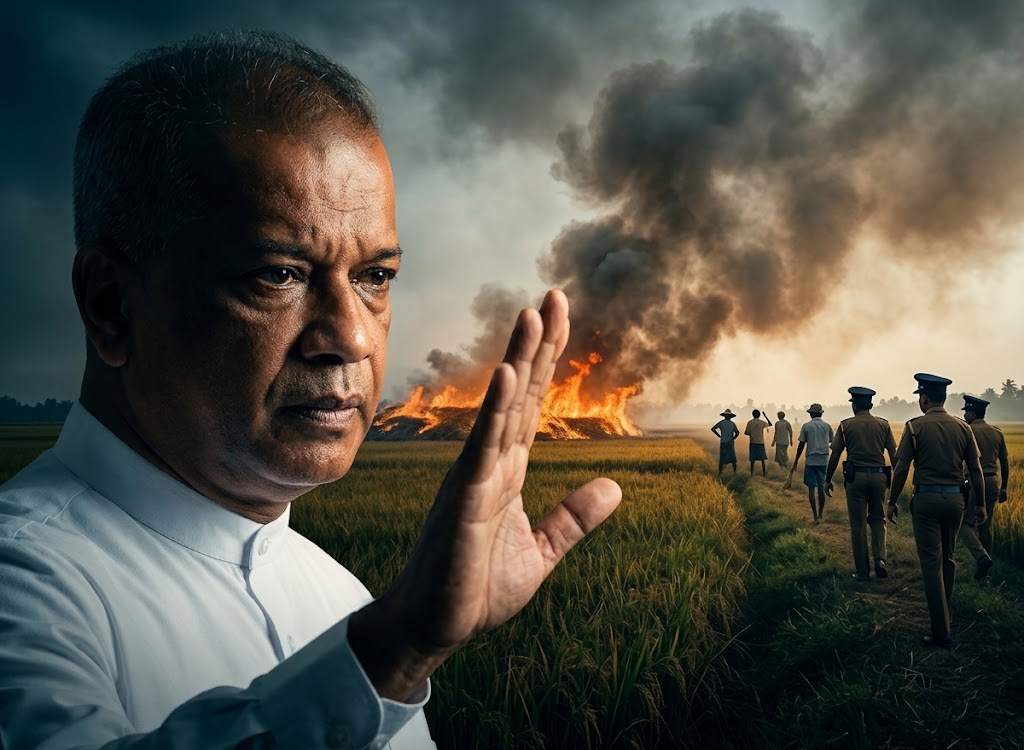
The controversy followed remarks by Agriculture, Livestock, Land and Irrigation Minister K.D. Lalkantha, who called for legal action against farmers who burn straw in paddy fields.
Speaking at an event in Hurugamuwa in the Mahaweli H Zone to mark the commencement of deep ploughing and the expansion of paddy cultivation under the “Punarudayata Arunalu 2026” Maha cultivation programme, Lalkantha has said he had observed farmers burning straw while travelling through the Kekirawa area.
The Minister has said farmers had been advised against burning straw but had continued the practice, and argued that those responsible should face legal action.
However, farmers and their representatives have challenged what they see as an overly simplistic approach to the issue.
Why farmers burn the straw
Several farmers have said straw burning was not necessarily carried out deliberately to damage the environment or disregard Government instructions.
They have claimed that some farmers had been advised by Public Health Inspectors to remove or destroy straw piles because they could create conditions conducive to an increase in rat populations.
According to the farmers, the problem becomes more serious when rain begins. They have said rats could die and decompose in fields after the rains, creating sanitation and health concerns, including fears over leptospirosis, commonly known as rat fever.
For farmers operating on tight cultivation schedules, burning straw is therefore viewed by some as a quick way of clearing fields before the next stage of cultivation.
The farmers argue that any attempt to prohibit the practice through legal action must first provide them with practical and affordable alternatives for managing agricultural residue.
‘Real problem is being ignored’
Farmer organisation representatives have accused the Minister of misrepresenting the issue and shifting responsibility onto farmers.
They argue that the straw-burning controversy is only one part of a much larger problem facing the agricultural sector.
Among their concerns is the availability and pricing of agricultural inputs. Farmer representatives have also raised questions about what they describe as the uncontrolled sale of chemical fertiliser and other toxic agricultural substances.
For many farmers, however, the most immediate concern remains whether they can sell their harvest at a price that covers production costs.
They have claimed that although Government-set prices for Nadu, Samba and Keeri Samba paddy are Rs. 120, Rs. 130 and Rs. 140 per kilogramme respectively, farmers have in many instances been unable to sell their produce at those rates.
Instead, they have said, some farmers have been compelled to sell paddy for as little as Rs. 90 per kilogramme.
The difference is significant for farmers already dealing with expenses related to fertiliser, seed, machinery, labour, fuel and irrigation.
The price promise
The complaints also revive a broader question over the Government’s pre-election promises to the agricultural community.
Farmers’ representatives say the Government had pledged to make seeds, fertiliser and other agricultural inputs available at lower prices while establishing more stable and predictable prices for agricultural produce.
They now argue that the gap between those commitments and conditions on the ground is becoming increasingly difficult for farmers to ignore.
For farmers, the issue is not simply whether straw should be burned. It is whether they have been given workable alternatives, whether cultivation remains economically viable and whether Government intervention is reaching the field beyond policy announcements.
From straw to a bigger agricultural question
The dispute illustrates the difficulty of regulating farming practices without addressing the economic and practical circumstances in which farmers operate.
A ban or legal action against straw burning could potentially address environmental and public-health concerns, but farmers argue that enforcement alone will not resolve why they resort to the practice.
If straw is to be removed, incorporated into the soil or put to another productive use, farmers would need access to appropriate machinery, technical guidance and economically viable alternatives.
At the same time, ensuring that farmers receive prices that adequately reflect their production costs remains central to the sustainability of paddy cultivation.
The Government’s challenge, therefore, extends beyond stopping straw burning.
It must demonstrate that its agricultural policies can simultaneously address environmental concerns, public health, input costs and the persistent problem of farmers being unable to obtain the prices they are promised for their harvest.
For a farming community preparing for another Maha season, the question is increasingly whether the Government will address the symptoms — or the underlying problems that farmers say are driving them.













Leave a comment