
By The Pulseline News Desk
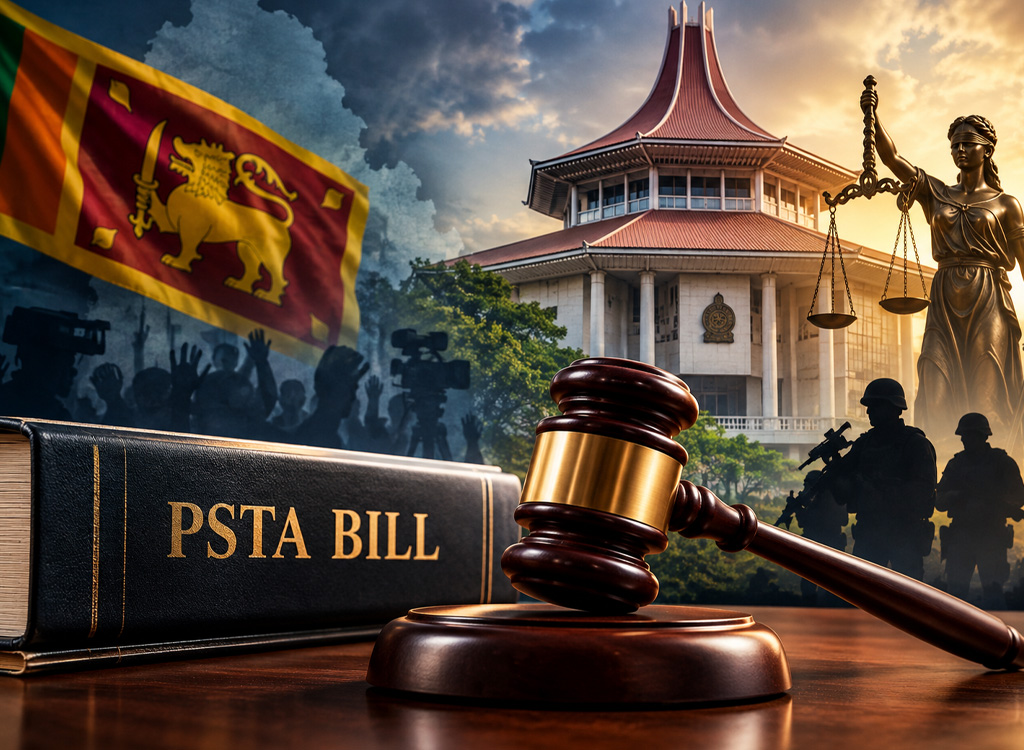
The Supreme Court is scheduled to hear petitions challenging the constitutionality of the Government’s proposed Protection of the State from Terrorism Bill (PSTA) today (20), bringing the controversial counter-terrorism legislation under judicial scrutiny amid mounting concerns over its potential impact on fundamental rights and civil liberties.
The petitions are scheduled to be taken up before a three-judge bench comprising Chief Justice Preethi Padman Surasena and Justices Achala Wengappuli and Sampath Abeykoon.
The legal challenges come as the Government seeks to replace the Prevention of Terrorism Act (PTA), a law that has faced decades of criticism over its extensive detention powers and alleged human rights abuses.
Several petitioners have approached the Supreme Court, arguing that provisions of the proposed legislation could violate constitutionally guaranteed rights and weaken safeguards against the misuse of state power.
Concerns over fundamental rights
A central issue in the challenges is whether the proposed legislation provides sufficient safeguards against arbitrary arrest, detention and restrictions on democratic freedoms.
The Bill seeks to establish a legal framework for preventing terrorism and addressing terrorism-related offences, including provisions governing the identification, arrest, detention, investigation and prosecution of suspects.
However, critics have raised concerns over the breadth of the proposed definition of terrorism, the powers granted to security forces and the executive, and the potential consequences for individuals exercising constitutionally protected freedoms.
Media rights advocates have warned that broadly framed offences could expose journalists to legal action for their reporting, particularly when investigations involve matters of public interest, government accountability or national security.
Human Rights Watch has also criticised the proposed legislation, pointing to concerns over the definition of terrorism, judicial oversight, search and arrest powers, and restrictions that could affect freedom of expression, assembly and association.
Replacing the PTA
The proposed PSTA is intended to repeal and replace the Prevention of Terrorism (Temporary Provisions) Act, No. 48 of 1979, which has remained in force for more than four decades despite longstanding demands for its abolition.
Successive governments have faced domestic and international pressure to reform Sri Lanka’s counter-terrorism laws and introduce stronger protections against arbitrary detention and other rights violations.
The current Government has presented the new Bill as a framework for protecting the State and its people from terrorism, including activities planned or facilitated within Sri Lanka for implementation abroad.
However, opposition politicians, civil society organisations and human rights advocates have questioned whether the proposed legislation adequately addresses the shortcomings associated with the existing law.
The controversy has intensified following concerns that the version presented to Parliament differs from the draft prepared by a committee of technical experts, particularly regarding provisions on bail and the extension of detention.
The Government has defended its authority to introduce changes to the experts’ draft, maintaining that the legislative process allows for further amendments.
Constitutional implications
The Supreme Court’s examination of the petitions will be significant in determining whether the challenged provisions are consistent with the Constitution and whether the Bill can be enacted through the ordinary parliamentary process or requires additional constitutional approval.
A determination requiring a two-thirds majority and a referendum could have substantial implications for the Government’s legislative plans.
The proceedings also place the balance between national security and individual freedoms at the centre of the debate over Sri Lanka’s proposed counter-terrorism framework.
The Court’s determination will be closely watched by political parties, media organisations, civil society groups and international human rights advocates as the Bill progresses through Parliament.
The outcome could shape the future of Sri Lanka’s counter-terrorism legislation and determine whether the proposed replacement for the PTA introduces stronger protections for fundamental rights or retains powers that critics consider open to abuse.










Leave a comment