
By The Pulseline News Desk
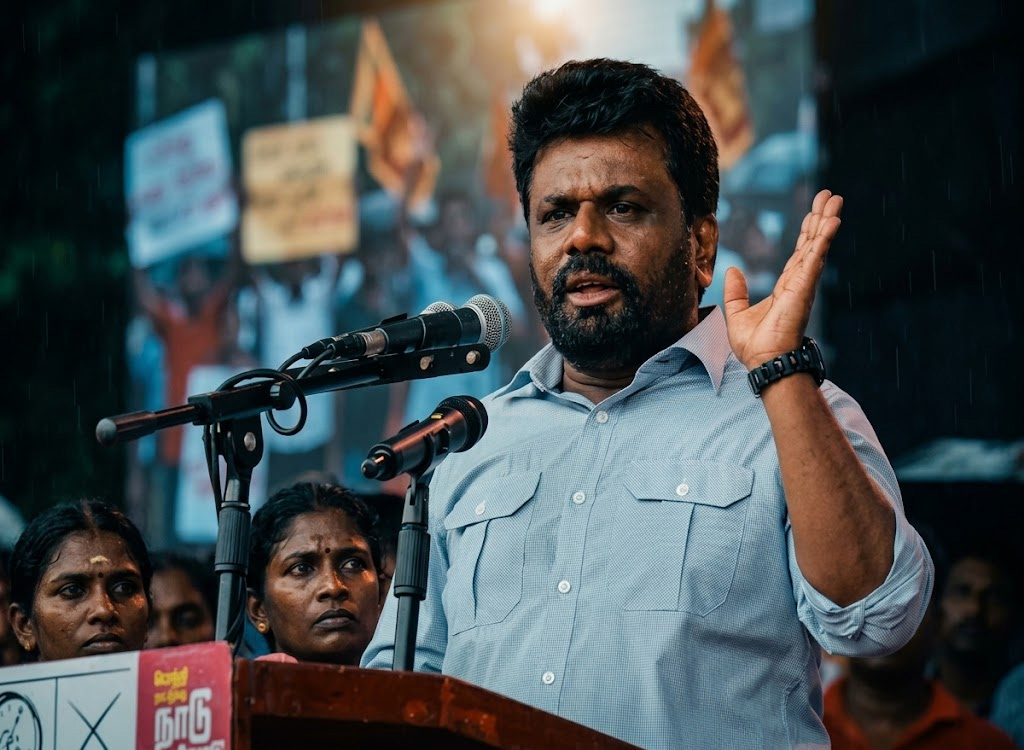
Two years after President Anura Kumara Dissanayake’s election victory raised expectations of a political reset in the country’s ethnic reconciliation process, Tamil political groups and activists have returned to the streets, accusing the Government of failing to deliver on key commitments made to the Tamil community.
The protests over the weekend, held in Jaffna, came as the National People’s Power (NPP) Government engaged in an island wide campaign to mark two years since President Dissanayake’s 2024 election victory. For Tamil groups, however, the anniversary provided an opportunity not for celebration but to highlight what they describe as continuing failures on land release, political prisoners, enforced disappearances and accountability for alleged wartime abuses.
The Democratic Tamil National Alliance (DTNA) has staged a one-day fast near the Chavakachcheri bus terminal last weekend, pressing the Government to release privately owned land still occupied by security forces, release political prisoners and provide justice for families of people who disappeared during the conflict.
The protest brought together political representatives and activists, underlining the continuing sensitivity of these issues in the North and East nearly two decades after the end of the war.
Land release remains a flashpoint
ITAK General Secretary M.A. Sumanthiran had joined the protest in solidarity and has questioned the continued delays in returning privately owned land held by the security forces.
Sumanthiran has questioned why further reports from the military were required before land could be returned to its legitimate owners.
The issue is particularly significant in the Northern Province, where land occupied for security purposes during and after the war remains a long-standing grievance among Tamil communities.
For families seeking to reclaim their land, the issue is not simply one of ownership. It is closely linked to livelihoods, resettlement and the restoration of normal civilian life.
The Government’s handling of the matter therefore remains an important measure of its commitment to reconciliation.
Chemmani adds pressure for accountability
The protests also brought renewed attention to the Chemmani mass grave, an issue that has the potential to further test the Government’s approach to transitional justice.
The Tamil National Council (TNC), led by MP Gajendrakumar Ponnambalam, has held a march in Jaffna on Sunday (13), culminating in a public rally at Kittu Park.
Protesters have demanded an international investigation into the mass grave discovered at Chemmani, while Ponnambalam has called for evidence recovered from the site to be properly preserved.
He has also called for a UN-led international investigation, arguing that an international mechanism was necessary to ensure credibility and accountability.
The Chemmani issue has revived painful memories surrounding allegations of wartime disappearances and killings and has placed renewed pressure on the Government to demonstrate that investigations into alleged violations will be independent and credible.
Political test for the NPP
The protests point to a growing gap between the expectations created by the NPP’s rise to power and the demands of Tamil political parties and civil society groups.
The NPP entered government promising a different political culture and greater equality, while President Dissanayake has repeatedly spoken of building a country in which all citizens enjoy equal rights.
Yet, two years into his presidency, Tamil groups argue that promises of change have not translated sufficiently into action on some of the most politically sensitive issues facing the community.
The Government now faces the difficult task of balancing national political pressures with demands for meaningful progress on reconciliation and accountability.
For the Tamil community, the anniversary of the President’s election has therefore become a moment to ask a fundamental question: Has the political change promised by the NPP translated into meaningful change on the ground in the North and East?
The weekend protests suggest that, for many Tamil activists and political groups, the answer remains far from satisfactory.
As the Government moves deeper into its term, the handling of land, political prisoners, enforced disappearances and the Chemmani investigation could become increasingly important in determining whether its promise of a new political culture is seen as extending to Sri Lanka’s long-standing ethnic question — or whether old grievances will continue to define the relationship between Colombo and the Tamil community.









Leave a comment