
By The Pulseline News Desk
The United National Party (UNP) has proposed introducing a social market economy guided by Theravada Buddhist principles, alongside stronger regional economic cooperation and institutional mechanisms to address religious disputes, as part of a broader effort to ensure policy continuity across successive governments.
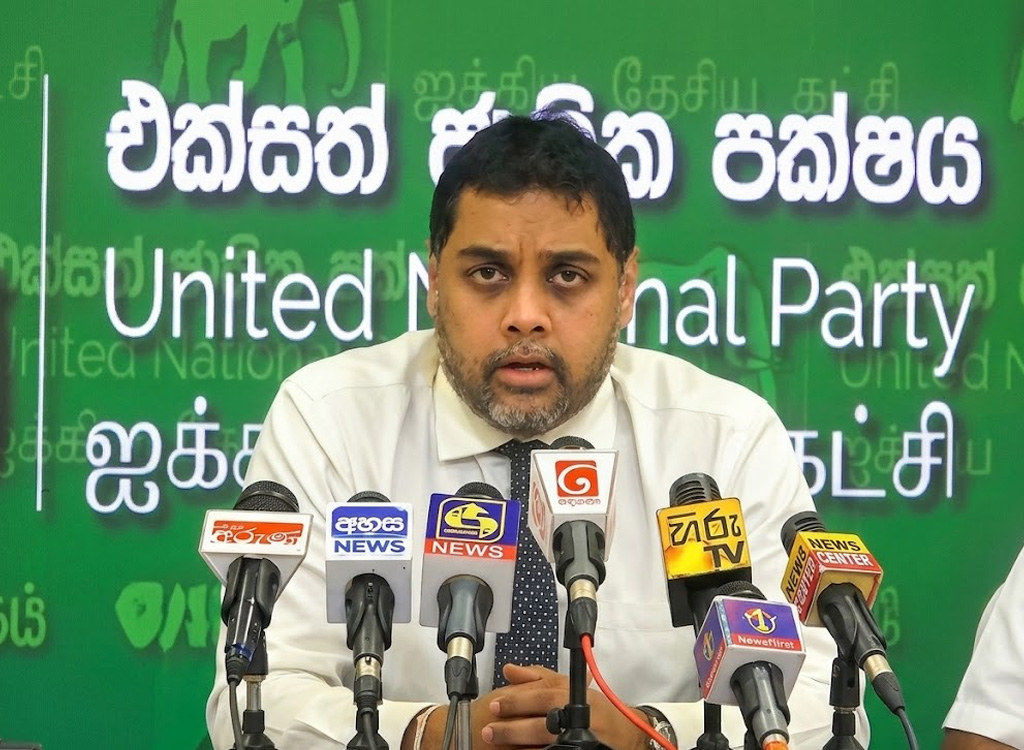
Presenting the proposals at a media briefing held at the party’s political office on Flower Road, Colombo, UNP Working Committee member Dinouk Colombage said frequent changes in national policies following changes of government had been a major contributor to Sri Lanka’s economic crisis.
He said the proposed framework, outlined in a green paper, sought to establish a set of national economic principles that political parties could agree on, reducing the disruption caused by changes in government.
Drawing inspiration from the European Union’s Lisbon Treaty, Colombage said the initiative aimed to develop a social market economy with Theravada Buddhist characteristics, combining economic development with social responsibility.
The green paper remains a work in progress, with the party expecting to incorporate proposals from universities, young people, the private sector and other stakeholders as it develops the framework further.
Regional integration and trade
Colombage also highlighted the need for Sri Lanka to strengthen its regional economic engagement as global economic influence increasingly shifts towards Asia.
Pointing to the failure to implement free trade agreements with Singapore and Thailand, he stressed that Sri Lanka needed to move beyond signing agreements and ensure that existing arrangements translated into tangible economic benefits.
He said the country should take a leading role in strengthening the Bay of Bengal Initiative for Multi-Sectoral Technical and Economic Cooperation (BIMSTEC), transforming it into a more influential regional economic, trade and maritime bloc.
Greater regional integration, according to the proposals, could create opportunities to expand trade, deepen economic partnerships and strengthen Sri Lanka’s position within the Asian economy.
Buddhist principles in economic policymaking
Attorney-at-Law Pasindu Gunaratne, who also addressed the briefing, said Buddhist economic principles could be incorporated into national economic planning while safeguarding the constitutional position of Buddhism and respecting the rights of other religions.
Referring to Articles 9 and 10 of the Constitution, he emphasised the importance of preserving the country’s constitutional framework while drawing on Buddhist teachings to inform economic policy.
Gunaratne identified the Sigalovada Sutta as a source of principles relevant to wealth management, investment and maintaining savings for emergencies.
He argued that these concepts could provide guidance for macroeconomic planning, particularly in promoting financial discipline, responsible resource management and economic resilience.
He also said the proposed approach could strengthen cooperation with other Theravada Buddhist countries, including Thailand, Myanmar and Cambodia, opening avenues for closer regional engagement.
Independent council proposed to address religious disputes
The proposals also extend to the management of religious affairs and the resolution of disputes arising from religious and social controversies.
Attorney-at-Law Nipuna Samaratunga said a statutory religious advisory council had been proposed to help address such issues through an independent institutional mechanism rather than political intervention.
The proposed body would comprise representatives of the Chief Prelates of the Malwathu, Asgiri, Amarapura, Ramanna and Kotte chapters, together with the Diyawadana Nilame and the Commissioner General of Buddhist Affairs.
Samaratunga said such a mechanism could provide a framework for resolving religious disputes and safeguarding religious harmony while reducing the scope for political interference.
The proposals reflect the UNP’s attempt to frame economic policy, regional cooperation and religious affairs within a broader national policy framework.
However, the green paper is still being developed, and its eventual scope will depend on the recommendations incorporated through consultations with relevant stakeholders.








Leave a comment