
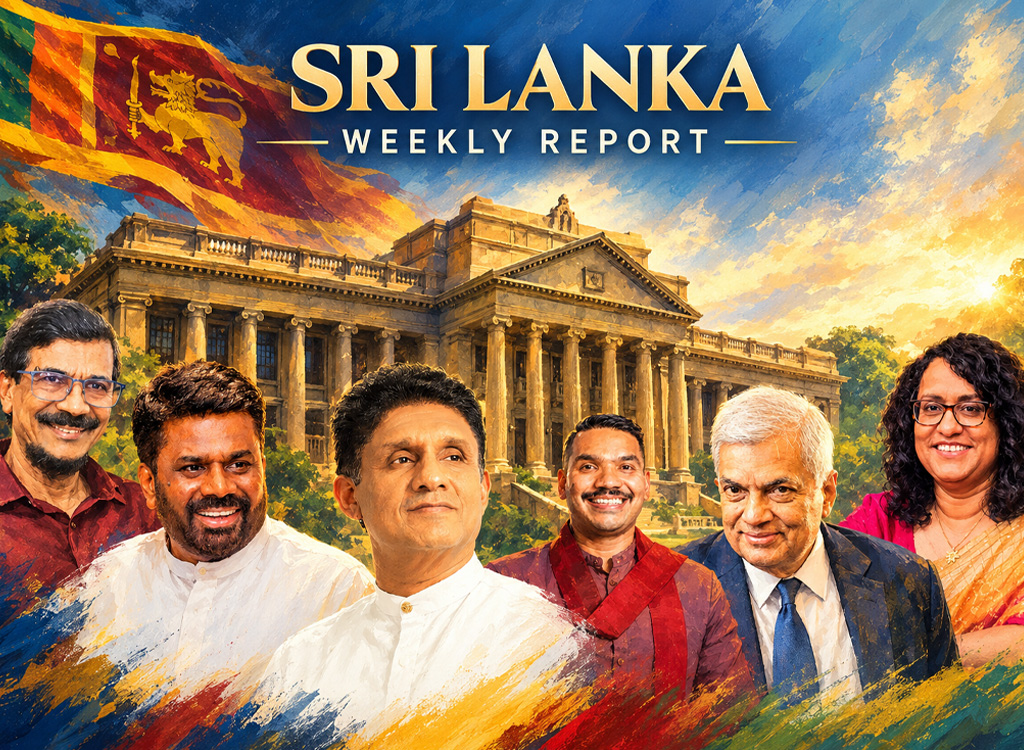
What happened, what mattered and what comes next
WEEK IN A MINUTE
The week was marked by intensifying anti-corruption investigations, renewed debate over the government’s economic direction, mounting financial-sector vulnerabilities and a series of decisions affecting infrastructure, education and public services. While the government highlighted revenue collection, prospective investment and economic growth, concerns persisted over capital-spending delays, weakening market sentiment, foreign-reserve movements and the concentration of lending against vehicles and gold.
The week also brought developments in politically sensitive court cases, fresh criticism of the proposed anti-terrorism legislation, questions over prison regulations and renewed warnings about extreme weather. Against this backdrop, the government sought to project a reform agenda centered on rural development, digitalisation and private-sector participation.
POLITICS, GOVERNANCE AND ACCOUNTABILITY
Anti-corruption investigations continued to generate headlines. Opposition politician Chamara Sampath Dassanayake was arrested by the Commission to Investigate Allegations of Bribery or Corruption (CIABOC) after providing a statement in an ongoing investigation and remanded until October 23.
MP Namal Rajapaksa was further remanded until October 27 over the Airbus deal investigation, while he and former Krrish Group director Janaki Siriwardhana were separately remanded until October 23 in an alleged bribery case involving the Krrish Group.
The courts also issued an arrest warrant for former minister Basil Rajapaksa over the alleged misuse of Tourism Promotion Bureau funds during the Uva Provincial Council election. The Illegal Assets Investigation Division was directed to seek an Interpol Red Notice.
Former First Lady Shiranthi Rajapaksa, meanwhile, was granted bail over allegations of misappropriating funds from the Siriliya Saviya account.
Former President Gotabaya Rajapaksa sought the lifting of his overseas travel ban.
Former State Minister Sivanesathurai Chandrakanthan, known as Pillayan, was further remanded until October 27 in connection with five murder cases in the Eastern Province.
Former State Intelligence Chief Suresh Sallay testified before the Permanent High Court Trial-at-Bar in the case concerning the kidnapping and disappearance of journalist Prageeth Ekneligoda.
President Anura Kumara Dissanayake announced that a CIABOC office would be established in every province. The proposal could improve public access to anti-corruption mechanisms.
The President said existing agreements with private fuel companies would be amended in the future, promised a non-aligned and independent foreign policy, and indicated that the government was prepared to enter into a new agreement with the International Monetary Fund (IMF) to achieve economic growth.
Solicitor General Viraj Dayaratne was appointed Acting Attorney General, while a special committee report recommending updates to laws, regulations and standing orders under the Prisons Ordinance was handed to the President’s Secretary.
The controversy over the treatment of imprisoned Buddhist monk Galagoda Aththe Gnanasara Thero continued. The Court of Appeal scheduled petitions challenging the removal of his robes for consideration on October 22. Justice Minister Harshana Nanayakkara said a monk taken outside prison could wear his robe unless his religious chapter objected, in accordance with the committee’s recommendations.
Members of the Maha Sangha participating in the “Nidahase Pada Yathra” from Kandy who arrived at the Presidential Secretariat were told that a decision would be made within a month. However, they demanded an official commitment to a specific date would remain until one was provided. A date was subsequently given. Police later obtained a Fort Magistrate’s Court order prohibiting protests in front of the Secretariat.
Transparency International Sri Lanka renewed its call to withdraw the proposed Protection of the State from Terrorism Bill, intended to replace the Prevention of Terrorism Act. Concerns about executive detention, judicial independence and civil liberties remain significant.
ECONOMY, MARKETS AND PUBLIC FINANCE
Sri Lanka Customs announced that it had achieved its 2026 revenue target of Rs. 2,207 billion by October 13, collecting approximately Rs. 2,208 billion.
Yet financial indicators offered reasons for caution. The Colombo Stock Exchange’s All Share Price Index fell below 20,000 points for the first time since August 14, 2025, signalling weakening investor sentiment. Foreign reserves declined by 1.1% to US$6,851 million at the end of September, from US$6,929 million a month earlier, despite the Central Bank purchasing a net US$64.2 million during the month.
The IMF’s latest global economic projections put Sri Lanka’s growth at 4% in 2026 and 3.7% in 2027. IMF Deputy Director for the Asia and Pacific Department Sonali Jain-Chandra said the institution stood ready to support Sri Lanka in whatever appropriate manner it desired. The President’s willingness to consider a new IMF agreement suggests that continued engagement with the Fund remains central to the government’s economic strategy.
A separate fiscal concern is the slow execution of capital expenditure. Government sources indicated that less than 30% of the 2026 capital-spending allocation had been utilised, although the government expects to spend the full allocation by year-end. President Dissanayake said procurement reforms and better alignment between budget preparation and procurement schedules were planned to accelerate implementation.
The Treasury sold Rs. 5 billion in bonds, bringing total bond sales during the week to Rs. 85.69 billion. The figures underline the government’s continuing need to finance its obligations through domestic borrowing.
The Central Bank also raised concerns about the financial system’s exposure to climate-related shocks. More frequent and severe extreme weather events threaten financial stability.
Nearly one in every four rupees lent by banks and finance companies is secured against vehicles or gold. Falling collateral values could expose lenders to losses.
In another Central Bank warning, more than a third of listed non-financial companies failed to generate sufficient operating profit to cover interest expenses in the first half of 2026, despite sharply rising revenues.
INVESTMENT, INFRASTRUCTURE AND ECONOMIC TRANSFORMATION
The government continued to promote private-sector participation and a broader transformation of the economy.
Sri Lanka is preparing to invite private investors to tender for four major high-voltage electricity transmission lines, potentially marking a significant departure from decades of state control.
The President said the government was considering dollar or cash incentives from 2027 for tourism operators who bring additional visitors to the country.
The US government announced US$17 million to digitalise the Colombo Port.
Separately, a parliamentary committee was told that several proposed Port City developments, including a private hospital, an educational institution and a gaming casino, had dropped out. Officials nevertheless maintained that the Treasury’s Rs. 9.7 billion investment in the Port City could be recovered once the first state-owned land parcel was leased.
The Board of Investment advanced plans for industrial zones at Paranthan and Kankesanthurai, with investor land reservations at Paranthan expected to begin by the end of November.
The Central Bank and Export Development Board also met electronics exporters to discuss easing foreign-exchange regulatory obstacles as Sri Lanka targets US$1 billion in electronics exports by 2028.
Government adviser Hans Wijayasuriya said the country aimed to increase the digital economy’s contribution to 12% of GDP by 2030, with innovation and intellectual property at its core.
The Cabinet approved a public-private partnership programme to diversify the State Printing Corporation. It also approved a US$100 million Asian Development Bank (ADB) loan for water-sector improvements and a separate US$100 million results-based ADB loan for technical and vocational education and training reforms.
Other approved projects included a Rs. 1.070 billion contract awarded to Tudawe Brothers to widen a section of the Kandy–Jaffna Road (A009), and a 12-month LPG supply contract with Oman’s OQ Trading Limited for 420,000 metric tonnes, with a tolerance of plus or minus 20%, beginning January 1, 2027.
The 2027 Budget, according to the President, will prioritise rural economic empowerment through improved roads and high-speed communications.
EDUCATION, HEALTH AND PUBLIC SERVICES
The Cabinet approved Rs. 6,000 in stationery assistance for 2027 for each eligible child among one million children from Aswesuma beneficiary families and another 500,000 identified by the Education Ministry. The government also approved a proposed five-year digital education programme estimated to cost Rs. 96 billion.
The government announced measures to strengthen cancer treatment at Maharagama’s Apeksha Hospital, focusing on medicine shortages, equipment, staffing and radiotherapy facilities.
The Government plans to appoint 1,540 Grama Niladharis to strengthen grassroots administration, with further recruitment expected next year.
TRADE, TOURISM, ENERGY AND FOREIGN RELATIONS
Sri Lanka’s external economic strategy featured prominently during the week. Foreign Minister Vijitha Herath met Azerbaijan’s President during an official visit, with discussions focusing on stronger cooperation in oil and gas supplies.
The President reiterated that Sri Lanka would pursue a non-aligned, independent foreign policy, an approach that will require balancing energy security, trade and diplomatic relationships amid international uncertainty.
SriLankan Airlines extended the suspension of flights between Colombo and Dammam and between Colombo and Riyadh until October 24 because of the prevailing regional security situation.
The President pledged to amend existing agreements with private fuel companies raising questions about the future contractual framework for fuel distribution.
LAW, SECURITY, HUMAN RIGHTS AND THE ENVIRONMENT
A significant diplomatic development came when Saudi Arabia’s Supreme Court set aside the death-penalty judgment against Sri Lankan migrant worker Anojan Sivarasa following sustained diplomatic and legal efforts by the Sri Lankan government.
In domestic security operations, the Police Special Task Force recovered over 100 kilograms of heroin from Kapparatota beach in Weligama.
The Central Crimes Investigation Bureau arrested a Chinese national allegedly connected to an organised criminal group in China over suspected extortion at Colombo Port City. Both cases underscore the need for effective action against transnational crime.
The government’s prison-reform review and ongoing dispute over a monk’s prison attire have renewed attention to prison administration, religious sensitivities and consistent application of the law. The Court of Appeal’s scheduled hearing on October 22 will be an important next step in the latter dispute.
Tusker Kavantissa, which had suffered gunshot wounds and was receiving veterinary treatment, died, according to the Environment Ministry.
The Court of Appeal reportedly directed state authorities to take measures to prevent wild elephants from being killed in collisions with trains.
Fresh warnings of heavy rainfall, flooding and landslides raised concerns about disaster preparedness.
ECONOMIC ACTIVITY AND BUSINESS CONFIDENCE
The Central Bank’s Purchasing Managers’ Index indicated that the services sector continued to expand in September, but at a slower pace. Its index declined to 60.5 from 65.6 in August. Manufacturing remained steady at 53.0, unchanged from the previous month. Both readings remained above the 50-point threshold associated with expansion.
The government’s rural development, digital-economy and industrial-zone plans offer opportunities to broaden growth beyond established economic centres.
THE WEEK IN NUMBERS
– Rs. 2,208 billion: Customs revenue collected by October 13, exceeding the annual target of Rs. 2,207 billion.
– US$6.851 billion: Foreign reserves at end-September, down 1.1% month-on-month.
– 4% and 3.7%: IMF growth projections for 2026 and 2027, respectively.
– Below 30%: Share of 2026 capital spending reportedly utilised so far.
– US$200 million: Two proposed ADB loans for water-sector improvements and skills development.
– 12% of GDP: Sri Lanka’s target for the digital economy by 2030.
– Rs. 96 billion: Estimated cost of the proposed five-year digital education programme.
– Rs. 85.69 billion: Government bond sales during the week.
WHAT MATTERED – THE DEEPER STORY
The central tension this week was between the government’s ambitious reform agenda and the institutional and financial constraints that could prevent it from delivering results.
The Customs revenue achievement offers a positive fiscal signal, while investment in digitalisation, rural infrastructure, vocational education and industrial zones could strengthen the foundations of long-term growth. Yet the slow execution of capital expenditure exposes a persistent weakness: announcing allocations and securing financing are not the same as completing projects that improve productivity and living standards.
The financial-sector warnings are equally important. Businesses struggling to cover interest costs, lenders increasingly dependent on vehicle and gold collateral, and declining foreign reserves all suggest that economic stability cannot be judged by growth forecasts or government revenue alone. The nationwide power interruption on Friday afternoon, which also disrupted water-supply systems, was a reminder of the importance of reliable essential infrastructure and resilience planning.
Meanwhile, the expanding anti-corruption investigations have created expectations that accountability will extend beyond political rhetoric. Arrests, remand orders and warrants are not proof of guilt. What matters is whether investigations are conducted impartially, evidence is presented in court and cases are concluded without selective treatment or undue delay.
The proposed anti-terrorism legislation presents a parallel test of governance. A government elected on promises of democratic renewal must demonstrate that national security measures are compatible with fundamental rights, judicial oversight and the rule of law.
Ultimately, the test facing the administration is whether it can convert political mandates, public revenue and international financing into measurable improvements while protecting institutional independence and public confidence.
THE WEEK AHEAD: 18–24 OCTOBER
Several developments merit close attention over the coming week.
Judicial and anti-corruption developments: Further proceedings in cases involving Namal Rajapaksa, Chamara Sampath Dassanayake and other political figures will test the credibility and consistency of accountability efforts. The October 22 Court of Appeal hearing concerning Gnanasara Thero’s prison robes will also attract attention.
IMF and economic policy: The government’s stated readiness to consider a new IMF agreement warrants clarification of its objectives and conditions. Markets will watch for signs of fiscal discipline, reserve stability and progress in implementing economic reforms.
Capital expenditure and the 2027 Budget: Procurement reforms and the promised rural-development focus will face scrutiny over project readiness, financing and execution.
Energy and infrastructure: The proposed changes to private fuel-company agreements, the next LPG supply contract and plans for private participation in electricity transmission will require transparent terms and credible safeguards. The consequences of the recent nationwide power interruption for electricity and water reliability also deserve attention.
Civil liberties and prison reform: Criticism of the Protection of the State from Terrorism Bill is likely to continue. The government’s response will indicate whether it is willing to address concerns over detention powers and judicial safeguards.
Weather and disaster readiness: Heavy-rainfall, flood and landslide warnings require heightened preparedness, particularly in vulnerable districts. Authorities must ensure that warnings lead to timely protective action.
Tourism and external relations: The extension of flight suspensions to Saudi Arabia and the wider regional security situation will remain relevant to travel and tourism. The proposed tourism incentives and discussions with Azerbaijan over oil and gas cooperation will also merit follow-up.
Investment and social services: Progress on the Paranthan industrial zone, Colombo Port City land leasing, electronics exports, Apeksha Hospital improvements and digital education will help indicate whether the government’s plans are moving beyond announcements.








Leave a comment