
By The Pulseline News Desk
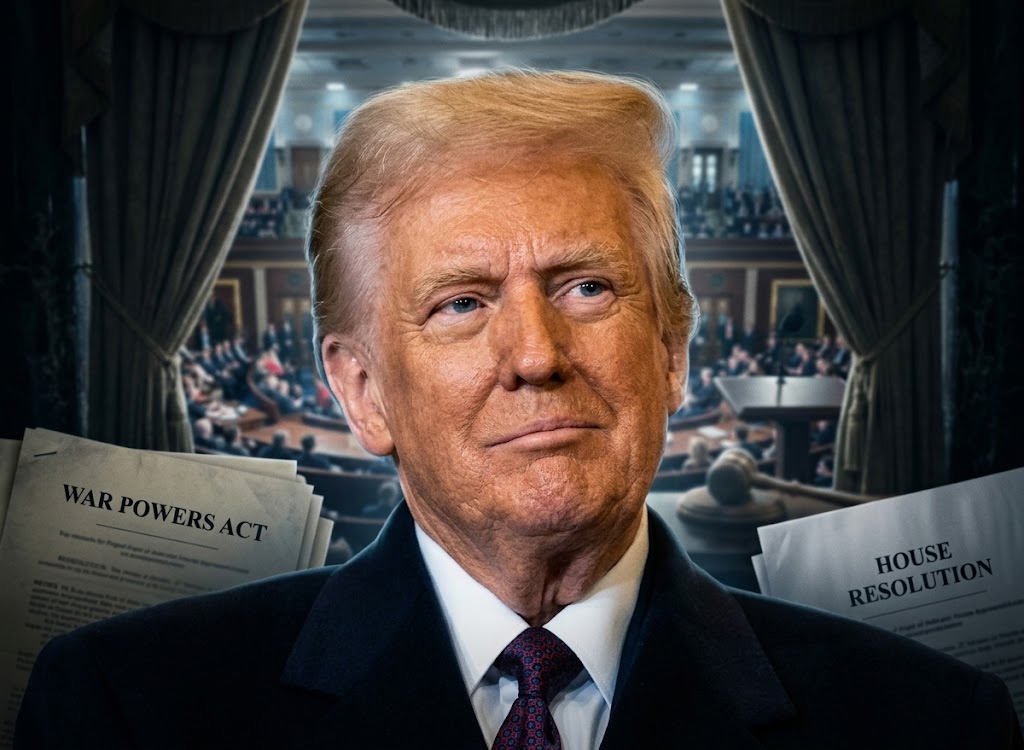
The US House of Representatives has voted for a third time to curb President Donald Trump’s ability to continue military operations against Iran without explicit congressional approval, highlighting growing unease within his own Republican Party as the conflict enters its seventh month.
The resolution, approved 220-204 late Tuesday (15), would invoke congressional war powers to require an end to the current US military action unless lawmakers provide authorisation. All Democrats backed the measure, joined by seven Republicans — including three who supported it for the first time.
The vote comes as lawmakers prepare to leave Washington for the final stretch of campaigning ahead of the US midterm elections, turning the Iran war into an increasingly important political issue.
Republican Congressman Zach Nunn of Iowa has said his support reflected the changing circumstances of the conflict.
“With the negotiating window closed, sustained combat operations now require congressional authorization,” Nunn has said, adding that he would not support “another open-ended war.”
The latest House action, however, faces the same obstacle as previous attempts. None of the resolutions approved by Congress has reached Trump’s desk, and the President would be expected to veto a measure that directly seeks to restrict his authority as commander-in-chief.
Republican Congressman Brian Mast, chairman of the House Foreign Affairs Committee, has challenged the resolution, questioning what military resources Democrats would seek to withdraw from the region while Iran remains a threat to the United States.
Mast argued that Trump was opposed to “forever wars” and has portrayed the military campaign as an effort to end decades of confrontation with Tehran.
“They are a continuous ongoing threat to the United States,” Mast has said. “Enough is enough.”
War comes with a rising economic cost
Beyond the constitutional dispute over presidential war powers, the conflict is increasingly carrying economic consequences for the US.
A new report from the nonpartisan Congressional Budget Office (CBO) has estimated that the first six months of the war have already cost the US Government about $38 billion, with expenditure projected to increase by approximately $3 billion a month if military operations continue.
The CBO has also warned of inflationary consequences, estimating that the conflict could add around 0.5 percentage points to US inflation during the first three months of 2027.
The pressure is not limited to government finances. The report also highlighted strains on US munitions stocks as the prolonged conflict consumes military resources.
For an administration that campaigned on avoiding prolonged overseas conflicts, the economic and military costs could become increasingly difficult for Republicans to ignore as voters head towards the midterms.
A growing congressional challenge
Congress has already attempted several times to alter the course of the conflict.
The House has approved similar war powers resolutions in June and July. The Senate has also approved a resolution on its 10th attempt, but Republican senators have reversed their position the following day after Trump criticised them during a closed-door lunch.
The latest House vote therefore represents another congressional challenge to the administration, but not necessarily an immediate change to US military policy.
The constitutional dispute centres on the division of war-making powers between Congress and the presidency. The Constitution gives Congress the power to declare war, while the President, as commander-in-chief, retains authority to conduct certain military operations.
The War Powers Act, enacted following the Vietnam War, has sought to establish clearer limits by requiring congressional authorisation for sustained military action after specified periods, generally 60 or 90 days.
Trump’s Iran campaign has now continued far beyond those initial periods, intensifying the debate over whether the executive branch can maintain prolonged military operations without fresh congressional approval.
Iran war becomes an election issue
The political stakes are rising as the November midterm elections approach.
The war, launched by Trump on February 28, has continued through repeated periods of deadly missile exchanges, contributing to instability across the Middle East and placing pressure on US military resources and household finances.
An AP-NORC poll conducted in July has found that most Americans believed the war had not been worth fighting, adding another layer of political pressure on lawmakers.
With fewer than 50 days remaining before the midterms, members of Congress are returning to their districts to campaign almost full-time. The elections will determine control of both chambers of Congress, with Democrats seeking to regain power from Republicans.
For Trump, the latest House vote therefore represents more than another unsuccessful attempt to invoke the War Powers Act. It signals that the political debate over the Iran war is moving closer to the heart of the US election campaign — where the administration’s promises on foreign intervention, the financial cost of the conflict and the constitutional limits of presidential power are likely to face increasing scrutiny.
For now, however, the balance of power remains with the White House. Unless Congress can overcome the President’s opposition, another House vote to restrict the war may end where the previous attempts did — without changing US military policy on the ground.
(With input from agencies)













Leave a comment