
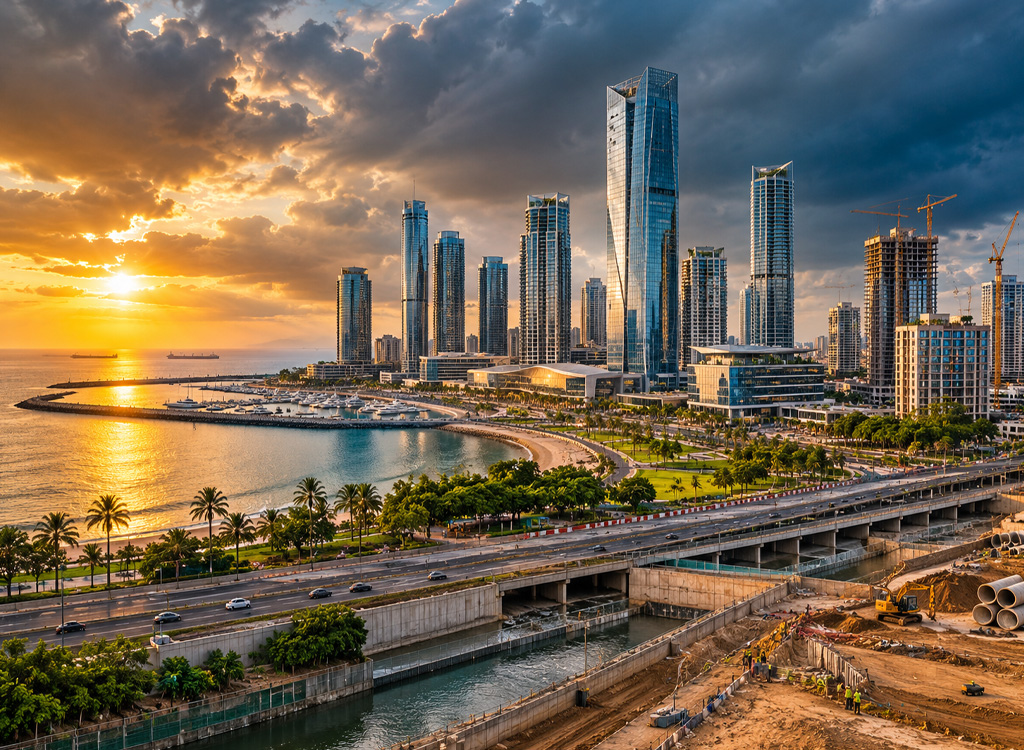
The apartments are being sold, the offices are being marketed and billions are being invested, but is the infrastructure ready for the city we are promising?
By Janathitha
Colombo Port City is arguably the most ambitious urban development project in Sri Lanka’s history. Built on 269 hectares of reclaimed land adjoining the capital, it promises to transform Colombo into an international financial, commercial and residential destination.
The vision is impressive with luxury waterfront apartments, international offices, hotels, shopping precincts, parks, a marina and an integrated transport network, together creating an urban environment unlike anything Sri Lanka has developed before. It is an opportunity that deserves to succeed.
But as developers begin selling apartments and committing substantial capital to new buildings, we must ask a question that is considerably less glamorous than the architectural renderings, which is, is the infrastructure ready to support the city we are selling?
I do not mean only the roads and pipes within Port City, but the entire network on which a city depends – water, sewerage, drainage, transport, waste collection, emergency services, schools and healthcare – and, above all, the capacity of existing Colombo to support it. A city does not function in isolation simply because it stands on reclaimed land.
There is a master plan. That is not the problem
Unlike many developments in Sri Lanka, Port City has been designed within a comprehensive master-planning framework. The Swedish consultancy SWECO prepared the original master plan, while Surbana Jurong of Singapore and Atkins of the United Kingdom prepared its Development Control Regulations. The project is divided into five precincts, each with designated land uses, building controls, open spaces, transport provisions and utility infrastructure.
The Development Control Regulations gazetted in June 2023, and amended several times since, set parameters for 74 development plots and a buildable area of approximately 6.3 million square metres. This is substantial planning work; Port City is not proceeding without a plan.
There is, however, an important distinction between having a master plan and demonstrating that the infrastructure required to deliver it is fully funded, operational and capable of supporting the completed development. A master plan is a promise; infrastructure capacity is a measurable engineering fact. The two must ultimately agree.
The apartments are already being sold
In January 2026, construction began on Bay One Residences Colombo, a US$112 million luxury development by ICC Port City and the first residential project to break ground in the special economic zone. It comprises 231 apartments and is scheduled for completion in January 2029. By late May 2026, its developer reported that approximately 50 per cent of the units had been sold; later announcements put the figure above 65 per cent.
This is encouraging, as property development brings investment and employment. But every apartment sold, every office and every restaurant represents a future demand on water, power, transport, waste and wastewater services.
We must therefore ask whether infrastructure delivery is keeping pace with property development – not simply whether a developer has obtained approval to build, but whether the whole city can function once those buildings are occupied.
The sewerage question nobody should ignore
A popular story claims that Dubai’s Burj Khalifa, the world’s tallest building, was built without a sewer connection and relies on fleets of trucks to remove its wastewater. That claim is misleading since the tower is connected to the municipal system. Nevertheless, Dubai’s rapid expansion did outstrip its sewerage capacity in parts of the city. The lesson stands that it is possible to construct extraordinary buildings while the infrastructure around them struggles to keep pace.
Which brings us to Colombo. In October 2025, Port City announced the completion of its first-phase infrastructure, including connections to the city’s electricity, water and wastewater networks. This is an important achievement and should be recognised. However, a sewer connection is not the same as proof that the entire downstream system can accommodate the wastewater of a fully developed city.
Colombo’s sewerage system is old. Planning began in 1896 and construction in 1906. In August 2025, Colombo Municipal Council officials acknowledged that the network – originally designed to serve around 50,000 people – now serves a far larger population and suffers from cracks, leaks and collapses, many undetected underground. The system comprises more than 250 kilometres of pipelines, 13 pumping stations and two deep-sea outfalls, through which roughly 30 million gallons of sewage are discharged into the sea each day. Officials identified funding as the main obstacle to the upgrades required.
That raises several questions:
*How much additional wastewater will Port City generate at full occupancy?
*What capacity has been reserved within Colombo’s existing network?
*Which pumping stations will handle the additional flows, and will new treatment facilities be required?
*What happens during a power failure, an extreme rainfall event or a major equipment breakdown?
*Who will finance the upgrades?
These questions should have documented engineering answers. If the assessments have been completed, they should be made public. If additional infrastructure is required, its delivery programme should be fixed before occupancy reaches the relevant capacity thresholds. A world-class city cannot be judged solely by its waterfront; it must also be judged by the infrastructure beneath its streets.
Parliament has already raised concerns
In August 2026, Parliament’s Sectoral Oversight Committee on Infrastructure and Strategic Development examined several issues relating to Port City. It raised concerns about delays and rising costs on the Port Access Elevated Highway, estimated at Rs. 28 billion when its cost and feasibility were last studied in 2015 and now estimated at Rs. 52 billion. Officials could not provide timelines or expected returns, and three of its four ramps were reported to be stalled at the planning and land-acquisition stages.
The Committee also asked how municipal services such as sewage disposal, garbage collection and firefighting, which would be provided by the Colombo Municipal Council, would be priced, and it urged the Commission to finalise service agreements with the Council. These are not minor administrative details. They go to the heart of whether Port City will function as a properly integrated part of the capital.
Without clear agreements and sustainable financing, the costs can fall on existing ratepayers. Colombo’s residents should not subsidise luxury developments through deteriorating public services; equally, Port City’s investors deserve confidence that essential infrastructure will be in place when their buildings are completed. Both interests require transparency.
A financial centre or a residential development?
Another important issue emerged before the Committee. According to reported findings, approximately 51 per cent of Port City’s land area is allocated to residential use. Commission officials said this had always been part of the plan, while acknowledging that the project’s marketing may have given a different impression. This does not necessarily mean that 51 per cent of the total floor area will be residential, but the residential component is clearly substantial for a project so often promoted as an international financial and commercial hub.
There is nothing inherently wrong with mixed-use development. But residential communities need different services from commercial districts like schools, healthcare, waste collection, emergency services, public transport and accountable local administration.
The Committee also raised questions about Port City’s local-government status and the rights of future residents. Officials told it that Port City does not fall under the Colombo Municipal Council, and they could not confirm whether residents would be able to vote in local-government elections. These matters should be resolved well before the development reaches significant residential occupancy. A special economic zone may operate under a distinct regulatory framework, but it cannot operate outside the practical requirements of urban life.
The transport problem
Port City’s master plan provides for a modern transport network, pedestrian-friendly streets and five proposed light rail stations. These are positive features. But provision for future public transport should not be confused with an operational system. Colombo’s Japanese-funded light rail project was cancelled in 2020, and although the government has since moved to revive it, final clearance from the Japan International Cooperation Agency was still pending in early 2026. A station on a master plan carries no passengers, and a highway does not ease congestion until it is completed and connected.
The real question is how people will travel between Port City and the rest of Colombo. How will workers commute from the suburbs? How will additional traffic affect Fort, Galle Face and Marine Drive? A financial district cannot function efficiently if the people who work there spend hours getting to it.
Completion is not the same as readiness
The completion of first-phase utility infrastructure is welcome. It should now be followed by a comprehensive and transparent account of the city’s long-term infrastructure capacity. For each major utility, the public should be able to understand five things:
- the estimated demand at full development;
- the infrastructure already constructed;
- the independently verified capacity available;
- the additional infrastructure required as development proceeds; and
- who is responsible for funding and delivering it.
For wastewater, that means the whole system, from building connection to final disposal; for stormwater, performance under extreme rainfall and coastal conditions. These are normal requirements of serious infrastructure planning, not commercially inconvenient questions.
The solution: an Infrastructure Readiness Report
Sri Lanka has an opportunity to set a new standard of transparency for major urban developments. The Colombo Port City Economic Commission, together with the master developer, the relevant utilities and municipal authorities, should publish an independently reviewed Infrastructure Readiness Report.
It should set out projected population, infrastructure demand, network capacities, upgrade programmes and financing – and, crucially, which infrastructure must be operational before buildings or precincts may be occupied.
A system that supports the first few hundred apartments may not support several thousand alongside office towers and hotels, so readiness must be assessed against cumulative development, not building by building. The report should be updated annually and independently audited, so that developers, purchasers and the public can all rely on it.
Let us not repeat the mistakes of the past
Sri Lanka has considerable experience of developments in which infrastructure failed to keep pace with construction. Roads become congested, drainage is overwhelmed, utilities need costly retrofitting and public facilities arrive years after residents have moved in. Correcting these deficiencies usually costs far more than planning properly in the first place.
Port City began with a largely blank slate, which is a significant advantage – and a greater responsibility. When a city is designed from the outset, there are fewer excuses for failing to coordinate its infrastructure. The objective must be not merely to sell land, but to create a functioning, productive and resilient city.
Port City could make an important contribution to Sri Lanka’s economy, and that opportunity should be supported. But support should not mean an absence of scrutiny, nor should criticism be mistaken for opposition to development.
The questions are straightforward. Is the water supply sufficient? Is the electricity network capable? Can the sewerage system cope with the projected population? Are the transport connections funded and scheduled? Who will provide essential municipal services? And who will pay when additional infrastructure becomes necessary?
The answers may already exist in detailed engineering studies and agreements. If so, publishing them would strengthen confidence in the project. If material gaps remain, identifying them now would allow them to be corrected before they become expensive problems.
The true measure of Port City’s success will not be the number of apartments sold, the height of its towers or the value of its land. It will be whether the city works as promised when people actually begin living and working there. A world-class city is not created by renderings and marketing campaigns alone; it is created by infrastructure, institutions, services and the discipline to deliver what has been planned. We should not wait until the buildings are occupied to discover whether the city beneath them is ready.
Disclaimer: The views and opinions expressed in this article are those of the writer and do not necessarily reflect the official position of this publication.











Leave a comment