
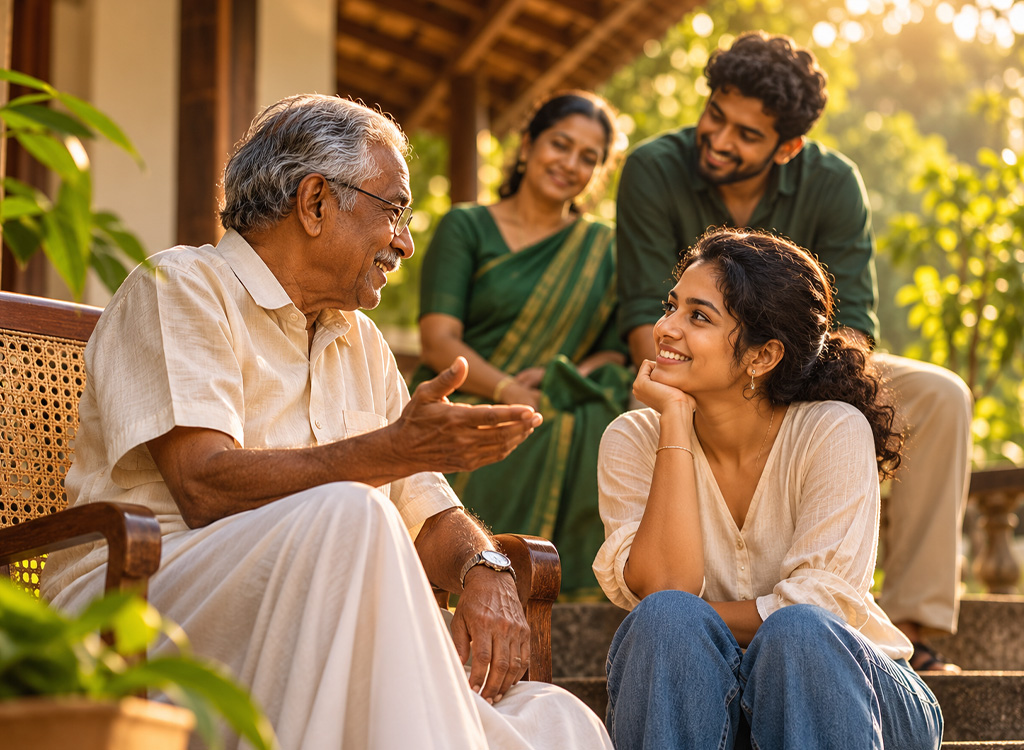
Age should bring wisdom, youth should bring curiosity, and both should bring courtesy. How can Sri Lanka bridge the widening gap between its generations?
By Janahitha
We are told, rightly, that the young must respect their elders, that older people deserve care, and that a lifetime’s experience has value. Civilised societies rest on these ideas.
Respect, however, runs in both directions. Age is no licence for bad behaviour, and neither is youth. Seventy years of wisdom can be undone by five minutes of arrogance, just as a bright 20-year-old can be let down by an inability to listen, hold back or show ordinary good manners.
It is time we spoke more frankly about how the generations in Sri Lanka treat one another.
Years are not the same as wisdom
Growing older is inevitable; growing wiser is a choice. Age gives us the chance to experience success and failure, love and loss, and all the unpredictability of life. Ideally, they leave us with perspective, patience and compassion. They do not always.
Some people grow more gracious with age, while others grow more bitter. Some elderly people become a source of comfort and guidance; others become hard to be around, nursing grievances and slights that should have been let go decades ago. Wisdom lies less in what has happened to us than in what we have made of it: the ability to reflect on experience, understand it and come out of it a better person.
Older people have a great deal to give. Yet that wisdom goes to waste when it arrives wrapped in anger, condescension, entitlement or constant criticism. The young may stop listening, not because the advice is wrong, but because the way it is delivered makes it hard to hear.
Respect is not a fixed deposit
In Sri Lanka, we sometimes treat respect like a fixed deposit, built up over a lifetime and drawing interest regardless of how one behaves today. It does not work like that.
Someone may have been an outstanding professional, a respected academic, a distinguished public servant or a devoted parent. Those achievements deserve recognition, but they do not excuse anyone from present-day courtesy. Respect for a person’s dignity should be unconditional. Respect for their judgement, conduct and character has to keep being earned.
You cannot demand politeness while being rude, consideration while being thoughtless, or patience while showing none yourself. Respect is something we practise every day: in the way we speak to the waiter, the domestic worker, the grandchild, the employee, the driver and the stranger who can do nothing for us in return. Age should deepen our grasp of this, not weaken it.
A Buddhist country that struggles to let go
Sri Lanka is a largely Buddhist country. Many of us learn as children about impermanence, non-attachment, loving-kindness, compassion and equanimity. We are taught that attachment causes suffering.
How well do we practise this as we age? Do we loosen our grip on our opinions, possessions, positions and sense of importance, or do we cling to them harder? Do we forgive, or do we keep a detailed mental record of every time someone offended us?
It is odd to spend a lifetime listening to sermons about letting go, only to spend our final decades holding on to petty disputes: a phone call that was not returned, an invitation that never came, a relative who did not visit, a younger person who dared to disagree, a family quarrel from twenty years ago. How much of the time we have left should we give to such things?
Upekkha, or equanimity, matters more as we grow older. It asks us to keep our balance through praise and blame, gain and loss, pleasure and pain. Metta, or loving-kindness, asks us to meet others with goodwill rather than hostility. These are not simply words to recite at the temple; they are practical disciplines that can make us kinder people. One of the rewards of age should be seeing how little some things matter.
The difficulties of growing old
None of this means ageing is easy. Imagine spending forty years in a position of authority, making decisions, providing for a family and being consulted on things that matter. Then, gradually, the phone stops ringing. The children become independent, the work ends, the body slows down, friends die and technology changes faster than one can keep up.
For some older people, this is deeply unsettling. Loneliness, poor health, money worries and a sense of lost purpose can show up as irritability, frustration or a need to control other people’s lives. That does not excuse cruelty or rudeness, but it does explain some of it. Younger people should understand that an elderly relative’s difficult behaviour may come from a fear of becoming irrelevant, dependent or forgotten. What that person may need is not another argument, but a sense of purpose, company and belonging.
Older people, in turn, need to accept that their worth does not depend on their authority. It is possible to remain valuable without being in charge of everything.
Have the young lost the art of grace?
The burden does not fall on the elderly alone. There is an equally important conversation to be had about the young.
Has confidence been confused with arrogance, independence with selfishness, and freedom of expression with vulgarity? Has restraint given way to a constant need to be seen and approved of?
We live at a time when visibility is rewarded. Social media invites people to put their opinions, possessions, holidays and achievements in front of an audience made up largely of strangers. A whole commercial industry works to persuade the young that their worth lies in what they own, where they travel, what they wear and how others see them. Consumerism is no longer only about buying things; it shapes how people build their sense of who they are.
Yet some of the finest human qualities cannot be bought, photographed or posted: courtesy, discretion, humility, thoughtfulness, reliability, emotional intelligence and the ability to listen without interrupting. There is a quiet elegance in someone who does not need to dominate every conversation, announce every success or comment on every subject. There is dignity in being quietly good at what you do, and sophistication in knowing when to stay silent. The idea that less is more applies to conduct as much as to fashion or possessions.
The lost art of anticipation
One of the loveliest forms of courtesy is anticipation: noticing what someone needs before they have to ask. It is fetching a chair for an elderly guest, offering a visitor a glass of water, or noticing that someone feels left out. It is ringing your parents without being asked, and putting your phone away when someone is talking to you.
These gestures seem small, but they say something important: I see you, and your comfort matters to me. Anticipation depends on attention, and attention means setting ourselves aside for a moment: a rare habit in a distracted age.
The young should cultivate it, and so should the old. An elderly parent who recognises that their grown children have demanding jobs, financial pressures and families of their own is showing the same consideration. Courtesy is courtesy, whichever way it travels.
Guidance without control
One of the greatest gifts an older person can give a younger one is perspective. Those who have lived through economic booms and slumps, career setbacks, family troubles, political upheaval and personal disappointment often understand life in ways no classroom can teach.
Offering guidance, however, is not the same as demanding obedience. Young people today live in a very different world from the one their parents and grandparents knew. Integrity, discipline, kindness and hard work still matter; how we apply them may be different.
A wise older person understands this. They offer principles rather than orders, share experiences rather than impose conclusions, and let younger people make their own decisions, including ones they would not have made themselves.
A wise young person, likewise, knows that old does not mean obsolete. Human nature has not changed as quickly as technology. Ambition, envy, greed, love, loyalty, betrayal and the search for happiness are not modern inventions, and our elders have dealt with all of them before us. They are worth listening to.
The best relationship between generations is one of mentoring and learning from each other, not one of command and obedience.
Sri Lanka’s opportunity
In one respect, Sri Lanka is fortunate. Our older citizens have lived through remarkable change: the years after independence, economic liberalisation, civil war, natural disasters, the arrival of new technology and one economic crisis after another. Between them, they hold a vast store of professional knowledge, cultural understanding, practical skill and lived experience.
Are we making good use of it? Retirement need not mean intellectual retirement. A retired engineer can mentor young engineers. A former teacher can help children who lack educational opportunities. A one-time entrepreneur can advise young business owners, and a retired agricultural specialist can help farming communities raise their yields. Grandparents can pass on family history and values.
Schools, universities, businesses and community groups could set up programmes that bring the generations together. Older people would gain purpose and company; younger people would gain knowledge that might otherwise take decades to acquire. Such schemes need respect on both sides. The old must share what they know without claiming superiority, and the young must receive it without assuming they know better.
Bridging the divide
There are a few simple principles we could all adopt, whatever our age.
Be courteous regardless of rank. Speak to a twenty-year-old with the same basic politeness you expect from them.
Disagree without being disagreeable. A different opinion is not an insult or a challenge to your authority.
Offer advice without forcing it. Guidance is worth more when the other person is free to weigh it.
Listen before you reply. The old do not know everything because they have lived longer, and the young do not know everything because they have more information at their fingertips.
Learn to forgive. Life is too short to keep a ledger of grievances.
Practise restraint. Not every thought needs saying, not every disagreement needs pursuing and not every achievement needs advertising.
Stay curious. Once we decide there is nothing left to learn, we stop growing.
Make time for each other. The occasional formal visit is not enough.
None of this requires legislation, public money or institutional reform. It requires self-awareness.
The privilege of growing older
Growing older is a privilege many are denied. Each extra year is a chance to become more thoughtful, more patient, more generous and less weighed down by things that do not matter.
As we age, we might measure ourselves differently: not by how many people obey us, but by how many freely seek our advice; not by the authority we keep, but by the wisdom we pass on; not by the wealth we gather, but by our freedom from being ruled by it; and not by the arguments we win, but by the ones we are wise enough to avoid.
For the young, maturity might be measured not only by independence, career success or financial achievement, but by the ability to stay humble, considerate and open while pursuing those goals.
Sri Lanka does not need a contest between generations. It needs the energy of its young and the perspective of its old: new ideas alongside experience, ambition alongside restraint, and progress that respects what came before. Above all, it needs mutual respect.
Older people should aim to be the kind of people the young are drawn to, not the kind they feel obliged to put up with. Younger people should aim to be the kind of people their elders can admire, not the kind they struggle to understand.
Growing older is a biological process. Growing wiser is a discipline of mind and spirit. Becoming more gracious, at any age, is a choice we can make every day.
Disclaimer: The views and opinions expressed in this article are those of the writer and do not necessarily reflect the official position of this publication.













Leave a comment