
Why Sri Lanka needs educational games that teach children not only to think, but also to care
By Dr. Nadee Dissanayake
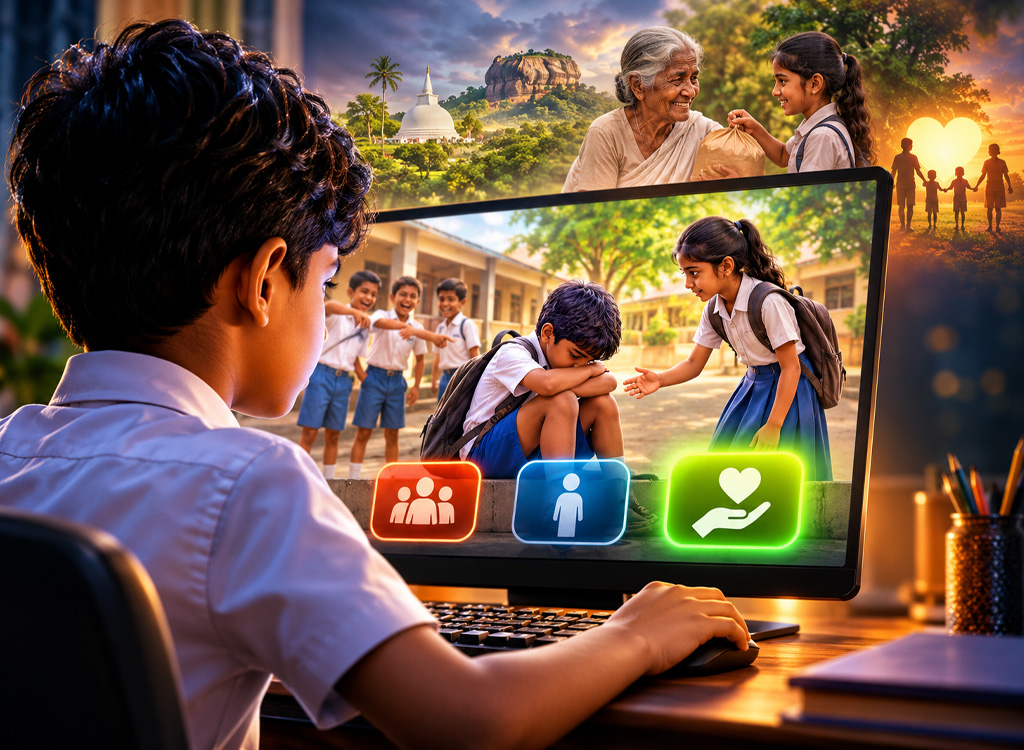
Imagine a child playing a video game. A new student has joined a school but is being laughed at by classmates. The player has three choices: join the laughter, ignore the situation or stand beside the student. There is no teacher to provide the answer and no parent to offer advice. The child must decide.
What makes this moment important is not the score or the next level. It is the opportunity to think about how another person might feel. This is the kind of experience we should consider when discussing the future of educational video games.
We often worry about children spending too much time in front of screens. Parents worry about gaming habits, teachers worry about attention and society questions the influence of digital entertainment. These concerns are valid. But perhaps we should also ask a different question: if digital technology has become part of childhood, can we use it to develop qualities that help children become better human beings?
Beyond learning facts
Many educational games help children recognise letters, solve mathematical problems, match pictures and answer quizzes. These activities can support learning, especially among younger children. However, educational games can offer much more than digital versions of classroom exercises.
A well-designed game can place a child in a situation, allow them to make decisions and show how those decisions affect others. It can encourage children to explore different points of view rather than simply identify the correct answer.
Consider a game set in a Sri Lankan school. A new student arrives from another part of the country and speaks a different language. The student struggles to make friends. The player can ignore the newcomer, make fun of the difference or invite the student to join a group. As the story develops, the player discovers more about the student’s life, abilities and feelings.
The purpose is not to tell children that everyone must become best friends. It is to help them understand that people have different experiences and that we should not judge someone without knowing their story.
Can games develop empathy?
Empathy is the ability to recognise and understand another person’s feelings and consider a situation from their point of view. It helps us listen before judging, respect differences and respond with kindness. Emerging research suggests that carefully designed digital games can encourage perspective-taking and positive social behaviour among children.
Of course, playing a game does not automatically make a child compassionate. Helping a virtual character is not the same as helping a real person. But games can provide a safe space to practise making decisions, recognising emotions and thinking about consequences. The important question is whether these experiences can influence how children behave outside the game.
Sri Lankan stories, global possibilities
Sri Lanka has a wonderful opportunity to develop educational games that reflect our own society rather than simply reproduce stories and experiences created elsewhere. Imagine a child exploring a coastal village, a hill-country town or a busy neighbourhood in Colombo. Along the way, the player meets an elderly neighbour who needs help, a family recovering from a flood, a child who feels excluded or a community struggling to protect its water source.
The challenges could encourage players to cooperate, share resources, protect the environment, resolve disagreements and consider the needs of others. One story might explore the consequences of bullying. Another could show how spreading an unkind message online can hurt someone. A different game could involve children working together to solve a community problem.
Through such experiences, children could develop environmental awareness, financial understanding, road safety, digital responsibility and respect for diversity without feeling that they are attending another classroom lesson. Our languages, music, landscapes, wildlife, festivals and everyday experiences provide rich material for storytelling. Children should be able to see their own communities and familiar surroundings reflected in the games they play.
Design with children, not just for children
An effective educational game does not necessarily require expensive graphics or complicated technology. It needs a meaningful story, engaging characters and a clear understanding of the children who will use it.
Children themselves should be involved in the design process. Developers should listen to what interests them, what challenges they face and what makes them curious. Teachers, parents, child-development specialists, psychologists, writers, artists and technology experts can contribute different perspectives.
Games must also reflect children’s different stages of development. A five-year-old may enjoy simple activities involving colours, sounds and caring for characters. A ten-year-old may enjoy solving problems with friends, while a teenager may prefer stories involving difficult choices and competing responsibilities.
Accessibility is equally important. Games should offer Sinhala, Tamil, and English language options, work on affordable devices and, where possible, allow offline play. Children with disabilities should also be considered in the design.
Most importantly, children’s safety must come before commercial success. Excessive advertising, manipulative rewards, unsafe online interactions and unnecessary collection of personal information have no place in games designed to support children’s development. The aim should not be to keep children playing for longer, but to make the time they spend playing worthwhile.
The real game begins outside the screen
Technology cannot replace the relationships through which children learn to care. Empathy grows when a child listens to a friend, shares with a sibling, respects an elderly person, apologises after hurting someone or welcomes someone who feels left out. A game can introduce an idea, but real life gives children the opportunity to practise it.
Imagine a child who has played a game about helping an elderly neighbour. The next day, the child sees an elderly person struggling with shopping bags. Does the child offer help? Or consider a child who has experienced a story about bullying. Will that child be more willing to stand beside someone being excluded?
These are the outcomes that matter. The success of educational games should not be measured only by downloads, playing hours or points collected. We should also consider whether children become more willing to listen, cooperate, share and think about how their actions affect others.
Parents and teachers can help by discussing the choices children make in games and connecting those experiences with everyday situations. Children must also have time to play outdoors, build friendships, explore nature and experience the world beyond screens.
What kind of future are we creating?
Today’s children are growing up in a world where technology can answer questions, create pictures, translate languages and offer experiences that were once unimaginable. Artificial intelligence will make digital games even more interactive and personalised. But technological ability alone cannot teach a child to understand another human being.
Sri Lanka does not need to begin with an expensive national gaming industry. We can start with a small, thoughtfully designed game, test it with children, listen to parents and teachers, and improve it based on what we learn. Our educational knowledge, creative talent and cultural richness can come together to create something meaningful.
Perhaps the greatest achievement would be a child finishing a game and saying, “I never thought about it from that person’s side.”
That moment may be worth more than a thousand virtual rewards.
Technology can help children find answers faster. But we must also help them understand people better, recognise the needs of others and make thoughtful choices.
The future of educational gaming should not be measured only by how well children play, but also by how they treat others when the game is over.
Because the most valuable game may not be the one a child wins, but the one that helps a child learn to care.
Disclaimer: The views and opinions expressed in this article are those of the writer and do not necessarily reflect the official position of this publication.












Leave a comment