
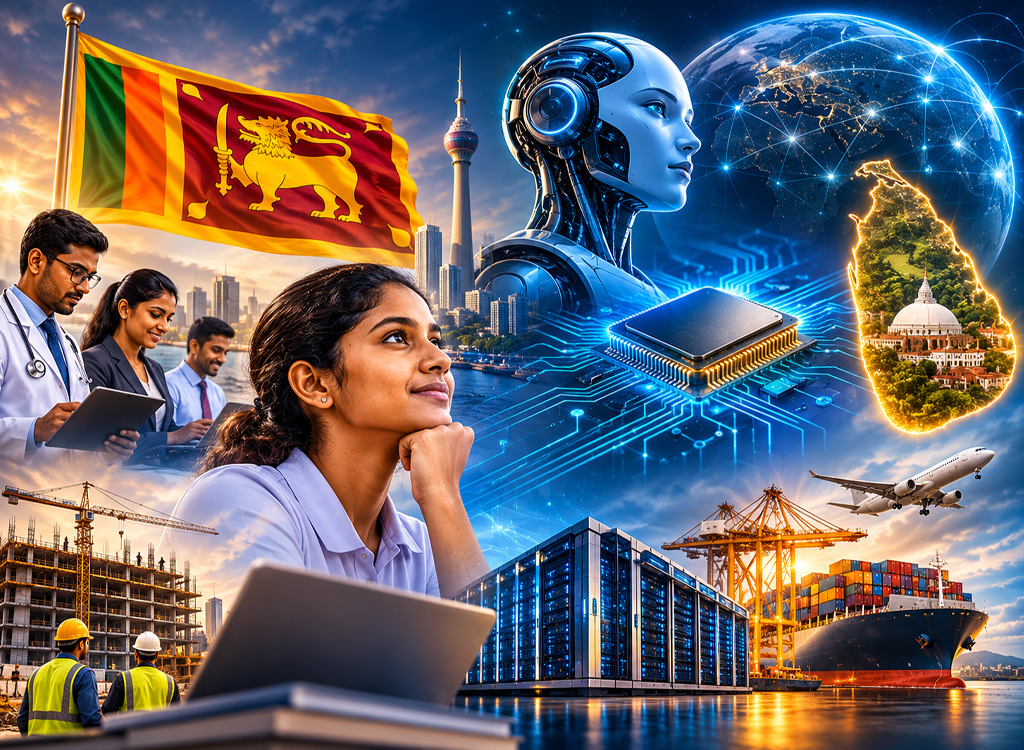
What is AI, why has a chip once built for video games become one of the most important technologies on earth, and what does this revolution mean for ordinary Sri Lankans, their children and their jobs?
By Janahitha
Imagine telling a Sri Lankan family in 1995 that, within 30 years, they would carry a device in their pockets through which they could bank, attend university lectures, buy groceries, consult doctors and speak to relatives thousands of kilometres away. Imagine telling them that some of the world’s most valuable companies would manufacture few conventional goods and earn billions from something called software. It would have sounded improbable. Yet here we are.
We are now witnessing another transformation that could prove as consequential as the internet itself: artificial intelligence. Behind it lie unfamiliar terms that increasingly appear in our newspapers – NVIDIA, GPUs, CUDA, large language models, data centres and cloud computing. For many Sri Lankans, these remain distant abstractions. They should not.
Whether you are a doctor in Colombo, a farmer in Anuradhapura, an accountant in Kandy, a garment manufacturer in Katunayake or a student preparing for the Advanced Level examinations, Artificial intelligence (AI) is likely to shape your life. Much of this transformation will reach us regardless. The real question is whether we understand it well enough to benefit from it.
What AI actually is
AI describes computer systems that perform tasks ordinarily associated with human intelligence: recognising patterns, understanding language, interpreting images, generating content and making predictions.
Traditional software follows explicit instructions, such as rejecting any bank transaction that exceeds the customer’s balance. An AI system can instead examine millions of past transactions, learn the patterns associated with fraud and estimate whether a new transaction is suspicious, even in circumstances nobody programmed in advance.
AI is not a single product, but a family of technologies. Predictive AI forecasts outcomes, such as whether a borrower is likely to default. Computer vision interprets images, helping hospitals to spot abnormalities in scans. Generative AI – the kind behind ChatGPT – produces text, images, software and audio. Newer ‘agentic’ systems carry out sequences of tasks towards a goal, within the permissions they are given.
‘Intelligence’ here does not mean consciousness or wisdom. AI systems can produce remarkably sophisticated results while still making basic mistakes.
Nor is AI the same as automation. A payroll system or a factory production line executes a fixed process with little human intervention and has done so for decades. AI adds interpretation, prediction and adaptability. A conventional accounting system sends a payment reminder after thirty days; an AI-enabled one might also flag unusual expenditure and forecast cash-flow difficulties. In healthcare, lending, law and government, however, human supervision and accountability must remain.
Why a gaming chip now matters so much
Every computer contains a central processing unit (CPU): a versatile processor that runs the operating system and handles a wide variety of tasks, largely one after another. A graphics processing unit (GPU) is built differently. It excels at performing enormous numbers of similar calculations at the same time.
A CPU is like a handful of brilliant mathematicians working through complicated problems in turn; a GPU is like thousands of workers each doing a small sum simultaneously.
Modern AI depends on exactly this kind of work: vast quantities of matrix calculations that allow a system to represent relationships between words, images and sounds. Developing an advanced model can require thousands of specialised processors working together, and serving millions of users afterwards requires still more. That is how the GPU moved from the gaming computer to the heart of the world’s digital infrastructure.
NVIDIA’s advantage, however, is not simply the chip. In 2006, the company introduced CUDA (Compute Unified Device Architecture), a platform that lets developers use its GPUs for general computing tasks far beyond graphics. Over two decades, an ecosystem of software libraries, AI frameworks, university courses and trained engineers has grown around it. A competitor may build an excellent processor, but customers must ask whether their existing software and teams can work with it. Rivals are developing alternatives, but this ecosystem explains much of NVIDIA’s dominance.
How machines learn
AI involves two processes: training and inference. Training is how a model develops its abilities. A language model is exposed to vast collections of text, and its internal parameters are adjusted repeatedly until its performance improves. This demands enormous computing power and capital.
Inference is what happens afterwards, when the trained model responds to a new request – explaining a legal document, say, or translating a paragraph from Sinhala into English. A rough analogy is a medical student: training resembles the years of study; inference resembles applying that knowledge to a new patient. The analogy is imperfect, because AI does not learn or understand as humans do, but it captures the distinction.
With billions of requests arriving continuously from people and automated systems, demand for inference capacity could become immense.
The cloud is not in the sky
We speak of information stored ‘in the cloud’, as though it floats somewhere intangible. In reality, the cloud lives in data centres: specialised buildings filled with servers, storage, networking equipment, backup power and cooling systems. When you use a banking app or ask an AI system a question, machines in a data centre are almost certainly processing your request.
AI-focused facilities are especially demanding, because advanced chips consume a great deal of electricity and generate considerable heat. According to the International Energy Agency’s 2025 report, Energy and AI, global investment in data centres reached about half a trillion US dollars in 2024, nearly double the 2022 level. Data centres consumed around 415 terawatt-hours of electricity in 2024, roughly 1.5 per cent of global consumption, and the IEA’s Base Case projects that this will more than double to about 945 terawatt-hours by 2030 – slightly more than Japan’s entire electricity consumption today. These figures cover all data centres, not only AI facilities, but the IEA identifies AI as the most significant driver of the increase.
The AI revolution, in other words, is not merely a software revolution. It is also an energy and infrastructure revolution.
AI is already here
Many Sri Lankans already use AI without realising it: when a navigation app predicts traffic, a bank blocks suspicious card activity or a smartphone sharpens a photograph, machine learning is likely at work.
Consider a student struggling with a physics concept. Where she once depended on a teacher, a textbook or an expensive tuition class, an AI application can explain the idea in several ways, set practice questions and adjust to her level, potentially in Sinhala, Tamil or English, although quality still varies between languages. This does not make teachers redundant; it gives them, and their students, better tools.
Over the next two years, AI is likely to become embedded in software people already use: email, accounting packages, banking apps and government services. A doctor could spend less time on paperwork and more with patients. A lawyer could review hundreds of documents in a fraction of the time, while remaining responsible for checking the results.
The immediate change, then, is less about replacing entire professions than about altering the speed and cost of individual tasks. Businesses may achieve the same output with fewer people, or the same people may deliver far more. Both outcomes are possible, and both carry consequences for Sri Lankan employment.
A decade ahead, the possibilities widen – personalised medicine, precision farming, smarter robotics – though such forecasts are scenarios, not promises. Higher productivity, moreover, does not automatically make everyone better off. That depends on who owns the technology and how the resulting value is shared.
What it means for Sri Lanka
Sri Lanka has long benefited from its location, an educated, English-speaking workforce and a well-connected professional diaspora. Over recent decades, it has built expertise in software, financial services, accounting, business process outsourcing and legal support, earning valuable foreign exchange.
AI is both an opportunity and a threat to that model. For decades, an international company compared the cost of an accountant in London with one in Colombo. Increasingly, it will compare both with an AI-enabled system supervised by a smaller professional team. When the work itself needs fewer hours, a labour-cost advantage counts for less.
The International Labour Organization’s (ILO’s) 2025 update on generative AI found that one in four workers worldwide is in an occupation with some degree of exposure to the technology. Exposure, however, does not mean redundancy. The ILO concluded that, because human input remains necessary, most jobs are more likely to be transformed than eliminated. Clerical work is the most exposed category; for Sri Lanka, that points to data entry, bookkeeping, call centres, basic translation and back-office administration. Even highly educated professionals are not immune: an accountant or software engineer may remain essential, while the number needed for a given volume of work falls.
None of this means that our outsourcing industry is doomed. Its future, however, depends on moving from selling human labour to selling expertise, technology and measurable business results. Our universities must produce graduates who can work effectively with AI, not merely more graduates in conventional disciplines.
Should we build data centres?
The global surge in AI infrastructure spending raises an obvious question: could Sri Lanka attract some of it? We have a strategic location, submarine cable connections and proximity to South Asian markets. A competitive AI data centre, however, needs far more than land and tax incentives. It needs reliable, competitively priced electricity, ample connectivity, efficient cooling, predictable regulation, skilled engineers and, above all, paying customers.
Consider a hypothetical 100-megawatt facility. Running continuously, it would consume about 876 million kilowatt-hours a year – roughly five per cent of all the electricity Sri Lanka generated in 2024, based on Public Utilities Commission figures. Our tropical climate raises cooling costs, advanced processors must be imported using scarce foreign exchange, and the equipment depreciates quickly. A data centre built without sufficient demand could become an extraordinarily expensive white elephant. Nor do such capital-intensive facilities create tens of thousands of permanent jobs.
Attracting data centre investment and building an AI economy are therefore not the same thing.
Fortunately, we do not need to own GPUs to take part. Cloud computing allows companies to rent computing power as they need it. A small team in Colombo can build specialised AI software for hospitals in Australia or banks in Europe by renting GPU capacity or using existing models through software interfaces. Sri Lanka does not need to become NVIDIA to benefit from NVIDIA’s technology.
Where we can win
The most promising openings lie where technology meets existing expertise: AI application development, systems integration, GPU and cloud engineering, healthcare and financial technology, AI testing and cybersecurity, data engineering, and Sinhala and Tamil language technology. A Sri Lankan accountant who understands both Australian taxation and AI has a rare and valuable combination of skills. So does a software engineer who understands American healthcare administration, or a lawyer versed in data privacy and AI regulation. Technology alone is not enough; nor, any longer, is industry knowledge alone. The combination is powerful.
Government, too, could benefit, from services offered through a single digital interface in Sinhala, Tamil or English to systems that flag unusual procurement spending and duplicate welfare payments. Yet AI cannot fix broken processes. Applied to inaccurate records and poor governance, it simply accelerates the problems. Digitisation, clean data and accountability must come first, and no citizen should be denied healthcare, welfare or any other entitlement by an algorithm without transparency and the right to human review.
Consumer or producer?
Sri Lanka has too often been a consumer of technologies developed elsewhere. AI presents the same risk on a larger scale. If our businesses buy foreign AI subscriptions, rent foreign computing power and automate domestic jobs with imported tools, without building export-oriented capabilities of our own, productivity may rise while the value flows overseas, spending on foreign digital services grows, and the intellectual property that earns recurring revenue remains foreign-owned.
If, instead, Sri Lankan companies develop AI-enabled services and products that international customers buy, the same transition could earn foreign exchange, create skilled employment and give our most talented young people a reason to build their careers at home.
The technology will arrive whether or not we are ready. Whether Sri Lanka merely consumes the AI revolution or helps to shape it is a choice we still have time to make – but not much.
Disclaimer: The views and opinions expressed in this article are those of the writer and do not necessarily reflect the official position of this publication.












Leave a comment