
By Janahitha
Colombo is fast becoming a cosmopolitan city of contrasts, character and considerable charm. From the leafy avenues of Ward Place and Colombo 7 to the oceanfront at Galle Face, and from the colonial architecture of Fort to the increasingly sophisticated cafés, restaurants and commercial districts emerging across the capital, Colombo is developing an identity that is distinctly its own.
There is much to admire from the street vendors, the familiar sound of three-wheelers negotiating their way through traffic, the energy of young Sri Lankans building their futures and older generations going about their daily lives.
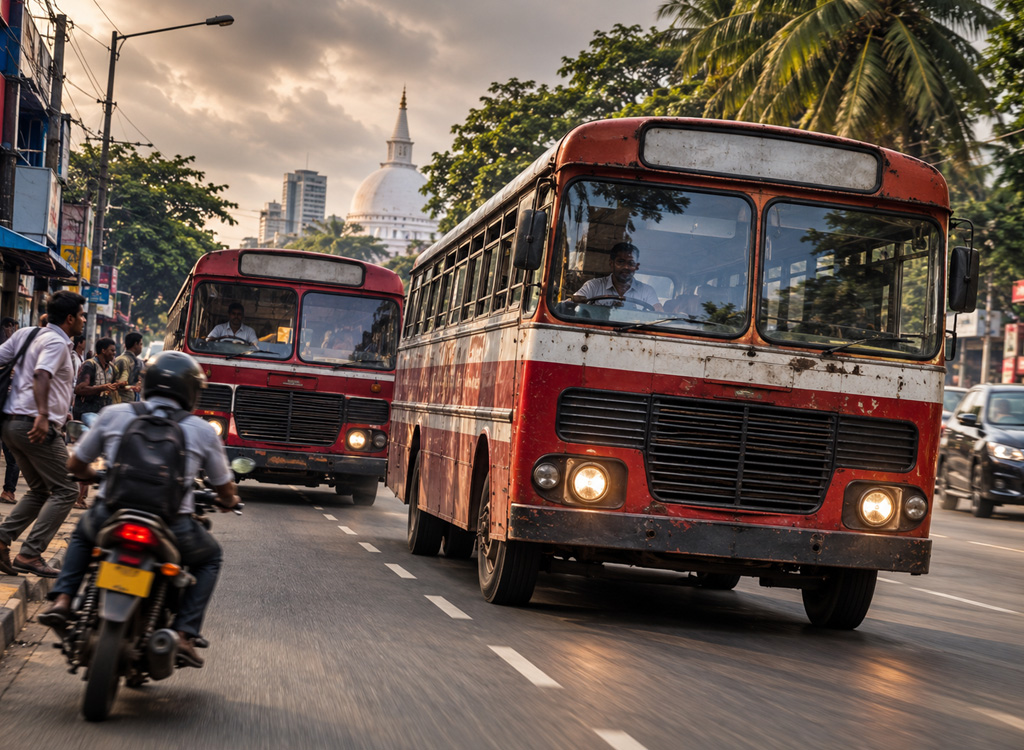
Yet, amid all this progress, one particularly unpleasant feature of our roads remains almost impossible to ignore, which is, the ageing Tata bus, seemingly driven by a village version of Formula One’s Kimi Antonelli.
Except this is no Formula One circuit. There are no crash barriers, no marshals, no safety cars and certainly no spectators who have consented to the risks. There are schoolchildren, mothers, fathers, elderly pedestrians, cyclists, motorcyclists, tourists and ordinary Sri Lankans simply trying to get through their day alive. That is precisely why this is no laughing matter.
A national menace disguised as public transport
Anyone who regularly travels Sri Lanka’s roads will recognise the phenomenon. From Kandy to Colombo, Dambulla to Anuradhapura and Galle to Ahangama, the spectacle is depressingly familiar: two buses racing each other to the next stop; a driver overtaking on a blind bend; a conductor hanging precariously from an open doorway, shouting instructions as the bus swerves across lanes; a vehicle pulling away before passengers have safely boarded or alighted. Most disturbing of all is the apparent indifference to the lives of everyone else on the road.
In Australia, particularly in Victoria, the term ‘hoon driving’ describes dangerous, reckless and antisocial driving. Sri Lanka appears to have developed its own public transport variation. The objective is not to reach a destination safely or on time; it is to reach the next bus stop before the competitor. One more passenger. One more fare. One small commercial advantage.
For some operators, that advantage is apparently worth risking the lives of dozens of passengers and countless other road users. What kind of society allows a commercial incentive worth a few hundred rupees to take precedence over human life? And why have we tolerated it for so long?
The problem is not simply the driver
It would be convenient to blame a few reckless individuals and move on. But the problem is systemic. We have created, or at least tolerated, a public transport environment in which dangerous behaviour can be commercially rewarded.
Drivers are frequently under pressure to maximise passenger numbers, compete with other buses and keep to schedules in congested conditions. Conductors may encourage aggressive competition for passengers. Bus owners benefit from the revenue but are not always exposed to the full consequences of dangerous operating practices. Regulators announce initiatives, enforcement campaigns are conducted and politicians promise improvements, yet the underlying incentives often remain unchanged.
When the financial reward for dangerous behaviour is immediate, but the likelihood of meaningful punishment is uncertain, recklessness becomes an entirely predictable outcome. This is not an excuse for the driver. It is an indictment of the system.
Nor should we overlook the condition of the vehicles. Sri Lanka still relies on an ageing bus fleet. Not every older bus is unsafe, and not every bus driver is reckless; thousands of conscientious drivers perform a difficult public service every day. But an old, inadequately maintained vehicle, driven aggressively within a poorly regulated commercial system, is a dangerous combination. A modern nation cannot treat this as an unavoidable feature of everyday life.
We have normalised the unacceptable
Perhaps the most troubling aspect of this issue is how ordinary it has become. A bus swerves across three lanes; we complain. A driver forces a motorcyclist off the road; we shake our heads. A pedestrian narrowly escapes being struck; we thank our lucky stars. When someone is seriously injured or killed, there is public outrage, a brief news cycle and another round of promises. Then life continues, until the next tragedy.
This is the extraordinary contradiction of Sri Lankan society. We are a people capable of immense compassion, generosity and collective mobilisation. We rally behind our cricket team with passion, organise whole communities after natural disasters and show remarkable solidarity in a crisis. Yet we appear strangely resigned to the dangers on our roads.
Road deaths are not an acceptable cost of economic activity, nor an unavoidable price of development. Every preventable death leaves a family whose future has been permanently altered: a child without a parent, a parent without a child, a spouse whose partner never returns home. No fare, timetable or commercial competition can justify that.
The solution: Make dangerous driving economically and personally ruinous
Sri Lanka needs a fundamental change in its approach to reckless public transport operations. Not another awareness campaign. Not another set of posters asking drivers to be considerate. Not another temporary enforcement drive that disappears when public attention moves elsewhere. We need severe, certain and consistently enforced consequences.
My proposal is deliberately uncompromising. Where a public transport driver engages in exceptionally dangerous conduct, particularly deliberate racing, extreme recklessness or conduct causing serious injury or death, the consequences should extend well beyond an ordinary traffic fine.
First, immediate impoundment of the vehicle. A bus involved in serious reckless driving should be taken off the road immediately, subject to proper evidentiary and legal safeguards. Where repeated or particularly grave violations are established, the law should permit permanent forfeiture of the vehicle. In the most egregious cases, involving deliberate and repeated life-threatening conduct, destruction of a forfeited vehicle should be an available sanction where proportionate and authorised by a court. The economic consequences must be significant enough that bus owners cannot simply treat penalties as a cost of doing business.
Second, criminal accountability for drivers and conductors. Drivers who deliberately endanger the public should face criminal investigation and, where the evidence warrants it, prosecution. Conductors who actively encourage or participate in dangerous conduct should also be held accountable. Arrest must rest on lawful grounds and evidence, not merely public anger; but where serious offences are committed, the criminal justice system must respond decisively.
Third, lifetime disqualification for the worst offenders. A driver found responsible for an exceptionally grave act of deliberate recklessness causing death or catastrophic injury should face the possibility of permanent disqualification from operating public transport. Driving a bus is not an unconditional entitlement; it is a position of enormous responsibility. A person entrusted with the lives of fifty passengers, and the safety of everyone around them, must be held to a higher standard than an ordinary motorist.
Fourth, meaningful accountability for bus owners and operators. If a driver is punished but the owner simply hires another and carries on under the same commercial incentives, nothing fundamental changes. Owners who knowingly encourage, tolerate or repeatedly fail to prevent dangerous operations should face substantial penalties, suspension of operating permits and, in serious cases, permanent cancellation of those permits. Corporate and individual accountability must follow responsibility.
Fifth, technology-led enforcement. Sri Lanka does not need to invent new technology. GPS tracking, speed monitoring, onboard cameras, digital tachographs and automated reporting systems already exist. Every licensed public bus should progressively be required to carry appropriate monitoring equipment, and repeated speeding, dangerous acceleration, route racing and other high-risk behaviour should trigger independent review and enforcement. Operators should not be permitted to disable these systems without consequences, and enforcement must be transparent and protected against corruption or selective application.
But punishment alone is not enough
If we want drivers to stop racing for passengers, we must stop designing a system that rewards them for doing so.
Public transport should operate to predictable schedules, defined service standards and properly regulated routes. Drivers should receive fair pay that does not depend on competing recklessly for the next passenger. Operators should be rewarded for safety, reliability, punctuality and passenger satisfaction, rather than simply for maximising the number of fares collected. Sri Lanka should examine route-based contracts, scheduled services, electronic ticketing and performance-based operating arrangements. These are not revolutionary concepts; they are ordinary features of functioning public transport systems in many parts of the world.
Severe penalties without structural reform may punish individual offenders while leaving the underlying problem untouched. We need both.
What if it were your daughter?
Some readers will consider these proposals heavy-handed. Confiscating buses? Permanent licence bans? Criminal prosecution? Potential destruction of vehicles? Surely that is excessive?
Perhaps. But I would ask those readers one question. How heavy-handed would you want the law to be if your daughter were run over at Borella Junction because she could not get out of the way of a speeding bus? What if it were your son crossing the road after school, your elderly mother returning from a hospital appointment, or your wife driving home from work?
Would you still believe that a modest fine and a temporary suspension were sufficient? Would you be satisfied to discover that the driver had previously been reported for reckless driving, but nothing meaningful had been done? Would you accept that the bus owner bore no responsibility whatsoever?
The answer, I suspect, would be very different. The value of a human life should not become apparent only when that life belongs to someone we love. That is the fundamental moral issue: we should demand the same protection for a stranger’s child that we would demand for our own.
A cosmopolitan city requires civilised roads
Colombo has ambitions. Sri Lanka has ambitions. We want international investment, more tourism, sophisticated infrastructure, better public spaces and cities that can compete with the best in Asia.
But a city is not cosmopolitan merely because it has expensive restaurants, five-star hotels and modern office towers. A truly civilised city is one in which an elderly person can cross the road without fear; where a child can travel to school safely; where a tourist can use public transport without feeling they have involuntarily entered a motorsport competition; where a bus driver understands that arriving safely is infinitely more important than arriving first; and where the state places the protection of human life above the commercial interests of transport operators.
There is nothing sophisticated about a city whose roads remain governed by intimidation and recklessness, and nothing economically progressive about a transport system that exposes its own workforce, passengers and citizens to preventable danger.
Enough is enough
Sri Lanka does not lack intelligent people, capable administrators, competent engineers or the technological means to address this issue. What we have lacked is the sustained political will to make road safety non-negotiable.
We need legislation with real consequences, and enforcement that cannot be bought or ignored. We need bus owners to understand that their operating licences are privileges carrying serious obligations, and drivers and conductors to recognise that public transport is a public responsibility, not a competitive blood sport. And we need a national transport policy that removes the financial incentive to race for passengers.
The vast majority of Sri Lankans are simply trying to work, study, raise families and build better lives. They should not have to gamble with those lives every time they step onto a road.
Let Kimi Antonelli race in Formula One. Let Sri Lankan bus drivers drive buses. And let us finally establish a simple national principle: the right to earn a living must never include the right to endanger someone else’s life.
Because a country that cannot protect its citizens on an ordinary journey home has much more to fix than its public transport system.
Disclaimer: The views and opinions expressed in this article are those of the writer and do not necessarily reflect the official position of this publication.








Leave a comment