
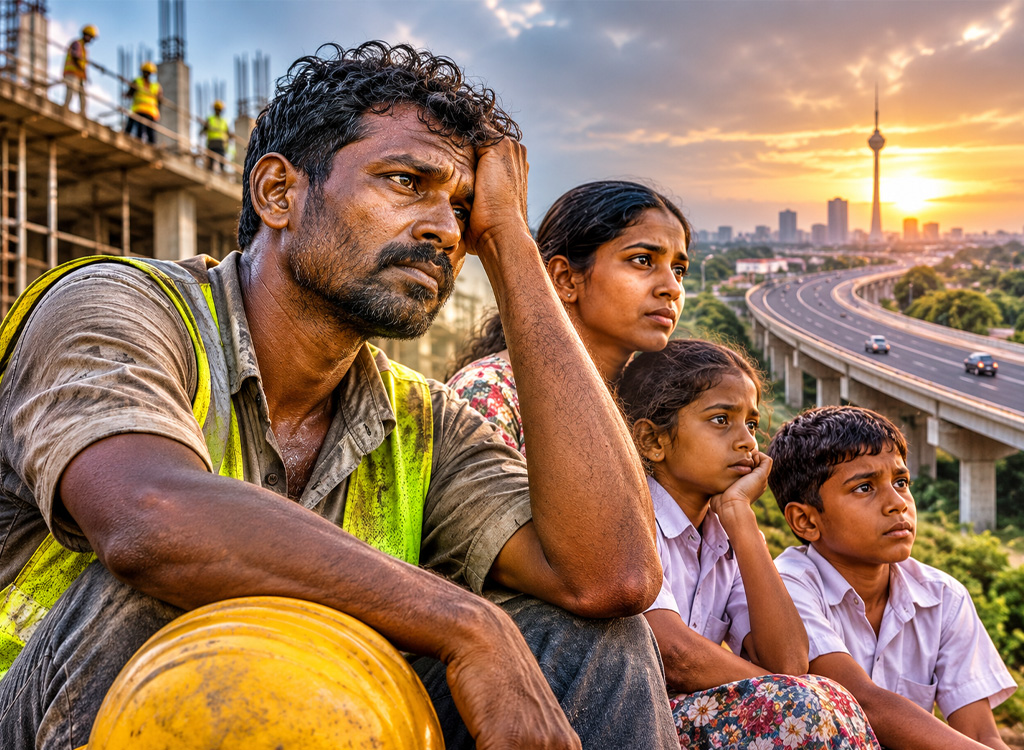
What does a day of hard physical labour actually mean for this man and his family?
By Janahitha
His basic monthly wage is Rs. 58,800. Overtime adds a further Rs. 12,860, and the household brings in another Rs. 14,500 from other sources. In total, the family has Rs. 86,160 a month.
Food and groceries alone take Rs. 43,750 of this. More than half of the household’s income goes simply on feeding the family.
A further Rs. 15,000 goes on housing or loan repayments, Rs. 8,000 on transport, Rs. 6,000 on his children’s education, Rs. 5,500 on electricity and water, and Rs. 3,000 on medical expenses.
At the end of the month, the family is left with Rs. 4,910. That is about Rs. 164 a day.
He wakes at 4.00 a.m., gets his children ready for school, goes to work on a construction site, puts in overtime and gets home at almost 7.00 p.m.
Even so, and with the extra income the rest of the household brings in, the family saves less than six per cent of what it earns each month.
Nothing in the budget is set aside for a family holiday, entertainment, a serious medical emergency, home repairs or any other unexpected cost. Whatever comes up has to be paid for out of the little that is left over.
A ten per cent rise in the cost of food would wipe out almost all of the family’s monthly savings. Without overtime, the household would run a deficit of Rs. 7,950 every month. Overtime is what keeps this family out of the red.
And the work that supports the family may, in time, wear down the body on which its income depends.
What happens if he injures his back? What happens if he develops a chronic illness? What happens if the construction project is suspended? For this family, any one of these could turn a medical or work problem into a financial crisis.
The retirement he may struggle to afford
At the current rate, and assuming nothing unexpected comes up, the household would save just Rs. 58,920 in a whole year. It would take more than four years to build an emergency fund covering three months of household expenses.
This is where the Employees’ Provident Fund (EPF) and the Employees’ Trust Fund (ETF) matter. For people in physically demanding jobs, EPF and ETF are much more than an added perk of employment. They are one of the few ways such workers can build up some security for the day their bodies can no longer cope with hard labour.
Taking his basic monthly wage of Rs. 58,800 as an example, the combined statutory employee and employer contributions to EPF and ETF would come to Rs. 13,524 a month, or Rs. 162,288 a year. That is almost three times what the whole household can currently save on its own.
Think about what happens to a worker if those contributions are never paid, are paid only now and then, or stop during long gaps between construction projects.
Over 20 years, at today’s wages and contribution rates, the contributions alone would come to more than Rs. 3.2 million, before any investment returns. To a wealthy person, that may not sound like a great deal. For this family, it could decide whether he has some financial independence in retirement or has to rely on others.
That is why enforcing EPF and ETF obligations across Sri Lanka’s construction industry matters so much, especially where workers are hired through subcontractors, on temporary arrangements or on daily wages. The government must make sure that the people building its infrastructure receive the statutory protections to which they are entitled.
Good legislation is not enough on its own. It has to be implemented, monitored and enforced.
The true measure of national development
This man is not asking for charity.
He gets up before sunrise. He works, earns overtime, educates his children and provides for his family. He contributes to the development of his country. He is doing what society expects of a responsible citizen.
The question is whether society is meeting its responsibilities to him.
No one can put right every economic inequality overnight, and businesses and governments cannot ignore commercial and fiscal realities. But a man who spends his working life building a nation’s infrastructure should have a fair chance to save, look after his health, educate his children and, in time, retire with dignity.
One day, we will drive along the expressway he helped to build and save an hour or two on our journeys. He will have given thousands of hours of his life to make that possible.
Perhaps the true measure of the Colombo–Kandy Expressway’s success should be not only how quickly it gets us to our destinations, but whether the men who built it are able to reach theirs.
Disclaimer: The views and opinions expressed in this article are those of the writer and do not necessarily reflect the official position of this publication.









Leave a comment