
By Kusum Wijetilleke
Sri Lanka’s economy has recovered from the worst of the economic crisis. GDP is growing again, inflation has fallen sharply from its peak, foreign exchange reserves have recovered and Government revenue has increased.
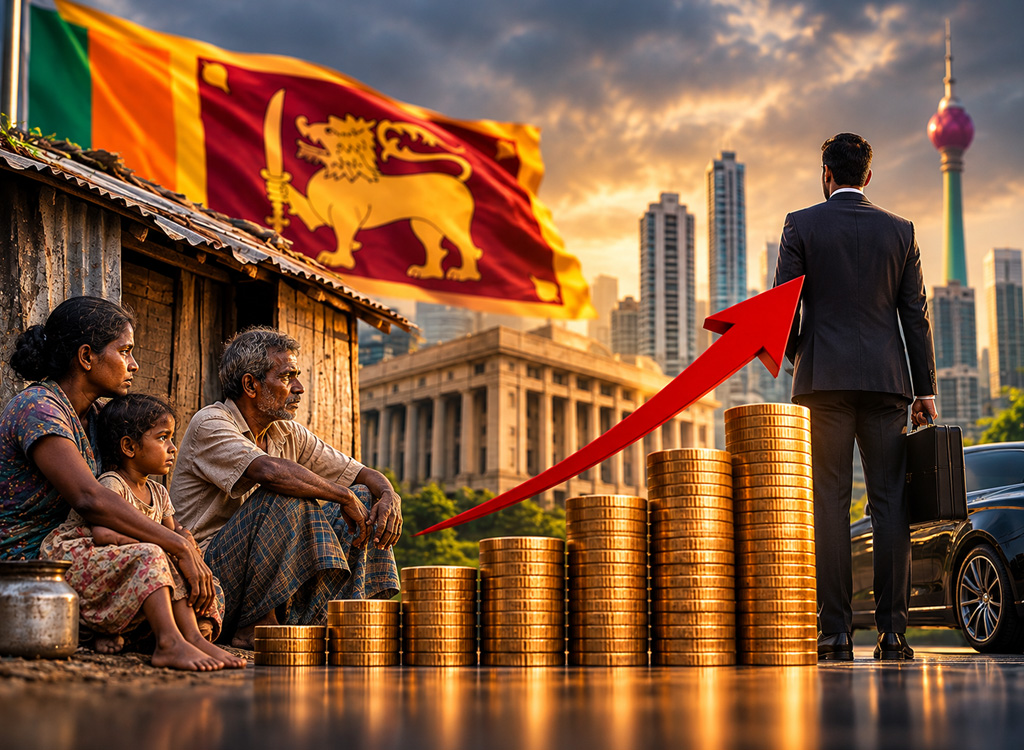
The distribution of income and wealth, however, tells a very different story, with household income data show a clear shift in income towards the top.
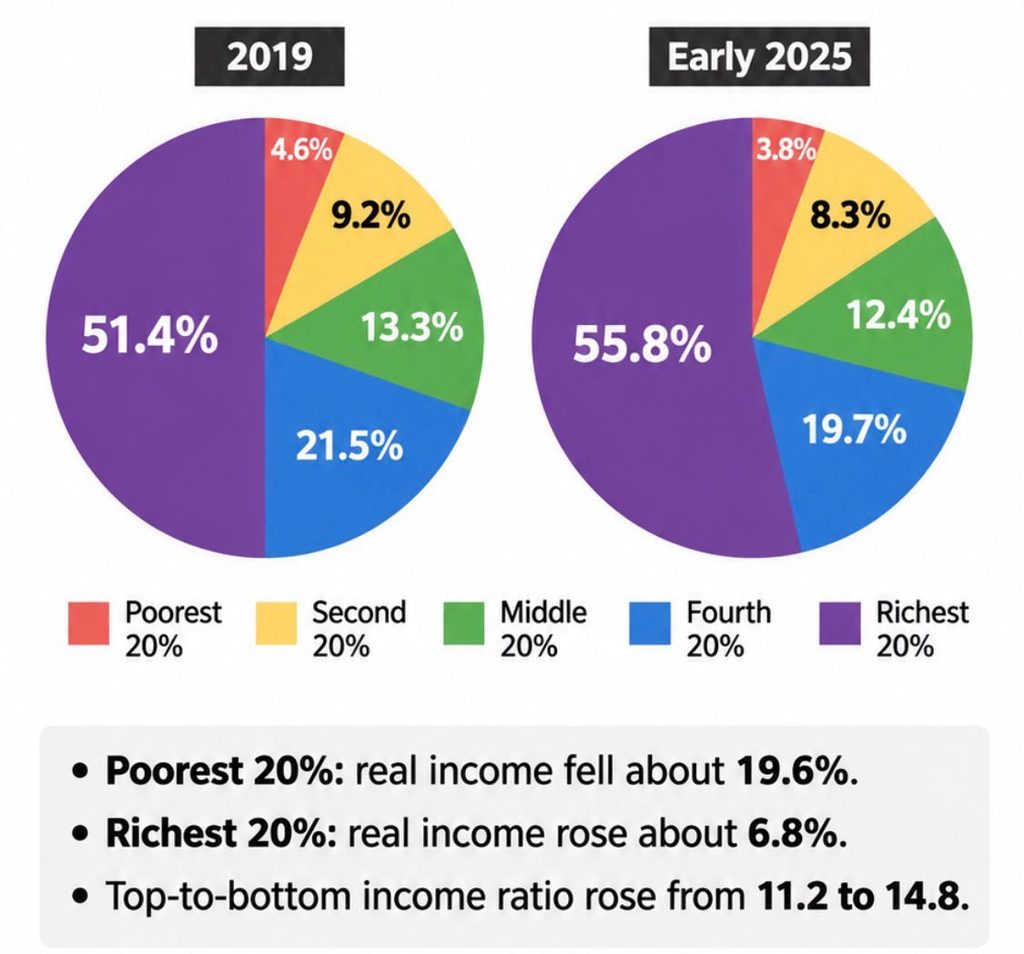
An Institute of Policy Studies analysis of Department of Census and Statistics data finds that between 2019 and early 2025, real household income of the poorest 20% fell by about 19.6%. Real income of the richest 20% increased by about 6.8%.
The gap between the two groups widened sharply. In 2019, the average household in the richest 20% earned 11.2 times as much as a household in the poorest 20%. By early 2025, the richest earned 14.8 times as much as the poorest.
The typical household also became poorer. Real median household income fell by 11.1% between 2019 and early 2025. Real mean income fell by only 1.7%. Median income is the income of the household exactly in the middle of the distribution: it fell 11.1% but the average income across all households fell only 1.7%, distorted by much higher real incomes at the top end.
This shows that the household in the middle became significantly poorer. The distribution of total household income shows the same pattern.
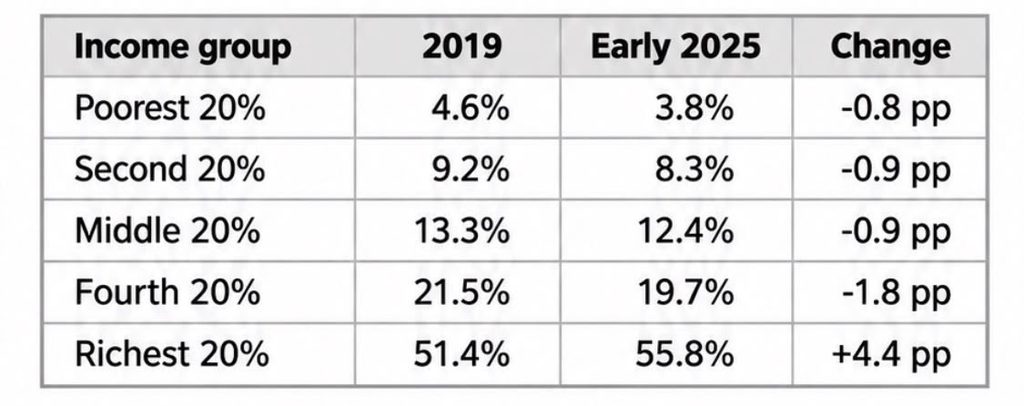
In 2019, the poorest 20% received about 4.6% of household income. By early 2025, this had fallen to about 3.8% and all other segments also saw a reduction except the richest 20%, who moved in the opposite direction. Their share increased from 51.4% to about 55.8%.
This is not simply a case where everyone became poorer and poorer households suffered more. Real incomes at the top increased while real incomes at the bottom fell.
Several factors help explain this:
Inflation was one of the most important. Sri Lanka experienced an extraordinary increase in prices during the crisis. Food prices more than doubled between 2021 and 2024. Real wages have still not fully returned to their 2019 levels. Inflation does not affect everyone in the same way: a household dependent on a salary and cash savings has limited protection.
A household that owns land, property, businesses, stocks or other assets has more protection. The nominal value of those assets have largely risen with prices, creating the conditions for an upward shift in wealth as well as income.
We do not have recent household balance-sheet data that allow us to calculate the distribution of wealth in the same way that we can calculate the distribution of income. We therefore cannot say precisely how much wealth has moved towards the top.
But there is evidence of serious damage to household balance sheets.
The Department of Census and Statistics found that 60.5% of households experienced a fall in real monthly incomes during the crisis. At the same time, 91.1% experienced higher monthly expenditure.
Debt became part of the adjustment. By 2023, 54.9% of households were in debt. Around 22% of all households had taken on debt because of the economic crisis. This matters because households did not experience the crisis only through lower consumption. Many exhausted savings, sold assets, pawned jewellery or borrowed to maintain basic expenditure. Those decisions weaken household wealth even as inflation falls.
Tax policy added further pressure. Sri Lanka increased VAT from 15% to 18% and removed a number of exemptions in January 2024. The World Bank estimates that these changes increased poverty by around 2.2 percentage points and inequality by around 0.2 Gini points.
VAT represented around 5.3% of pre-fiscal income for the poorest 10% of households in 2024, compared with 4.7% in 2019 as per the World Bank. Indirect taxes matter because poorer and middle-income households spend a larger share of their income on consumption.
Sri Lanka therefore relied heavily on households to carry the adjustment. They faced higher indirect taxes, higher administered prices and a major fall in purchasing power.
Continuing the structure
Budget 2027 does nothing to substantially change this structure. There is no wealth tax or major new tax on high-value property. The tax system continues to rely heavily on consumption taxes. There is also no clear programme to bring more professional income, self-employed high earners, property income and other income outside the salaried tax system, into the tax net.
Direct taxation is already much more progressive than VAT. IPS estimates that the richest 10% account for around 95% of PAYE and personal income tax. But collection remains weak. IPS estimated PIT liabilities of around Rs. 131 billion in 2023, while only around Rs. 43 billion appears to have been collected.
There is therefore room to improve direct tax collection without relying as heavily on consumption.
The Budget does provide some middle-class tax relief: The monthly personal income tax threshold rises from Rs. 150,000 to Rs. 162,500. But households continue to face high food, electricity, transport, housing and borrowing costs. The proposed reduction in the 18% VAT rate will also take place gradually over two to three years rather than immediately.
Unfortunately. Household debt receives relatively little attention. Microfinance regulation is useful but household debt extends well beyond microfinance. Families also rely on pawning, credit cards, consumer loans and informal credit. Lower-income households need access to cheaper regulated finance as well as protection against predatory lending, so-called “gini poli” schemes.
Housing presents a similar problem with rising land and property values benefiting existing owners. They make entry into the property market harder for younger and middle-income households.
Yet Budget 2027 contains no major first-home programme. There is no large mortgage guarantee programme, deposit support scheme or long-term low-cost housing finance programme. There is also no comparable affordable urban housing programme despite substantial public spending on infrastructure.
Social assistance and allowances amount to around 0.6% of GDP according to the Budget figures. Education spending also remains low, with the central Education Ministry allocation at around 0.8% of GDP.
Recovery stories
Sri Lanka therefore has two different recovery stories, exhibiting the now well documented K-shaped recovery phenomenon. The macroeconomic recovery is real; Output has recovered; Inflation has fallen; Government finances have improved but the household recovery is much weaker.
The World Bank estimates that in 2026 around two-fifths of Sri Lankans were either poor or living close to the poverty line. Poverty remains above its 2019 level. Real income recovery also stalled during the first half of 2026.
The distribution of income since 2019 makes the problem clearer.
The poorest 20% lost almost one-fifth of their real household income. The richest 20% gained almost 7%. The richest fifth increased its share of household income from about 51% to about 56%.
That is strong evidence for an upward redistribution of income while an upward redistribution of wealth is also extremely likely. Asset-price inflation protected existing asset owners while many other households lost savings, accumulated debt and sold assets.
Budget 2027 does little to directly reverse these trends. There is limited immediate reduction in household costs. There is no major wealth or high-value property tax. There is no large first-home programme. Household debt remains largely unresolved. Social assistance remains small. The reduction in VAT is delayed.
The Budget instead depends heavily on investment and future economic growth eventually raising household incomes. While Growth remains critical to debt sustainability, the experience since 2019 shows that growth and economic stabilisation do not determine how income is distributed and cannot adjust for such large imbalances across disparate income deciles.
Beyond macroeconomic stability, the real test is whether rising national income also translates to rising household incomes, and whether households that carried much of the cost of the crisis might also participate in the recovery and sustain their stake in Sri Lanka’s stability miracle.
(The writer is a political commentator, media presenter, and foreign affairs analyst. He serves as Advisor on Political Economy to the Leader of the Opposition of Sri Lanka and is a member of the Working Committee of the Samagi Jana Balawegaya (SJB). A former banker, he spent 11 years in the industry in Colombo and Dubai, including nine years in corporate finance, working with some of Sri Lanka’s largest corporates on project finance, trade facilities, and working capital. He holds a Master’s in International Relations from the University of Colombo and a Bachelor’s in Accounting and Finance from the University of Kent (UK). The writer can be contacted via Email [email protected] and Twitter: @kusumw)
Disclaimer: The views and opinions expressed in this article are those of the writer and do not necessarily reflect the official position of this publication.





Leave a comment