
By The Pulseline News Desk
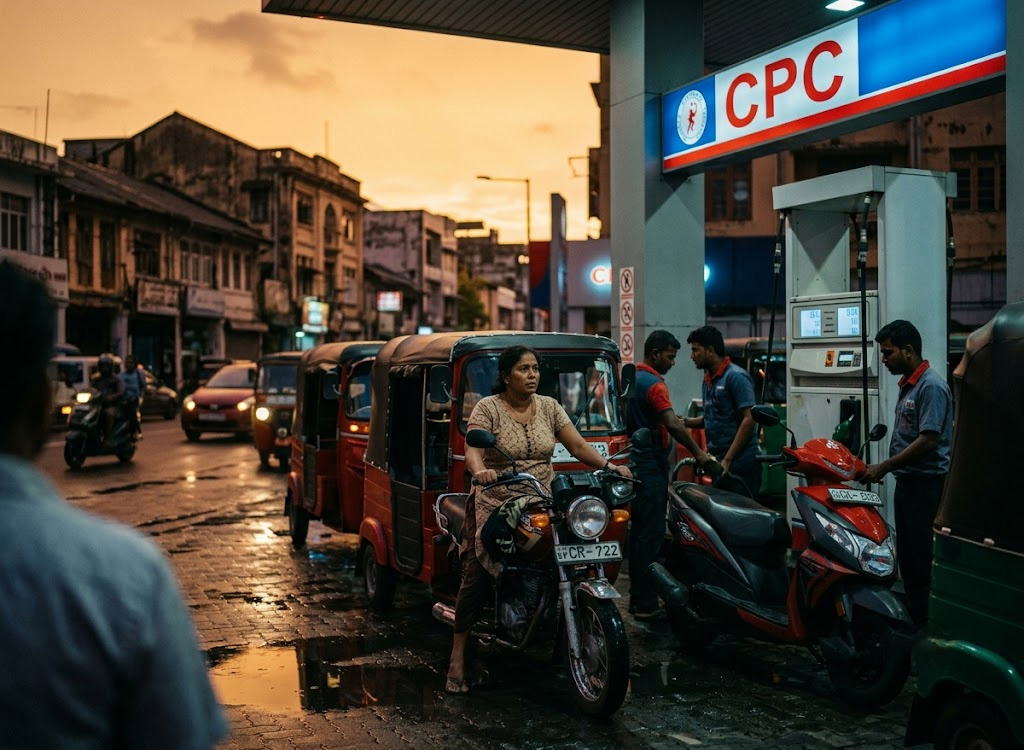
The government is considering reintroducing fuel subsidies for petrol and diesel as escalating tensions in the Middle East once again drive up global crude oil prices, raising concerns over the impact on Sri Lanka’s fragile economic recovery and the cost of living.
Senior government officials say discussions are underway on restoring the subsidy scheme that was discontinued in June, with the objective of shielding consumers from another round of fuel price increases if international oil prices continue their upward trajectory.
The proposal comes as crude oil prices have climbed by more than 14 percent over the past week amid renewed instability in the Gulf region, reigniting fears of supply disruptions through one of the world’s most strategically important energy corridors.
“We want to make a request to the President to reintroduce the subsidy because further increases in petrol and diesel prices will place a heavy burden on the public,” a senior government official has told the media.
If approved, the move would allow domestic fuel prices to remain unchanged while the government absorbs part of the increase in import costs.
Middle East tensions rattle energy markets
Global oil markets have once again become highly volatile as conflict in the Middle East intensifies, prompting traders to price in the risk of disruptions to oil production and shipping routes.
The Gulf region accounts for a significant share of the world’s crude oil exports, and any escalation involving major producers or threats to maritime routes such as the Strait of Hormuz immediately affects international energy markets.
Although oil supply has not yet been significantly disrupted, heightened geopolitical uncertainty has been enough to push benchmark crude prices sharply higher over the past several days.
For countries such as Sri Lanka, which rely almost entirely on imported petroleum, sustained increases in global oil prices translate directly into higher import bills, greater pressure on foreign exchange reserves and the prospect of increased fuel prices.
Government seeks to cushion consumers
Sri Lanka introduced a temporary fuel subsidy in April when oil prices spiked following earlier tensions in the Middle East.
Under that programme, the government subsidised diesel by Rs. 100 per litre and petrol by Rs. 20 per litre, allocating approximately Rs. 57 billion to keep retail fuel prices lower than they otherwise would have been.
The subsidy was withdrawn in June after international oil markets showed signs of stabilising.
However, officials now say the latest surge in prices has prompted a fresh review.
“We are making every effort to maintain fuel prices at their present levels during the next revision,” the official has noted.
“However, if international prices continue to rise significantly, an increase may become unavoidable.”
Officials believe that reinstating the subsidy, even temporarily, would help reduce the impact on transport costs, food prices and other essential goods, all of which are closely linked to fuel prices.
Inflation concerns
The timing of the latest increase in global oil prices presents a fresh challenge for Sri Lanka, which has only recently begun emerging from its worst economic crisis in decades.
After experiencing record inflation in 2022 and 2023, the country has seen a gradual stabilisation in prices as economic reforms, debt restructuring and tighter monetary policies took effect.
A sharp increase in fuel prices could reverse some of those gains by increasing transportation costs across the economy and placing renewed pressure on household budgets.
Economists note that fuel prices have a cascading effect, influencing everything from electricity generation and public transport to agricultural production and consumer goods.
The government therefore faces the difficult task of balancing fiscal discipline with protecting consumers from another inflationary shock.
Russian suppliers enter Sri Lankan market
In a development that officials hope will strengthen competition in fuel procurement, two Russian state-linked companies have now registered with the Ceylon Petroleum Corporation (CPC) to supply crude oil and refined petroleum products.
Officials believe the entry of additional suppliers could diversify Sri Lanka’s procurement options and improve price competitiveness at a time when global markets remain volatile.
“With the entry of the Russian companies into the market, competition will increase, and that should help stabilise prices in the longer term,” the official has further noted to the media.
Sri Lanka has been seeking to broaden its pool of international fuel suppliers since the economic crisis exposed vulnerabilities associated with relying on a limited number of trading partners.
Difficult choices ahead
Whether fuel prices remain unchanged in the coming weeks will largely depend on developments far beyond Sri Lanka’s shores.
If tensions in the Middle East continue to escalate and global crude prices remain elevated, policymakers may be forced to choose between absorbing billions of rupees in additional subsidy costs or allowing domestic fuel prices to rise.
Either option carries significant economic consequences.
For a country still recovering from a severe financial crisis, the latest surge in global oil prices serves as another reminder of how geopolitical events thousands of kilometres away can have immediate consequences for households, businesses and the wider economy.












Leave a comment