
By The Pulseline News Desk
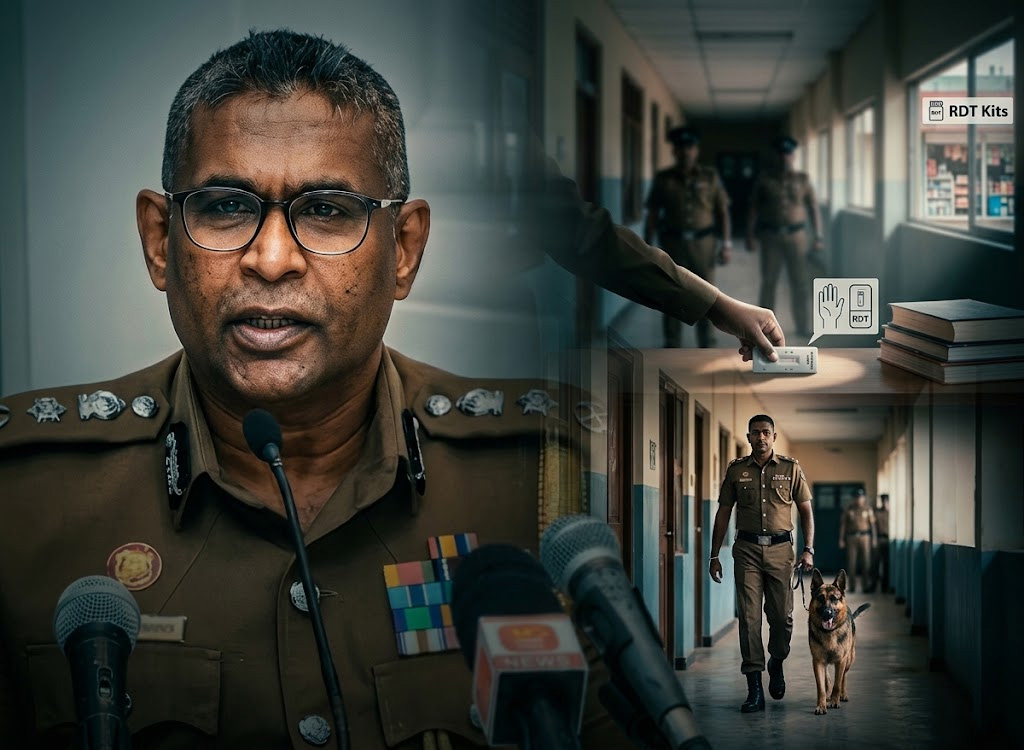
Sri Lanka’s intensified campaign against narcotics is set to move deeper into the country’s schools, with police preparing to conduct drug searches and urging school authorities to seek police assistance, including sniffer dogs and specialised officers, to prevent the spread of drugs among children.
Inspector General of Police (IGP) Priyantha Weerasuriya has called on principals, teachers and parents to remain particularly vigilant about changes in the behaviour and activities of schoolchildren, as authorities step up efforts to identify and disrupt drug use at an early stage.
The IGP has said schools could request police support where necessary, including the deployment of officers and trained sniffer dogs to conduct searches for narcotics.
The move comes as the Government considers expanding access to rapid drug-testing kits that could allow drug use to be detected at an early stage.
According to the IGP, a proposal has been submitted to the national committee chaired by President Anura Kumara Dissanayake to make rapid drug-testing kits more readily available to the public.
The longer-term proposal is to make such kits available through local retail outlets, potentially allowing families to obtain testing facilities without having to rely exclusively on formal medical or law-enforcement channels.
The issue was previously discussed at the ‘Ratama Ekata’ National Operations Council on Eradicating the Drug Menace, chaired by President Dissanayake at the Presidential Secretariat.
The Government had said it was considering introducing testing kits to the local market that would enable parents to privately check whether their children had used narcotics.
Police warned over links to drug trade
While the campaign expands into schools and communities, the police hierarchy has also issued a warning from within the force itself.
The IGP has said police officers involved in criminal activities, narcotics use or collusion with drug traffickers would have no place in the Sri Lanka Police.
A zero-tolerance approach would be adopted against personnel involved in the illicit drug trade or other criminal activities, he said, stressing that discipline and integrity within the police force were essential to the success of the national campaign.
The warning comes as police operations against narcotics networks have intensified across the country.
The IGP has said the recent increase in drug-related arrests should not necessarily be interpreted as an indication that narcotics activity had suddenly increased. Instead, he has attributed the rise largely to intensified police operations and growing public confidence in law enforcement.
According to Weerasuriya, members of the public are increasingly providing reliable information about drug activity, enabling police to deploy experienced officers and conduct targeted raids.
He has acknowledged that a substantial quantity of narcotics continued to circulate in the country, but maintained that the increase in arrests and seizures demonstrated that the enhanced operational strategy was producing results.
Targeting overseas traffickers and prison networks
Police are also pursuing major drug traffickers believed to be operating from overseas.
The IGP has said steps were being taken to apprehend such individuals, although he declined to reveal operational details that could jeopardise ongoing investigations.
Authorities are also focusing on criminal networks allegedly being coordinated by inmates from inside prisons.
The development highlights the increasingly complex nature of Sri Lanka’s narcotics problem, with law enforcement required to address not only street-level distribution but also organised networks operating across borders and from within the prison system.
Manpower shortage and major recruitment drive
The police are simultaneously attempting to strengthen their capacity to deal with the expanding workload.
The IGP has said technology would increasingly be used to compensate for existing manpower shortages, while a major recruitment programme is also being implemented.
The Sri Lanka Police plans to recruit up to 10,000 new personnel to strengthen the force.
Nearly 1,500 recruits are currently undergoing training, while another 1,500 are expected to be recruited this year. A further 7,000 recruits are planned over the coming years.
The recruitment drive is expected to provide additional manpower for operations ranging from narcotics enforcement to maintaining law and order.
Five committees to drive anti-drug campaign
The nationwide campaign is also being reorganised through a new mechanism established on the President’s direction, comprising five specialised committees tasked with tackling both the supply and demand sides of the narcotics problem.
The IGP, who chairs the main operational committee, has said the initiative had received unprecedented cooperation from various Government institutions.
However, he has stressed that law enforcement alone would not be sufficient to eradicate the drug menace.
Public participation, he has said, remained essential.
That message is particularly significant as the Government turns its attention towards schools and families, where early detection and intervention could become a key component of the national strategy.
The Government’s approach is therefore evolving beyond traditional raids and arrests, combining law enforcement operations with school-level searches, public reporting, drug-testing initiatives, institutional coordination and efforts to dismantle organised trafficking networks.
For parents and teachers, the emerging message from the authorities is clear: the fight against drugs is increasingly being pushed into the community, and vigilance at home and in schools is expected to become an important first line of defence.












Leave a comment