
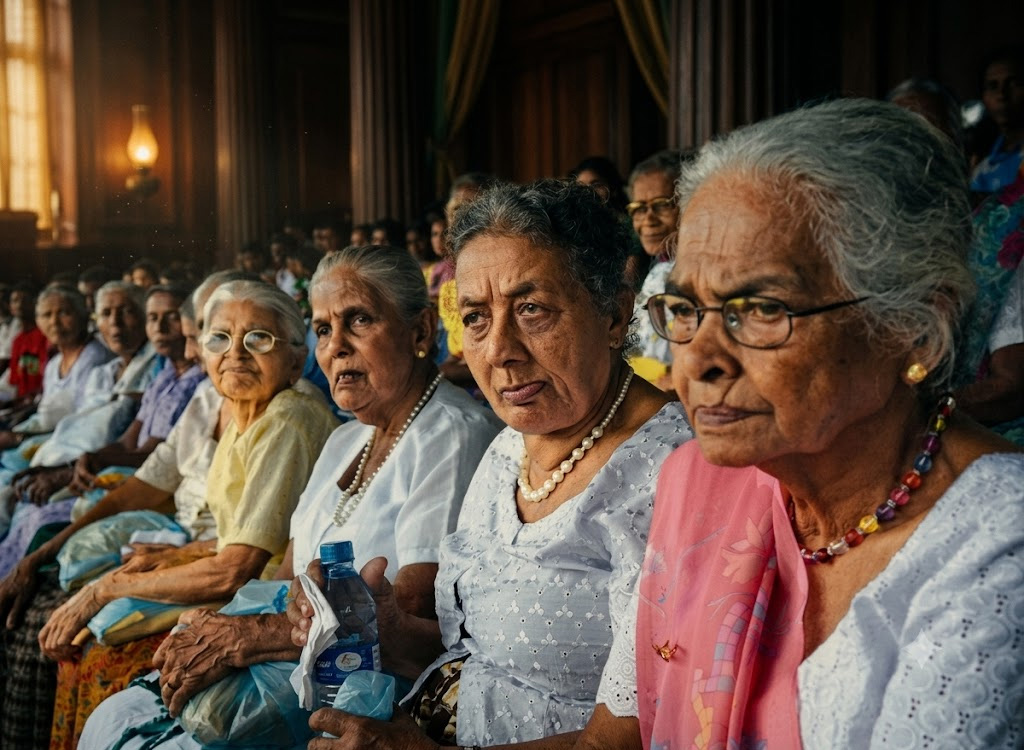
Majority of the country’s elders’ homes remain unregistered despite long-standing legal requirement
By The Pulseline News Desk
Sri Lanka’s rapidly ageing population is placing increasing pressure on the country’s elder care system, but a recent audit has revealed that a large number of residential facilities caring for senior citizens remain outside the formal regulatory framework designed to protect them.
According to a report by the National Audit Office (NAO), only 136 of the 456 elders’ homes operating across the country have been registered with the National Secretariat for Elders, despite a legal requirement that has been in place for more than 12 years. The findings have raised concerns about oversight, standards of care, and the welfare of thousands of elderly residents living in institutional settings.
The audit paints a troubling picture. Nearly 70 percent of elders’ homes continue to operate without formal registration, even though regulations require any facility accommodating more than five elderly persons to register with authorities. Registration is intended to ensure compliance with standards covering accommodation, healthcare, nutrition, sanitation, staffing, and the overall wellbeing of residents.
For social welfare advocates, the findings highlight a longstanding weakness in the country’s elder care system.
“Registration is more than a bureaucratic requirement,” a social policy expert noted. “It is the primary mechanism through which authorities can inspect facilities, monitor standards, and intervene when problems arise.”
Without registration, institutions may operate with minimal oversight, making it more difficult to identify inadequate living conditions, neglect, staffing shortages, or other risks faced by elderly residents.
A growing demand for care
The issue comes at a critical moment as the country is experiencing one of the fastest demographic transitions in South Asia, with the proportion of citizens aged 60 and above steadily increasing over the past two decades.
Longer life expectancy, declining birth rates, urbanisation, and labour migration have transformed traditional family structures that once provided care for older relatives. As more families become geographically dispersed and household sizes shrink, institutional care has emerged as an increasingly important option for elderly persons requiring long-term support.
The National Secretariat for Elders, established under the Protection of the Rights of Elders Act, is responsible for safeguarding the rights, welfare, and dignity of older persons. Among its key responsibilities is the regulation and monitoring of residential care facilities.
However, the NAO report suggests that implementation and enforcement efforts have struggled to keep pace with the sector’s growth.
Regulatory delays and constitutional challenges
Government efforts to strengthen regulation have also encountered legal and administrative hurdles.
Minister Upali Pannilage recently acknowledged that plans to introduce stronger regulations for elders’ homes have been delayed because social services fall under the jurisdiction of Provincial Councils under the 13th Amendment to the Constitution.
As a result, the central government cannot unilaterally introduce new regulatory measures without obtaining provincial consent.
According to the Minister, discussions are currently underway with Provincial Councils to secure the necessary approvals and expedite the regulatory process. He also disclosed that a new bill aimed at strengthening elderly welfare has already received Cabinet approval and has been forwarded to the Legal Draftsman’s Department for further action.
The delays have drawn attention to a broader governance challenge: how to ensure consistent standards of care across the country while balancing the constitutional division of powers between the central government and provincial administrations.
Concerns beyond registration
Authorities are also attempting to identify and register unregistered elders’ homes operating around the country. During these efforts, officials have reportedly uncovered institutions functioning with inadequate infrastructure and insufficient staffing levels.
Such findings have intensified concerns about the vulnerability of elderly residents, many of whom depend entirely on care providers for their daily needs, medical attention, and social support.
While official figures indicate that approximately 455 registered elders’ homes currently accommodate around 10,000 residents nationwide, the existence of numerous unregistered facilities means the true scale of institutional elder care may be significantly larger.
Experts warn that without comprehensive registration and effective monitoring, authorities cannot accurately assess conditions within the sector or ensure that minimum standards are being maintained.
A test for an ageing nation
The audit findings serve as a reminder that Sri Lanka’s ageing population presents not only a social challenge but also a policy challenge.
As demand for residential elder care continues to rise, the effectiveness of the country’s regulatory framework will play a crucial role in determining whether older citizens can live with dignity, security, and adequate support.
The NAO report is expected to increase pressure on policymakers to accelerate reforms, strengthen enforcement mechanisms, and ensure that all elders’ homes are brought under proper supervision.
For thousands of elderly Sri Lankans living away from their families, the issue is ultimately about more than registration certificates and regulatory compliance. It is about ensuring that some of the country’s most vulnerable citizens receive the care, protection, and respect they deserve in the later years of their lives.
This version is written in a newspaper feature style, combining news reporting, policy analysis, demographic context, and human-interest implications.













Leave a comment