
By The Pulseline News Desk
Sri Lanka’s foreign debt burden is measured not only by how much the country owes, but increasingly by the value of its own currency.
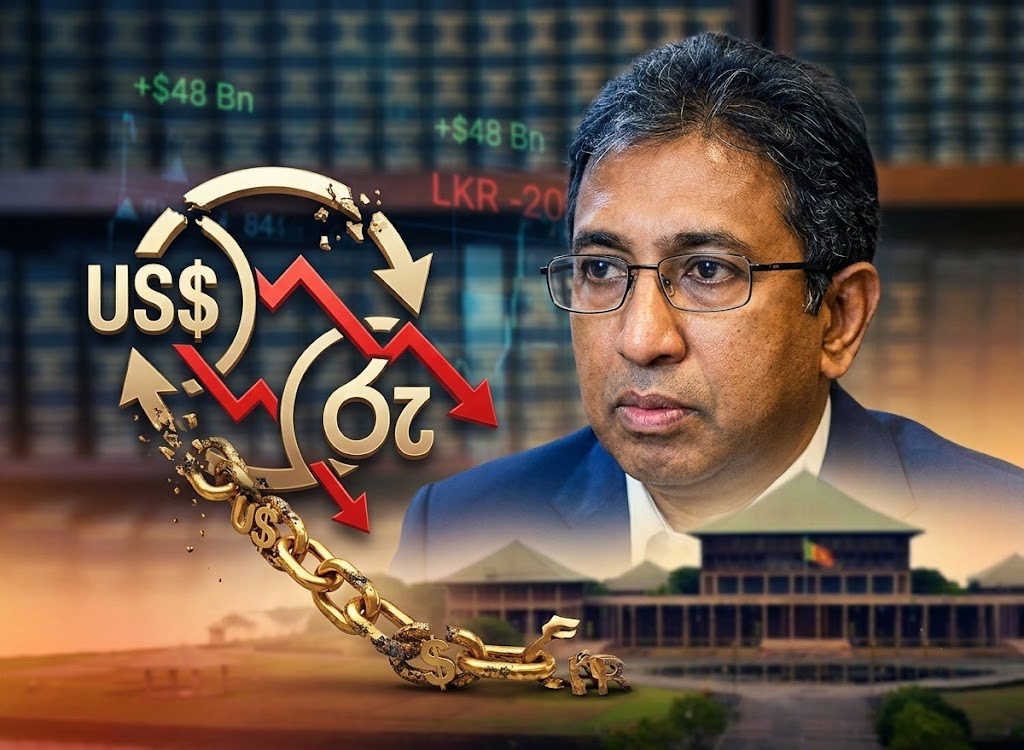
That reality was underscored recently at the Committee on Public Finance (COPF), where Finance Ministry officials had revealed that the depreciation of the Sri Lankan rupee against the US dollar added approximately Rs. 48 billion to the Government’s foreign debt servicing bill in 2025.
The disclosure, made during a parliamentary oversight hearing, illustrates how exchange rate movements continue to shape Sri Lanka’s public finances even after the completion of its sovereign debt restructuring.
Responding to questions from COPF Chairman Harsha de Silva, officials from the Ministry’s Public Debt Management Office had explained that Sri Lanka had serviced around $2.4 billion in external debt during the year. With the rupee weakening by roughly Rs. 20 against the dollar over the same period, the Government had incurred an additional Rs. 48 billion simply because more rupees were required to purchase the foreign currency needed for repayments.
The calculation is straightforward. The fiscal implications are not.
The exchange rate matters
For countries with significant foreign currency debt, exchange rate fluctuations directly affect the cost of repayment in local currency.
Even when the amount owed in dollars remains unchanged, a weaker domestic currency means governments must raise more local revenue to purchase the same amount of foreign exchange.
In Sri Lanka’s case, that additional Rs. 48 billion represents money that could otherwise have been directed towards public services, infrastructure or social welfare programmes.
The disclosure is a reminder that debt sustainability is influenced not only by borrowing levels and interest rates but also by currency stability.
Beyond debt restructuring
Sri Lanka emerged from one of the largest sovereign debt restructurings in its history after defaulting on external debt in 2022.
While agreements reached with bilateral and commercial creditors have eased repayment pressures and extended maturities, the country remains exposed to movements in global financial markets and the value of the rupee.
The latest figures suggest that even under a restructured debt framework, exchange rate volatility can substantially alter the Government’s financing requirements.
For policymakers, this reinforces the importance of maintaining macroeconomic stability, rebuilding foreign exchange reserves and sustaining confidence in the currency.
Questions over higher payments
The parliamentary hearing also raised another issue that may receive closer scrutiny.
De Silva had questioned Finance Ministry officials about reports that Sri Lanka had paid an additional $600 million in foreign debt servicing during 2025.
While officials had provided an oral explanation before the Committee, the response did not satisfy the Committee Chairman, who had directed the Ministry to submit a comprehensive written report detailing the circumstances behind the additional payments.
That request signals Parliament’s intention to subject the Government’s debt management strategy to closer oversight, particularly as Sri Lanka transitions from crisis management to longer-term fiscal consolidation.
Transparency under the spotlight
The COPF has increasingly positioned itself as one of Parliament’s key oversight mechanisms, regularly summoning Treasury and Finance Ministry officials to explain fiscal decisions, borrowing strategies and public expenditure.
The latest hearing reflects growing recognition that debt management is no longer confined to technical discussions within the Treasury. With public debt continuing to shape taxation, government spending and economic policy, Parliament is seeking greater transparency over how borrowing decisions – and external economic factors such as exchange rate movements – affect the national budget.
The request for a detailed report on the additional $600 million in debt payments also highlights a broader expectation that debt servicing decisions should be fully accounted for, particularly after the extensive restructuring process that followed the country’s sovereign default.
Continuing vulnerability
Although Sri Lanka’s foreign reserves have improved since the height of the economic crisis and the exchange rate has stabilised relative to the sharp depreciation experienced in 2022, the country’s debt profile remains heavily exposed to foreign currency risk.
As long as a significant share of public debt is denominated in dollars and other foreign currencies, fluctuations in the rupee will continue to influence the Government’s finances.
The Rs. 48 billion disclosed before COPF is therefore more than an accounting adjustment. It is a reminder that restoring debt sustainability requires more than restructuring loans. It also depends on maintaining a stable currency, strengthening export earnings, attracting foreign investment and ensuring sufficient foreign exchange inflows to meet future obligations without placing additional pressure on public finances.
For Sri Lanka, the debt crisis may have entered a new phase. But as Parliament’s latest inquiry demonstrates, the cost of servicing that debt remains closely tied to the fortunes of the rupee.













Leave a comment