
By The Pulseline News Desk
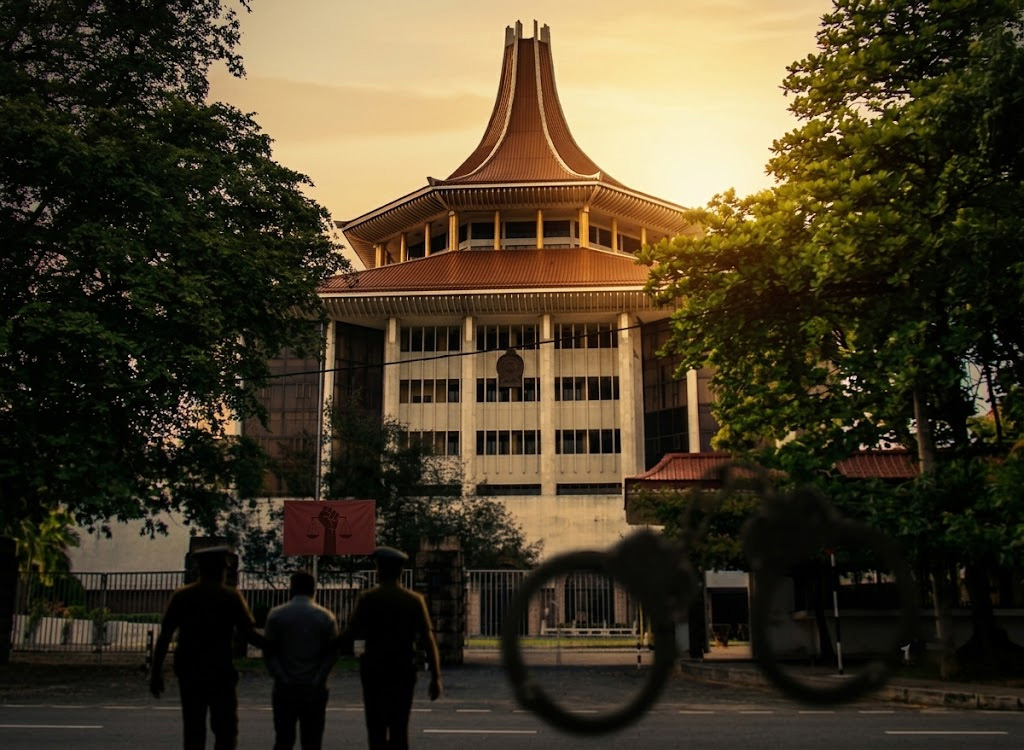
Nearly four years after the mass protests that transformed Sri Lanka’s political landscape, the Supreme Court has delivered one of its clearest judicial statements on the limits of police power during the Aragalaya, ruling that the arrest of a social activist over his support for the “GoHomeGota 2022” campaign violated the Constitution.
The judgment, delivered on July 23 by a three-judge bench, held that the 2022 arrest of Muthuheen Gedara Thisara Nuwantha Anuruddha Bandara was unconstitutional, finding that the Police lacked objectively reasonable grounds to deprive him of his liberty. The Court declared that his Fundamental Rights under Articles 12(1), guaranteeing equality before the law, and 13(1), protecting against arbitrary arrest, had been infringed by then Senior Deputy Inspector General (SDIG) Deshabandu Tennakoon and another police officer.
Although the ruling concerns a single arrest, its implications extend well beyond one petitioner. It provides important judicial guidance on how the State may respond to political dissent, the evidentiary threshold required for arrests under national security provisions, and the constitutional protections afforded to peaceful criticism of the government.
Judgment rooted in constitutional principles
At the centre of the case was the Police decision to arrest Bandara under Section 120 of the Penal Code, a provision dealing with attempts to excite disaffection against the State.
Police argued that intelligence information suggested certain individuals were attempting to overthrow the government during the volatile period leading up to the nationwide protests that culminated in President Gotabaya Rajapaksa’s resignation.
The Supreme Court, however, found the evidentiary foundation for the arrest to be deeply flawed.
According to the judgment, the intelligence report relied upon by investigators did not identify the petitioner by name. Instead, the Police sought to rely on a separate annexure that included his name. The Court found that annexure to be undated, unsigned and unsupported by any explanation as to who prepared it or when it became part of the intelligence file.
Those deficiencies, the judges held, undermined the credibility of the material on which the arrest was based.
In constitutional law, suspicion alone is insufficient. The Court reaffirmed that police officers must possess objectively reasonable grounds before exercising the extraordinary power to arrest a citizen.
Protest is not a crime
Perhaps the most significant aspect of the judgment lies in the Court’s interpretation of Section 120 itself.
The provision has historically attracted criticism because of its potential use against political opponents and dissenters. However, the section also contains an important qualification: criticism intended to expose governmental mistakes or advocate lawful reform does not constitute an offence.
The Court found that Bandara’s social media activity and participation in the “GoHomeGota 2022” campaign fell squarely within the realm of protected political expression.
The judges concluded that the petitioner’s conduct amounted to criticism of the government rather than criminal incitement, drawing a clear distinction between peaceful political advocacy and actions that threaten public order or constitutional government.
The ruling reinforces a fundamental democratic principle – that criticism of those in power, even when forceful or unpopular, enjoys constitutional protection unless it crosses the threshold into unlawful conduct.
Intelligence cannot replace evidence
The judgment also delivers a broader message about the limits of intelligence-led policing.
Throughout the economic crisis, security agencies increasingly relied on intelligence assessments to monitor protest movements amid fears of escalating unrest. While intelligence may justify closer investigation, the Court made clear that it cannot substitute for evidence when constitutional rights are at stake.
The judges noted that the Police failed to produce material linking the petitioner to acts of violence during the March 2022 protests, despite attempting to justify the arrest on that basis.
Indeed, the Magistrate subsequently discharged Bandara after finding no evidence connecting him to any criminal offence.
That sequence of events strengthened the Court’s conclusion that the arrest lacked a lawful foundation from the outset.
Due process matters
The Supreme Court was equally critical of the manner in which the petitioner was treated following his arrest.
The judgment records that Bandara was moved between multiple police stations, returned to his residence for further searches, and produced before a Magistrate only nearly 24 hours after being taken into custody.
Although the Court stopped short of finding separate violations arising from each procedural step, it observed that the circumstances raised serious concerns regarding compliance with constitutional safeguards designed to prevent arbitrary detention.
The judges also highlighted another procedural defect.
Because prosecutions under Chapter VI of the Penal Code require the sanction of the Attorney General, the absence of evidence demonstrating such approval further weakened the legal basis of the proceedings.
Landmark in the Aragalaya’s legal legacy
The Aragalaya produced hundreds of arrests, investigations and prosecutions as authorities sought to contain escalating demonstrations during Sri Lanka’s worst economic crisis.
In the years since, many of those actions have come under judicial scrutiny through Fundamental Rights applications challenging the legality of police conduct.
This latest judgment adds to a growing body of Supreme Court jurisprudence emphasising that constitutional protections do not disappear during periods of political instability or public protest.
The Court’s decision is particularly notable because it rejects the notion that participation in a movement demanding political change can, without more, justify criminal prosecution.
Instead, it reaffirms that the State bears the burden of demonstrating lawful grounds for restricting liberty, supported by credible evidence rather than broad allegations or questionable intelligence material.
Rights vindicated, but questions remain
While the Supreme Court declared that Bandara’s Fundamental Rights had been violated, it declined to award compensation or legal costs, citing the special circumstances of the case.
That aspect of the judgment may disappoint some rights advocates, who often regard compensation as an essential mechanism for ensuring official accountability.
Nevertheless, the legal significance of the ruling lies less in the remedy than in the principles it establishes.
For future protest movements – and for the law enforcement agencies tasked with policing them – the judgment sends a clear constitutional message. Political dissent is not, by itself, a criminal offence. Intelligence cannot replace evidence. And even during moments of national crisis, the powers of arrest remain subject to the discipline of the Constitution.
As Sri Lanka continues to confront the legal legacy of the 2022 protests, the Supreme Court has once again affirmed that the rule of law is measured not by how the State treats its supporters, but by how it respects the rights of its critics.












Leave a comment