
By The Pulseline News Desk
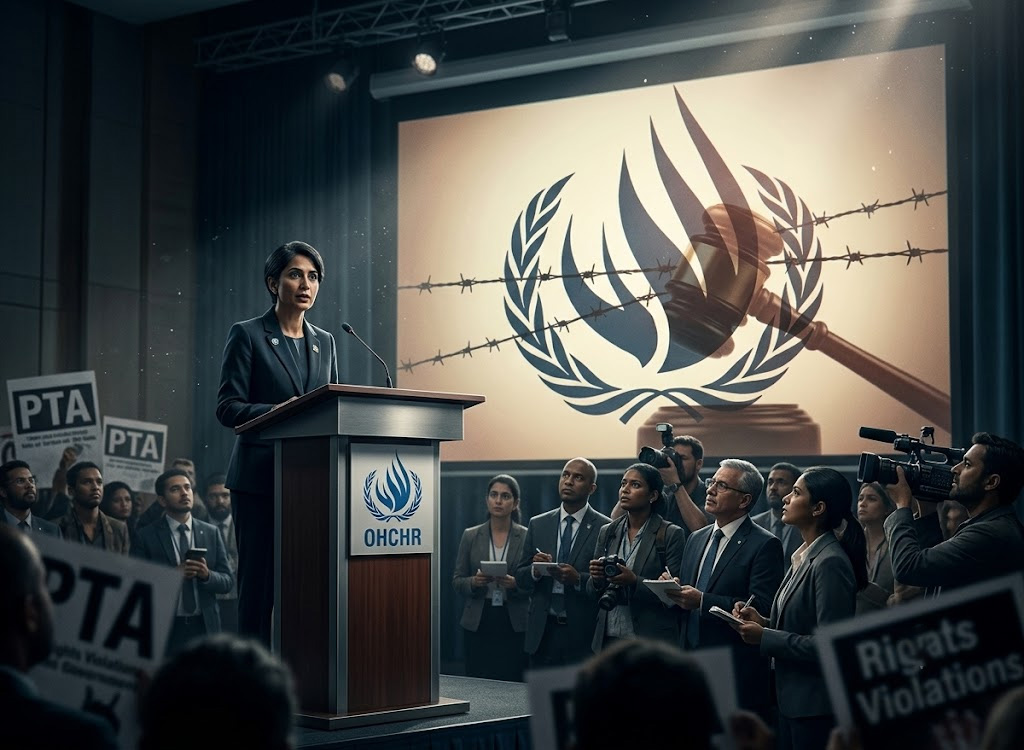
The United Nations (UN) Office of the High Commissioner for Human Rights (OHCHR) has cautioned that Sri Lanka’s proposed counter-terrorism law continues to reflect many of the structural weaknesses of the controversial Prevention of Terrorism Act (PTA), despite government efforts to replace it with new legislation.
In detailed observations submitted to the Government, the OHCHR has said the draft Protection of the State from Terrorism Act (PSTA) contains overly broad and vague provisions that could lead to over-criminalisation and further restrict civic space.
The UN rights body has warned that expansive definitions of terrorism and prohibited conduct risk capturing a wide range of activities, potentially undermining fundamental freedoms including expression, assembly, association, and media freedom. It has said such provisions could contribute to an increasingly constrained civic environment.
The OHCHR has also raised concerns over sweeping executive powers with limited oversight, arbitrary arrest, and prolonged detention without effective judicial review. It has cautioned that these gaps could expose individuals to torture, ill-treatment, and enforced disappearance, while falling short of international standards on due process and fair trial rights.
While acknowledging the Government’s intention to replace the PTA with a more rights-compliant framework, the OHCHR has said the current draft still requires “substantive redrafting” to meet international principles of legality, necessity, and proportionality.
It has noted some improvements in the latest version of the bill, including the removal of provisions allowing confessions made to police officers in custody to be used as evidence. However, it has said these changes do not adequately address broader concerns.
A central issue highlighted by the OHCHR is the bill’s definition of terrorism. It has said the proposed wording relies on ambiguous criteria that go beyond internationally accepted standards, including those outlined in UN Security Council Resolution 1566 (2004) and guidance from UN human rights mechanisms. The OHCHR has stressed that terrorism should be narrowly defined to include intentional violent acts resulting in death, serious injury, or hostage-taking, committed with the intent to intimidate a population or compel state action.
Instead, it has said the draft expands the scope of the offence in ways that risk criminalising legitimate activity and replicating the rights violations seen under the PTA, including arbitrary detention and enforced disappearances.
The OHCHR has urged the Government to undertake a comprehensive revision of the bill and ensure inclusive consultation with civil society and other stakeholders. It has also reiterated its call for a moratorium on the use of the PTA until a fully rights-compliant framework is in place.
While welcoming the intent to reform counter-terrorism legislation, the UN body has stressed that only a substantial overhaul of the draft would ensure compliance with Sri Lanka’s international human rights obligations and prevent a repeat of past abuses.











Leave a comment