
By The Pulseline News Desk
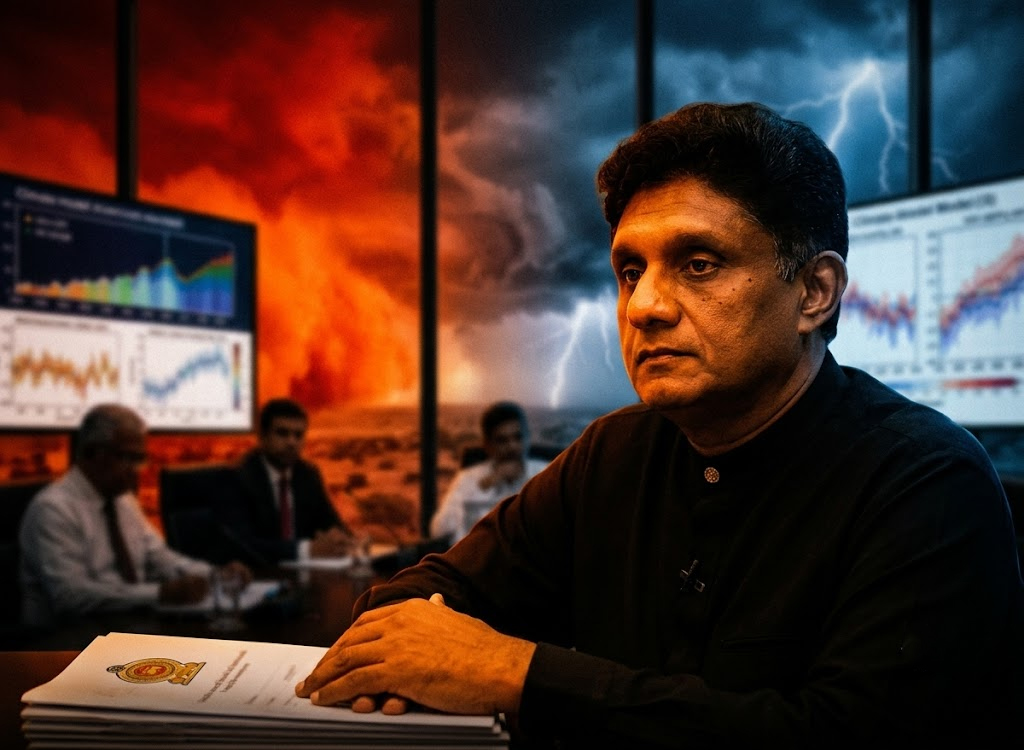
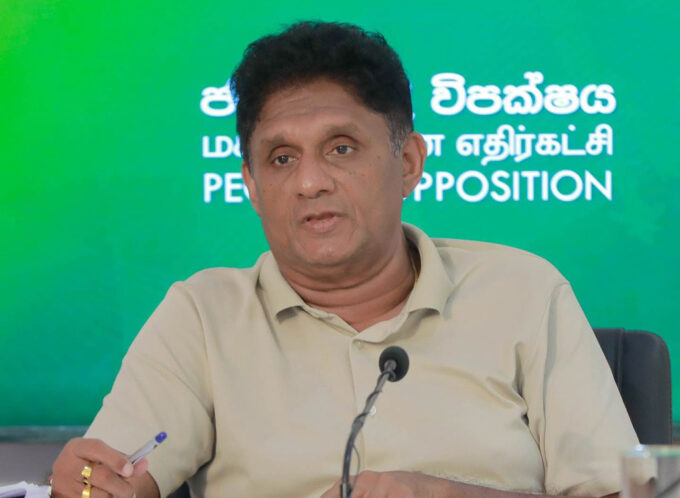
Leader of the Opposition Sajith Premadasa has urged Sri Lanka to adopt a whole-of-government, science-driven approach to climate resilience and disaster preparedness, warning that climate-related risks are increasingly becoming a matter of national security that transcends political divisions.
Addressing the National Council for Disaster Management (NCDM), chaired by President Anura Kumara Dissanayake, Premadasa highlighted the urgent need to strengthen national preparedness in anticipation of the 2026–2027 ENSO (El Niño–Southern Oscillation) cycle. His remarks were accompanied by a Strategic Policy Proposal aimed at supporting ongoing national policy discussions on climate resilience.
At the outset, Premadasa commended the President for convening the Council at a critical time, stressing that disaster preparedness is a shared national responsibility. “When the lives, livelihoods and security of our people are at stake, there should be only one side, and that is Sri Lanka,” he said.
He emphasised that his observations were intended in a spirit of national unity and constructive engagement, rather than political criticism, and were based on emerging scientific assessments and international best practices.
Citing global climate forecasts, the Opposition Leader warned that the developing 2026–2027 El Niño event could be among the most severe in recent decades, increasing the likelihood of extreme climate variability, including prolonged droughts followed by intense flooding – what climate scientists increasingly describe as “climate whiplash.”
He noted that Sri Lanka has a narrow window to strengthen preparedness before these impacts materialise, stressing the need to move away from reactive disaster response towards anticipatory governance, where forecasting, risk analysis and early action guide national decision-making.
Reflecting on recent disaster experiences, including Cyclone Ditwah, Premadasa said Sri Lanka could no longer rely primarily on post-disaster response mechanisms. Instead, he called for a structured shift towards prevention-oriented planning supported by science and data.
Outlining his key proposals, he emphasised three central priorities: embedding anticipatory governance as the foundation of disaster management; ensuring climate resilience is treated as a whole-of-government responsibility across all key sectors; and recognising that climate resilience is inseparable from economic stability, given its direct links to food security, water security, energy systems, public health and fiscal resilience.
He further identified several priority areas for national action, including integrated water and reservoir management, climate-smart agriculture, improved early warning systems using impact-based forecasting, strengthened disaster risk financing, heatwave preparedness, resilient infrastructure development, and the possible establishment of a National Climate Risk and Disaster Intelligence Centre to support evidence-based policymaking.
Premadasa also pointed to international examples, noting that countries such as India and Australia have strengthened climate forecasting systems and integrated resilience planning frameworks that Sri Lanka could study and adapt to its own context.
He stressed that climate resilience cannot be achieved by government alone, but requires coordinated action across Parliament, state institutions, provincial and local authorities, the scientific and academic community, the private sector, civil society, and development partners.
Looking ahead, he suggested the preparation of a Presidential White Paper on National Climate Resilience and Disaster Preparedness, arguing that such a framework could provide long-term strategic direction beyond individual administrations.
Concluding his remarks, Premadasa reiterated that climate change is indifferent to political boundaries. “Floods do not distinguish between political parties. Droughts affect every farmer. Heatwaves affect every family,” he said, adding that protecting citizens must remain a shared national responsibility.
He expressed confidence that climate resilience could serve as a unifying national agenda and reaffirmed his readiness to support initiatives aimed at strengthening Sri Lanka’s preparedness through science-based planning, institutional coordination and long-term strategic vision.











Leave a comment