
By Prof. Udayanga Hemapala
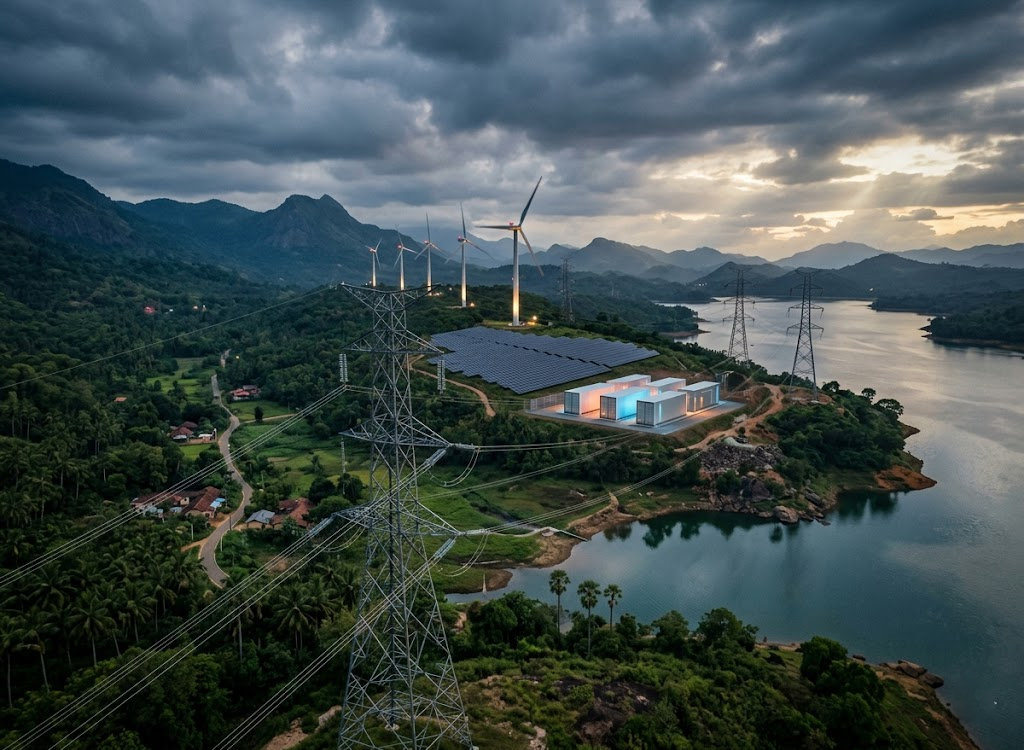
Sri Lanka’s energy transition will not be financed by government budgets alone. That much is clear from the numbers. Achieving 70 percent of electricity generation from renewable sources by 2030 — as mandated under the Sri Lanka Electricity Act, No. 36 of 2024 — requires mobilising between $ 15 billion and $ 30 billion across generation, transmission, distribution, storage and related infrastructure.
Public funding, multilateral loans and bilateral grants will contribute meaningfully. The Asian Development Bank (ADB) approved a $ 200 million loan in November 2024 for grid strengthening and renewable integration, and a further $ 30 million facility for Ceylon Electricity Board (CEB) operational sustainability in December 2024. The World Bank Group approved a $ 150 million programme in June 2025 — ‘Secure, Affordable, and Sustainable Energy for Sri Lanka’ — expected to catalyse a further $ 800 million in private investment. These are significant commitments. But they are not sufficient at the scale and pace the transition demands.
The gap between what public finance can provide and what the energy system requires must be filled by new commercial models — models that convert infrastructure assets into investable propositions, transfer construction and operational risk to private parties, and reduce the capital burden on the CEB at a time when that institution is simultaneously being restructured.
Sri Lanka’s recent legislative reforms have created the enabling architecture for these models. The Sri Lanka Electricity Act, No. 36 of 2024, and the subsequent Amendment Act, No. 14 of 2025, together unbundle the CEB into distinct corporate entities covering generation, transmission, distribution and system operations, and establish the framework for a wholesale electricity market. Full implementation commenced on 9 March 2026, when the Act’s provisions were brought into force by Extraordinary Gazette. This structural separation is not merely an administrative exercise: it is the prerequisite for attracting private capital at scale, because investors and lenders require clear counterparties, defined asset boundaries, and regulatory independence. The architecture is now in place. What is needed is its purposeful use.
The Investment Gap Is Not a Funding Problem — It Is a Model Problem
Sri Lanka’s clean energy investment reached approximately $ 843 million in 2024, up marginally from $ 824 million in 2023. Against a requirement of $ 15–30 billion over the decade to 2030, this represents a fraction of what is needed. The shortfall is not primarily a problem of investor appetite — private capital globally is actively seeking exposure to clean energy infrastructure in emerging markets. The problem is that Sri Lanka’s existing commercial frameworks do not yet make that capital feel welcome, bankable, or appropriately de-risked.
Three structural features have historically deterred private investment at scale. First, Power Purchase Agreement (PPA) terms that lenders regard as insufficiently bankable. Second, land acquisition and pre-development risks borne entirely by developers, compounding timelines that already run to several years from tender to commissioning. Third, an institutional landscape — spread across the Ministry, Public Utilities Commission of Sri Lanka (PUCSL), CEB, Sri Lanka Sustainable Energy Authority (SLSEA), and Treasury — in which no single entity has end-to-end accountability for delivery.
These are not insurmountable barriers. They are model design problems, and they have model design solutions. Countries across Latin America, South Asia and East Asia have addressed analogous barriers by creating new commercial structures that partition risk more efficiently between the public and private sectors. Sri Lanka can adapt these models to its own institutional context. The six that follow are not theoretical — each has a proven track record, and several have direct application to specific gaps in Sri Lanka’s current programme.
Six Business Models That Can Unlock Private Capital
| Business Model | What shifts to private sector | Sri Lanka relevance |
| Independent Transmission Project (ITP) | Construction, financing and operating risk for discrete transmission assets | Needed urgently for priority transmission corridors identified in the Long-Term Transmission Development Plan (LTTDP); reduces sovereign borrowing load |
| OPEX Smart Metering (AMISP model) | Meter procurement, installation, maintenance and communication network — utility pays performance fee | Enables nationwide smart grid rollout without NSO capital outlay; proven under India’s RDSS scheme |
| Firm Energy Competitive Tender | Technology choice and risk — developers compete using Solar+BESS, Wind+BESS or hybrid solutions | Shifts emphasis from energy volume to dispatchable reliability; addresses night peak directly |
| Developer-Secured Land Procurement | Site identification, land acquisition and pre-clearance risk — NSO specifies grid points only | Eliminates the single largest cause of project delay without changing NSO’s procurement authority |
| Demand Response / Virtual Power Plant | Aggregation, technology deployment and demand-reduction obligations | Defers investment in costly peaker plant; creates compensated industrial and commercial participation |
| BESS as Infrastructure Asset Class | Utility-scale, distribution-level and behind-the-meter storage; BOO structure with regulated tariff | 160 MW/640 MWh BOO tender is first application; scalable to 460+ MW announced in 2026 |
The table above is a summary map. Each model is examined in detail below, with specific relevance to Sri Lanka’s current programme gaps.
Transmission Infrastructure as an Investable Asset
Transmission infrastructure has historically been financed through one of two channels in Sri Lanka: government budgetary allocation, or concessional loans from development partners such as the ADB, World Bank, and AIIB. Both channels involve lengthy approval processes, sovereign guarantee requirements, and procurement timelines that routinely stretch across multiple years. The ADB’s $ 200 million November 2024 loan for the Power System Strengthening and Renewable Energy Integration Project — which includes new transmission lines and substations at 220kV and 132kV — is a welcome commitment, but it illustrates the dependency on sovereign-backed borrowing at a time when Sri Lanka’s fiscal space remains constrained.
The restructuring of the electricity sector under the 2024 and 2025 Acts creates a structural opening for an alternative: the Independent Transmission Project (ITP) model, under which a private company develops, finances, constructs, and operates a discrete transmission asset under a long-term licence, earning a regulated rate of return.
The ITP model is not experimental. Between 1999 and 2017, Brazil conducted 38 ITP tenders, resulting in 211 awarded projects spanning over 69,000 kilometres of transmission infrastructure. India, the United States, and the United Kingdom have all employed variants of this model. South Africa’s National Treasury launched an ITP pilot programme in late 2024 specifically to deploy off-balance-sheet private capital for 1,164 kilometres of new transmission lines.
An ITP approach converts a transmission corridor from a sovereign debt obligation into a private infrastructure investment — removing it from the government balance sheet while accelerating delivery.
For Sri Lanka, the most immediate application is the Long-Term Transmission Development Plan (LTTDP) and its priority transmission expansion project. Grid expansion is not simply a prerequisite for renewable energy integration — it is the critical path item. Without parallel investment in transmission, every new generation project faces connection delays, curtailment risk, and commercial uncertainty. Making discrete transmission corridors identified under the LTTDP available to private investors under long-term transmission licences, with regulated tariff payments from the system operator, would accelerate build-out while preserving public ownership of the network assets.
This requires one institutional prerequisite: a credible, independent regulator capable of setting and enforcing transmission tariffs predictably over the licence period.
Smart Metering Through an Operational Expenditure Model
Sri Lanka requires millions of smart meters to enable time-of-use tariffs, demand response, distributed generation management, and the broader smart grid applications that are foundational to renewable energy integration at scale. The GREAT 2025–2030 Renewable Energy Project Development Plan, identifies smart meter deployment and establishment of a Renewable Energy Control Desk as prerequisites for operational visibility over the growing rooftop solar fleet.
Purchasing smart meters through conventional capital expenditure (CAPEX) procurement — the traditional approach — requires substantial upfront cash that the EDL does not currently have. An OPEX-based deployment model offers a structurally superior alternative.
The reference case is India’s Revamped Distribution Sector Scheme (RDSS), launched in 2021, which mandates smart meter deployment through an Advanced Metering Infrastructure Service Provider (AMISP) model. Under this structure, private entities finance, supply, install, operate, and maintain the metering infrastructure over long-term service agreements of eight to 10 years. The distribution company pays a performance-based service fee rather than purchasing hardware as a capital asset. Revenue collection improvements fund the investment over the contract period.
India’s RDSS in practice: Under RDSS, 20.33 crore (203 million) smart meters have been sanctioned — with private AMISP entities bearing the upfront capital cost. AT&C losses (the gap between power supplied and revenue collected) fell from 21.9% in FY21 to 16.1% in FY24 (India Smart Grid Forum, 2025). The scheme demonstrates that OPEX deployment can rapidly scale smart metering without straining utility balance sheets.
Sri Lanka should adapt this model to its own scale and regulatory context. The EDL does not need to own every meter. It needs the data those meters provide and the billing accuracy they enable. A long-term service contract with a private AMISP — under which the private entity invests and the EDL pays a per-meter monthly service fee linked to performance — achieves both while preserving EDL capital for higher-priority system investments.
Without smart meters, time-of-use tariffs cannot be introduced for consumers above 180 units per month — a policy instrument identified in multiple national plans as one of the most cost-effective tools for reducing night peak demand. The absence of smart metering is not merely a technical gap; it is a regulatory and commercial gap that keeps a proven demand management tool out of reach.
Procuring Firm Energy, Not Just Megawatts
The conventional procurement model in Sri Lanka’s electricity sector — and across most emerging markets — procures electricity based on installed generation capacity. A project developer builds a specific technology (a solar farm, a wind park) and sells the output at a fixed tariff under a PPA. The grid operator then deals with the consequences of variability: excess generation during the day, insufficient supply at night.
This model made sense when renewable energy was a marginal contributor. It does not make sense when solar capacity exceeds 2,500 MW and the system’s critical constraint is dispatchable electricity during evening peak hours.
The future challenge is not building more solar megawatts. It is delivering reliable electricity when the grid actually needs it — and procuring accordingly.
The shift is from capacity procurement to firm energy procurement: rather than specifying the technology, the grid operator specifies the delivery obligation — a defined energy profile at a specified connection point, at a required reliability level. Developers then compete to meet that obligation using whatever technology combination — Solar plus BESS, Wind plus BESS, hybrid renewable systems — delivers the lowest cost.
India’s Solar Energy Corporation of India (SECI) has pioneered this approach at scale. In 2024, a SECI tender for 1,200 MW of solar PV paired with 600 MW/1,200 MWh of battery storage under tariff-based competitive bidding produced winning bids that outperformed recent peak power tenders — described by leading energy analysts as a ‘game changer’ for renewable energy procurement. By 2024, hybrid renewable tenders accounted for nearly half of all new renewable energy procurement in India, up from 12 percent in 2021.
For Sri Lanka, firm energy procurement has an additional benefit: it eliminates the need for the National Systems Operator (NSO) to specify, procure, and own energy storage separately from generation. The storage asset — Battery Energy Storage Systems, pumped hydro, or other technology — sits on the developer’s balance sheet, not the NSO’s. Payment flows only for delivered firm energy, not for capacity that may or may not dispatch. This is the most direct mechanism available for converting Sri Lanka’s solar base into round-the-clock dispatchable supply.
Competitive Development Without Government Land Acquisition
Land acquisition is among the most consistent causes of project delay in Sri Lanka’s renewable energy programme. The conventional approach assigns land acquisition to the government: the NSO or SLSEA identifies a site, the relevant ministry acquires it, and developers are then invited to tender for construction and operation. This places the pre-development risk — and the associated delays — entirely on the public sector. Community opposition, environmental clearances, and legal challenges then stall projects that have already consumed years of government effort.
An alternative that has demonstrated material results in multiple markets reverses this allocation. The utility identifies grid connection points and publishes available network capacity. Developers are responsible for identifying suitable land, securing it independently, obtaining environmental and social clearances, and competing through open competitive tender on the basis of delivered electricity cost. If a developer cannot secure land, they cannot tender — and they bear the consequence of that failure.
What this shifts: Under developer-led land procurement, the NSO specifies where it wants power connected and at what reliability standard. The developer determines how to produce it — including where to site it, what technology to use, and how to manage land and environmental risk. This transfers pre-development risk entirely to private parties, eliminates government land acquisition delays from the project timeline, and typically reduces implementation timelines significantly.
This requires the NSO to develop a different procurement competency: defining network connection points with sufficient transmission capacity to accept generation and publishing that capacity map transparently and regularly. The GREAT 2025–2030 plan’s commitment to a renewable energy map and grid connection framework is the necessary foundation — but it must be accompanied by a deliberate shift in procurement policy toward developer-led site development.
Demand Response as a Virtual Power Plant
The energy sector’s response to peak demand has historically been to build more generation. A second response — systematically under-utilised in Sri Lanka — is to reduce or shift demand at peak times. Demand response treats controlled load reduction as a dispatchable resource that can be called upon when the grid is under stress, avoiding the need for additional generation plant.
Industrial consumers, large commercial buildings, and aggregators can be compensated for reducing their demand during critical peak periods. With smart meters and time-of-use tariffs, this mechanism can extend to residential consumers — particularly those with rooftop solar and behind-the-meter storage, who can be incentivised to export stored energy to the grid during the evening peak rather than drawing from it.
A well-designed demand response market defers investment in expensive peaker plants. It is infrastructure spending avoided, not infrastructure spending deferred.
For Sri Lanka, the immediate opportunity is industrial demand response: contracting with large industrial consumers — garment factories, hotels, food processing facilities — to reduce load during the 6:30 PM to 10:30 PM peak period in exchange for compensation. This does not require smart meters across the system; it can begin with existing industrial metering infrastructure and a well-designed commercial contract framework. The longer-term opportunity is integrating residential rooftop solar and battery owners as VPP participants — a model that directly rewards the investment households have already made in solar assets.
Battery Energy Storage as a New Infrastructure Asset Class
Sri Lanka’s first grid-scale battery energy storage programme is now in delivery. The NSO issued a Request for Proposals in August 2025 for 160 MW/640 MWh of standalone BESS capacity, structured as 16 separate 10 MW/40 MWh projects across grid substations, developed under a Build-Own-Operate (BOO) model with a 15-year operating period. The Cabinet has subsequently approved procurement for two additional programmes of 250 MW and 50 MW.
This is a material step. But the BOO model as currently structured — with private developers owning and operating assets under a regulated tariff arrangement — is only the first layer of what BESS deployment at scale can look like. The sector globally is moving toward treating storage as a multi-revenue infrastructure asset: earning from energy arbitrage, from capacity payments, from ancillary services including frequency response, and from network deferral services.
Sri Lanka’s amended electricity law provides for a dual market architecture — a Wholesale Electricity Market (WEM) and a Regulated Retail Market (RRM). As the WEM develops, BESS assets will be able to participate across multiple revenue streams simultaneously, improving project economics and reducing the tariff obligation required to make storage commercially viable.
The 460 MW storage programme in context: Sri Lanka’s announced BESS pipeline — 160 MW already under procurement plus 300 MW of Cabinet-approved additional capacity — is the largest storage programme in the country’s history. If delivered on schedule, it represents a structural shift in the grid’s ability to manage the evening peak. But delivery requires that the BOO framework is credible to lenders, tariff structures are bankable, and grid connection is ready when the batteries arrive.
What the Reform Architecture Now Enables
The six business models described above are not proposals for legislative action — the enabling framework already exists. The Sri Lanka Electricity Act, No. 36 of 2024, and its 2025 Amendment together establish the corporate separation that makes independent asset ownership possible, the regulatory framework that makes long-term tariff commitments credible, and the wholesale market architecture that makes multi-revenue business models viable.
The Electricity Act mandates competitive bidding for new generation capacity, effective from June 2025. It envisages a NSO with responsibility for managing energy storage and ancillary services. It provides the PUCSL with strengthened regulatory independence and introduces automatic tariff adjustment mechanisms. These are precisely the institutional features that make private infrastructure investment bankable.
The Conditions That Make Private Capital Flow
Private capital moves when three conditions are simultaneously present: a credible regulatory counterparty, a bankable commercial framework, and a track record that demonstrates the system works. Sri Lanka is in the process of establishing all three — but the sequence matters.
Regulatory credibility is being built through the institutional unbundling of the CEB and the strengthening of the PUCSL. But investors and lenders will watch whether the amended Electricity Act’s provisions are consistently applied in practice — including the independence of tariff-setting from day-to-day political intervention. The World Bank and ADB have explicitly linked ongoing budget support to adherence to the reform agenda — that external accountability provides private investors with a commitment mechanism that makes regulatory reversal more costly.
A bankable commercial framework requires PPA terms that lenders are willing to accept as security for project financing. The World Bank Group’s June 2025 programme includes $ 40 million in guarantees specifically designed to de-risk CEB payment obligations to private power producers, with IFC and MIGA providing complementary direct investment and political risk insurance. This guarantee mechanism, if sustained and expanded, is one of the most important near-term levers for mobilising private investment at scale.
The track record dimension is the hardest to accelerate and the most damaging to neglect. Every project that has a signed PPA and fails to commission on schedule — every tender award that produces no construction — erodes the confidence of the next investor. Sri Lanka’s pipeline of stalled projects, documented across multiple previous articles in this series, represents not only a direct fiscal cost in diesel burned but an ongoing reputational cost in investment confidence not built.
International investors watch Sri Lanka’s existing pipeline as closely as they watch its policy announcements. Commissioning what has already been approved is the most powerful investment signal available.
Conversely, every project commissioned on schedule, every tariff payment made on time, and every regulatory decision made transparently strengthens the commercial case for the next transaction. The six business models in this article are not available simultaneously from day one — they are built sequentially, each successful transaction expanding the commercial foundation for the next.
Building the System That Finances Itself
Sri Lanka’s energy transition cannot be funded by government budgets operating alone. The investment requirement is too large, the timeline too compressed, and the fiscal constraints too real. But the constraint is not money — it is the commercial architecture that converts public assets and regulatory frameworks into private investment opportunities.
The six business models presented in this article — Independent Transmission Projects, OPEX smart metering, firm energy procurement, developer-led land acquisition, demand response markets, and BESS as an infrastructure asset class — each represent a structural shift in how Sri Lanka’s energy infrastructure is financed, built, and operated. None requires new legislation. All require institutional will and commercial precision.
The reformed electricity sector — now unbundled under the 2024 Act and its 2025 Amendment, with PUCSL as an independent regulator and a wholesale market under development — provides the architecture on which these models can be built. What comes next is purposeful use of that architecture: designing specific transactions, publishing bankable procurement frameworks, and commissioning the projects already in the pipeline with the accountability and speed that private investors and the national grid both require.
The energy transition’s financing challenge is ultimately a design challenge. The capital is available. The resources are available. The policy framework is in place. The question that will define the next decade is whether Sri Lanka designs the models that bring them together — or continues to debate, at the margin, the shape of a transformation that cannot wait.
(Prof. Udayanga Hemapala is a Professor in the Department of Electrical Engineering, University of Moratuwa, and a former Secretary to the Ministry of Energy, Sri Lanka)
Disclaimer: The views and opinions expressed in this article are those of the writer and do not necessarily reflect the official position of this publication.











Leave a comment