

By Dhewni Dias and Rehan Perera
In early December 2025, the Government of Sri Lanka announced the ‘Rebuilding Sri Lanka Fund’ as part of its response to the immense damage caused by Cyclone Ditwah. Ditwah wrought havoc, claiming hundreds of lives, displacing over 233,000 people, and causing severe damage to buildings, agriculture and critical infrastructure, with the World Bank estimating US$ 4.1 billion in direct physical damage as of 22 December 2025.
The government had and must continue to shoulder the responsibility of rebuilding the country. The context of post-disaster management calls for the principles of transparency and accountability to be upheld at the highest standard, ensuring that resource allocation is optimised, misinformation is minimised, with the primary goal of alleviating the suffering of victims. However, Sri Lanka’s tainted history of post-disaster management and handling of relief has created a significant deficit of public trust and, even by late-2025, early indicators unfortunately demonstrated that the handling of Ditwah may not be different.
In this context, the Rebuilding Sri Lanka Fund has raised several unanswered questions, including whether it has been formally established, how much money has been received, who is responsible for its management, and whether any funds have been used. In light of these concerns, Transparency International Sri Lanka (TISL) submitted Right to Information (RTI) requests to the Presidential Secretariat and the Ministry of Finance, Planning and Economic Development on 5 March 2026, seeking information on fund disbursements, management arrangements, monitoring and audit mechanisms, and other related matters. However, the responses received raised more questions than they answered, revealing discrepancies that have serious implications for the management of public funds and the preservation of public trust.
Who is responsible for the Fund?
The first question is basic: who is responsible for the Fund? As a statutory fund executed under the Presidential Secretariat, with funds obtained remitted to the accounts of the Central Bank of Sri Lanka (Cabinet Decisions, 1 December 2025). However, other State documents describe the Fund differently. Notably, the Post Disaster Needs Assessment (PDNA) published by the Disaster Management Centre (DMC) and the Department of National Planning refers to the Fund as “a central financing mechanism under the Ministry of Finance, Planning and Economic Development”. This matters because the institutional location of the Fund determines who is accountable for its management, reporting, audit and use – in simple terms, who is answerable for billions of rupees collected in the name of rebuilding.
There is, however, some clarity on the individuals entrusted with its governance. Through a Gazette dated 31 December 2025, the “Rebuilding Sri Lanka Fund Governing Committee” appointed earlier by the Cabinet of Ministers was formalised as the Committee on Finance and Funding for the Rebuilding Sri Lanka Presidential Task Force. The Committee includes senior Government officials as well as prominent private sector representatives. Accordingly, regardless of the ambiguity surrounding whether the Fund sits under the Presidential Secretariat, the Ministry of Finance, or an interim Treasury-linked account, the members of this Governing Committee bear responsibility for ensuring that the Fund is properly accounted for, transparently managed, and subject to clear reporting, audit and oversight mechanisms.
What is the legal basis of the Fund?
In response to TISL, the Presidential Secretariat stated that, under the Public Financial Management Act, a dedicated fund for disaster relief and rebuilding must be authorised by an Act of Parliament. It further stated that, as the legislative process would take time, an interim arrangement had been introduced to receive donor contributions through accounts under the Deputy Secretary to the Treasury, with the money to be used either through the Consolidated Fund or through a dedicated fund once established.
This position was later reflected in the disclosures made before the Committee on Public Finance (COPF) on 5 June 2025, where it was reported that the Rebuilding Sri Lanka Fund had not yet been formally established as a statutory fund and that donations received so far remained in a special account under the Deputy Secretary to the Treasury. The result is an unusual position: donations have been collected in the name of a Fund, and a Governing Committee has been identified to oversee it, but the legal vehicle through which the Fund is to operate remains pending.
This legal ambiguity is not a mere technicality. It raises fundamental questions about who has authority to approve spending, what rules govern disbursement, what audit and reporting requirements apply, and how the public can hold decision-makers accountable if the money is mismanaged or remains unused.
This is particularly significant because Sri Lanka already has a legal framework for disaster-related funds under the Sri Lanka Disaster Management Act No. 13 of 2005. That Act provides for a fund under the National Council for Disaster Management, including money received by way of loans, donations, gifts or grants from any lawful source. Funds handled through that mechanism would also be subject to statutory audit requirements, offering a clearer route for transparency and accountability.
The uncertainty therefore arises from the fact that neither available legal route appears to have been completed: the funds have not been brought within the existing Disaster Management Act framework, nor has a new statutory fund been established under the Public Financial Management Act. This raises important unanswered questions on who controls the money, what rules apply to it, and how its receipt and use can be verified.
What do we know about donations received?
TISL requested details from the Presidential Secretariat on funds received from both international and domestic sources. In response, the Secretariat did not provide a breakdown of the donations received but stated that the relevant donations had been credited to specified bank accounts and directed TISL to seek further transaction details from the Central Bank of Sri Lanka.
However, a separate RTI response obtained from the Presidential Secretariat by another requester and later made public appears to disclose the purported total amounts received from domestic and foreign sources. The said response also stated that details of individual donors and contributors were not available. This creates further questions, as the Presidential Secretariat did not provide TISL with the same level of information in response to its RTI request.
A further layer of confusion emerges from the response received from the Department of Treasury Operations. In response to TISL’s RTI request, the Department stated that funds received from both local and foreign sources had been credited to Deputy Secretary to the Treasury bank accounts maintained at the Bank of Ceylon, People’s Bank and the Central Bank of Sri Lanka. However, upon further inquiry, the Department stated that it was difficult to classify the deposits because depositors had not provided sufficient information when making payments into the relevant accounts.
In simple terms, one Government institution directed TISL to the Central Bank for more details on the donations, while another confirmed that the money is held in Treasury-linked accounts but said it could not clearly identify or classify the deposits because donors had not provided enough information. This leaves a basic but important questions unanswered: who gave the money, how much was given, and how is it being tracked?
How much money has been received and spent?
Therein lies the rub. The disclosures received and reported in relation to the ‘Rebuilding Sri Lanka Fund’ do not present a clear or consistent picture of how much money has actually been received, where exactly it is being held, or whether any of it has been used. As set out in Figure 1, three different figures are now in circulation: Rs. 12.9 billion disclosed to TISL by the Department of Treasury Operations as of 31 March 2026; approximately Rs. 9.8 billion reflected in a separate RTI disclosure made public by another individual on 27 May 2026; and Rs. 9.583 billion stated by Deputy Finance Minister Anil Jayantha Fernando before COPF as of 24 April 2026. These figures have not been publicly reconciled.
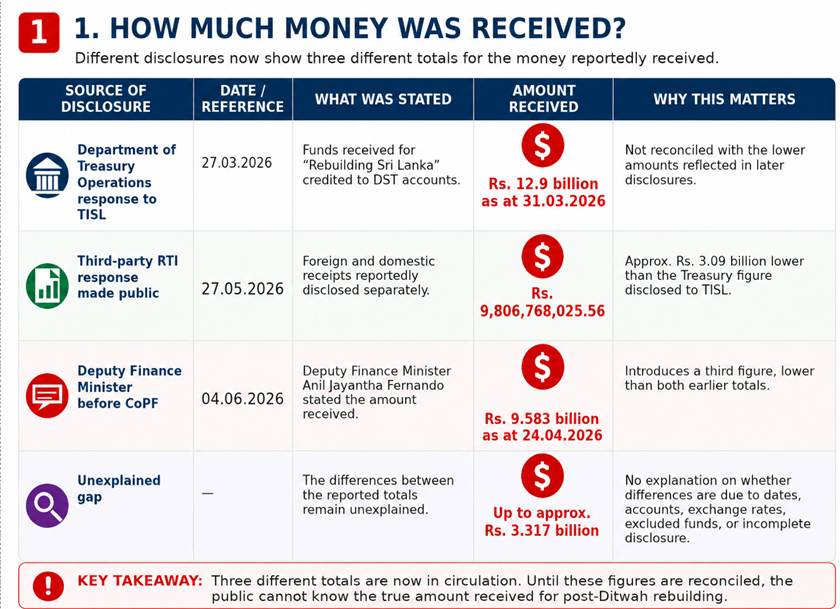
Figure 1: Different disclosed totals for money reportedly received for the Rebuilding Sri Lanka Fund.
The issue is not simply that the figures differ. It is that the differences relate to public donations collected for post-disaster recovery, at a time when affected communities continue to await relief, relocation and rebuilding support. The Government has not clearly explained whether these differences arise from different reporting dates, different bank accounts, exchange-rate treatment, excluded categories of funds, or incomplete disclosure. Without such clarification, the public cannot meaningfully assess the true scale of the Fund or track how donated money is being managed.
A similar contradiction arises in relation to whether any money has been spent or released. As set out in Figure 2, the Presidential Secretariat informed TISL that no expenditure had been made from these funds to date, while the Department of Treasury Operations later disclosed that Rs. 500,000 had been released to the Department of National Archives on 21 April 2026 from receipts for “Rebuilding Sri Lanka”. COPF was also informed that no funds received by the Fund had been utilised and that the donations remain in a Deputy Secretary to the Treasury account.
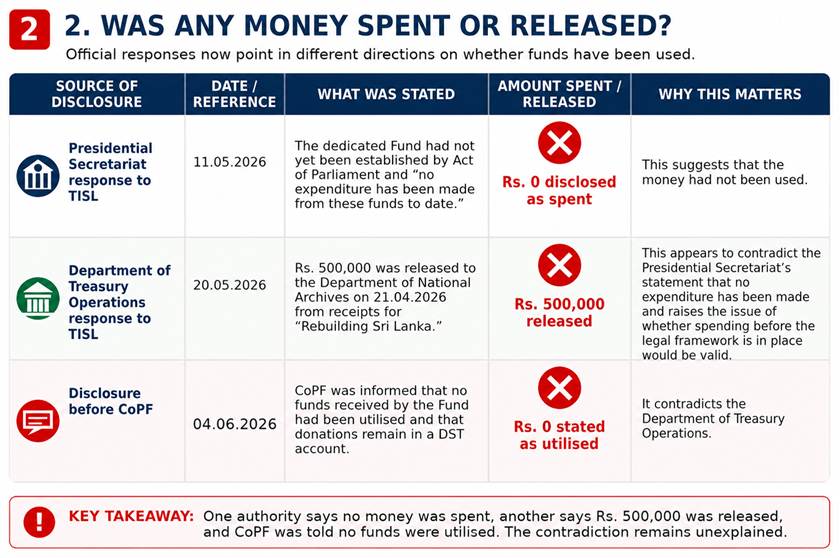
Figure 2: Conflicting information on whether any money has been spent or released.
This raises two serious concerns. First, public authorities appear to have given conflicting answers on whether any funds have in fact been used. Secondly, the purpose of the release to the Department of National Archives remains undisclosed. These contradictions reinforce the broader concern that the Fund is operating through an opaque interim arrangement, without sufficient public clarity on its legal status, total receipts, disbursements, purpose, oversight mechanisms or accountability structures.
What information is still missing?
Beyond the figures, TISL’s RTI requests also sought basic information on how the Rebuilding Sri Lanka Fund is being managed. This included information on district-wise allocations, implementing agencies or public authorities receiving funds, eligibility criteria for affected persons, and the monitoring, reporting, audit or evaluation mechanisms established to track the use of the money.
These details were not provided. The Presidential Secretariat stated that data could be provided once the funds were utilised, while the Department of Treasury Operations stated that the information was not available with the Department and later suggested that some of the requested information may be available with the President’s Office. The effect is that the public still cannot see how the money will be allocated, who will benefit, who will approve payments, or how the use of the Fund will be independently monitored.
What happens now?
At this stage, the concern is no longer merely one of administrative delay, but whether billions of rupees collected in the name of disaster recovery are being held, managed and potentially used in a manner the public can understand, verify and scrutinise. The Government must urgently reconcile and publish the total amount received, identify where the money is held, clarify whether any funds have been released or utilised, and explain the legal basis for doing so. It must also establish clear rules on eligibility, allocation, procurement, monitoring, auditing and public reporting – either by bringing the funds within the existing Disaster Management Act framework or by urgently enacting a statutory Rebuilding Sri Lanka Fund in line with the Public Financial Management Act. What cannot continue is the present uncertainty. When donations are collected to rebuild lives, and affected communities continue to wait for relief and relocation, the State owes the public a lawful, transparent and independently verifiable accounting of every rupee received, every rupee released, and every decision made in the name of rebuilding Sri Lanka.
(Dhewni Dias is Senior Officer – Advocacy and Research at Transparency International Sri Lanka and Rehan Perera is Advocacy and Research Officer, Transparency International Sri Lanka)
Disclaimer: The views and opinions expressed in this article are those of the writers and do not necessarily reflect the official position of this publication.









Leave a comment