
By Chanakya
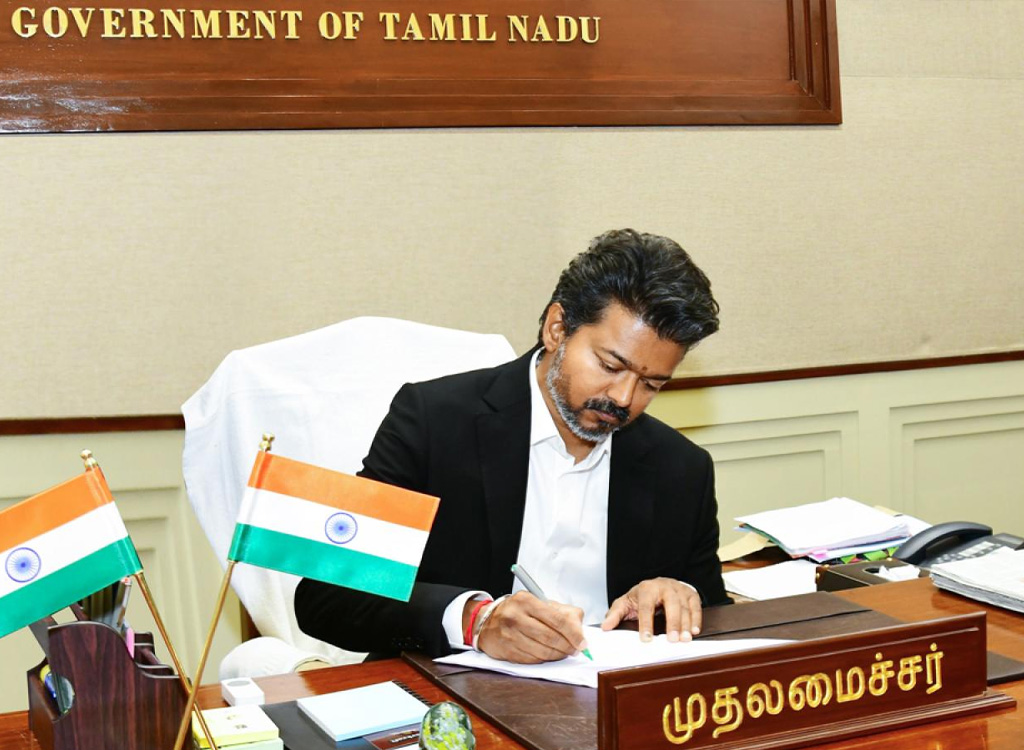
The political landscape of South India changed dramatically this week as actor-turned-politician C. Joseph Vijay, widely known as “Thalapathy” Vijay, officially assumed office as the Chief Minister of Tamil Nadu. His rise from one of Indian cinema’s biggest stars to the head of one of India’s most influential states marks a historic moment not only for India, but also for neighboring Sri Lanka.
For Sri Lanka, particularly the Tamil-majority Northern and Eastern Provinces, developments in Tamil Nadu are never viewed as distant political events. The cultural, linguistic, and emotional links across the Palk Strait have long ensured that political changes in Chennai resonate strongly in Colombo and Jaffna alike.
Vijay’s victory under the banner of his party, Tamilaga Vettri Kazhagam (TVK), signals the arrival of a new political force in Tamil Nadu after decades dominated by the Dravidian heavyweights DMK and AIADMK. Backed by massive youth support and a powerful fan base cultivated through cinema, Vijay campaigned on promises of social justice, anti-corruption reforms, employment generation, and welfare-oriented governance.
His ascent reflects a broader trend in South Asian politics where celebrity influence increasingly merges with populist politics. Yet unlike many film stars who briefly flirt with politics, Vijay’s entry appears calculated, organised, and ideologically driven. Political analysts believe his administration could reshape Tamil Nadu’s political priorities, with possible consequences for Sri Lanka.
Sri Lankan Tamil issues
One of the immediate areas Colombo will closely monitor is Vijay’s stance on Sri Lankan Tamil issues. Tamil Nadu governments have historically exerted pressure on New Delhi regarding accountability, reconciliation, and political rights for Sri Lankan Tamils following the island’s decades-long civil conflict. Former Tamil Nadu leaders frequently called on the Indian government to adopt tougher positions toward Colombo during periods of political tension.
Although Vijay has not yet outlined a comprehensive policy on Sri Lanka, his rhetoric emphasising Tamil identity and social justice suggests that issues affecting Sri Lankan Tamils may receive renewed attention from Chennai. This could increase diplomatic pressure on Colombo whenever concerns emerge regarding devolution, land rights, missing persons, or economic conditions in the North and East.
Fisheries dispute
Another sensitive issue likely to gain prominence under Vijay’s administration is the long-running fisheries dispute between India and Sri Lanka. Fishermen from Tamil Nadu regularly cross into waters claimed by Sri Lanka, leading to arrests, boat seizures, and periodic diplomatic friction. Political leaders in Tamil Nadu often adopt strong positions defending local fishermen, and Vijay may face pressure to do the same to maintain support among coastal communities.
At the same time, Vijay’s leadership could also open opportunities for closer economic and cultural engagement between Tamil Nadu and Sri Lanka. Tamil Nadu is one of India’s largest industrial and manufacturing hubs, with strong infrastructure, ports, and technology sectors. If relations remain constructive, Sri Lanka could benefit through increased trade, tourism, educational partnerships, and investment flows, particularly in the Northern Province, which shares close geographic and cultural proximity with southern India.
Beyond economics and diplomacy, Vijay’s influence may also shape public sentiment among Sri Lankan Tamils, especially younger generations. For decades, Tamil cinema has played a major role in shaping political imagination and cultural identity across Sri Lanka’s Tamil-speaking communities. Vijay’s transformation from cinema superstar to political leader may inspire renewed political engagement and reinforce emotional connections with Tamil Nadu.
Vijay’s foreign policy
However, analysts caution that India’s foreign policy remains firmly controlled by the central government in New Delhi. While Tamil Nadu chief ministers can influence public debate and political pressure, they do not directly determine India’s international relations. Much will depend on how Vijay balances regional Tamil interests with broader Indian national priorities.
Still, his rise represents more than a routine electoral victory. It symbolizes a generational shift in Tamil politics and the emergence of a leader whose influence extends far beyond state borders. For Sri Lanka, Vijay’s tenure as Chief Minister could bring both challenges and opportunities — from renewed scrutiny on Tamil political issues to deeper regional economic cooperation.
As Chennai enters a new political era under Vijay, Colombo is expected to watch developments across the Palk Strait with renewed attention.
Disclaimer: The views and opinions expressed in this article are those of the writer and do not necessarily reflect the official position of this publication.









Leave a comment