
By Rehana Thowfeek
The impact of the war depends on how long it lasts and how far it spreads; if it ends in a few weeks, stability can return in a few months. If it continues for months, it will take years for the global economy to stabilise.
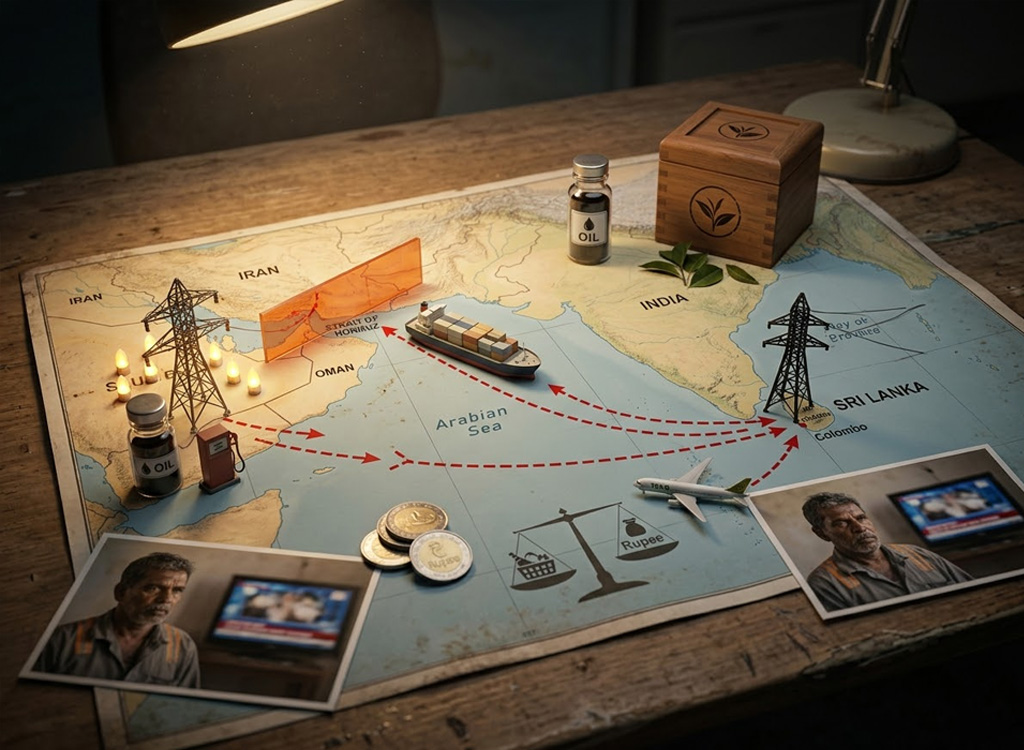
The Strait of Hormuz, located between Iran and Oman is a key chokepoint for global maritime trade with 30,000 ships passing through it annually. About 38% of the world’s crude oil, 29% of LPG, and 19% of LNG passesthrough it. Its closure on March 2nd has disrupted global supply chains.
The impact on Sri Lanka depends on our trade relations with the countries affected.
Oil
- The United Arab Emirates [UAE] supplies 38% of Sri Lanka’s oil. The UAE has cut its production and can’tship any oil due to the closure of the strait. This will have a major impact on supply to Sri Lanka and the globe.
- Major oil producing Gulf nations have been affected by bombings of their facilities and the closure of the Strait.
- Oil prices reached record highs due to supply chain disruptions.
- Sri Lanka’s CPC says it has one month of stock in storage.
Electricity
- Approximately 20% of electricity was generated from thermal oil in February 2026 – the reduction in supply of oil will affect electricity prices and generation.
- Sri Lanka’s monsoon season starts in May and during this time Sri Lanka usually generates about 50% of electricity from hydropower.
- Sri Lanka generated about 31% of electricity from thermal coal in February 2026.
- About 93% of coal products came from Russia in 2025. Russia is not in the conflict zone, but demand for coal will increase as a substitute for oil.
- Sri Lanka is already experiencing a disruption in coal supply due to reasons unrelated to the war. This will compound the impact on electricity generation.
Gas
- Sri Lanka imported about 53% of gas from Oman, 17% from the UAE, and 11% from Saudi Arabia in 2025.
- Oman is not directly involved and has ports that don’t need to cross the Strait. Still, their proximity to the war might affect their shipment ability – for instance, the Port of Salalah was bombed recently.
- Prices will increase from the supply shortage and higher insurance premiums.
- If the Strait of Hormuz stays closed, the supply will be disrupted.
- In December 2025 and January 2026 there was a noticeable shift in import source away from Oman and to USA.
- Sri Lanka is already facing a shortage of gas due to reasons unrelated to the war.
Food and other items
- When gas prices rise, food prices also rise.
- 57% of the fertilizer in Sri Lanka came from China. 10% comes from Uzbekistan. Both countries are outside the direct conflict zone.
- Yet, 22% of fertilizers came to Sri Lanka from countries in the Middle East.
- There will be an effect on fertilizer prices which will have a cascading impact on food supply and price levels.
- Oil and gas are key raw materials for many products. A reduction in supply of these will impact other items we use daily.
Exports
- 25% of Sri Lanka’s tea is exported to Saudi Arabia, Iraq, UAE, Iran, Kuwait, and Israel – as these countries face the blockade, tea shipping routes are significantly disrupted.
- The blockaded countries account for ~$450 million export revenue.
- About 52% of tea exports go to the wider Middle Eastern region.
- Countries not in the conflict may also face supply disruptions.
- Sri Lanka earns $852 million from merchandise exports to these blockaded countries. This amount is about 7% of the country’s total merchandise export revenues.
Worker remittances and tourism
- Worker remittances are a top source of foreign exchange inflows into the country.
- Kuwait, Saudi Arabia, the UAE, and Qatar are top sources of worker remittance inflows. In 2025, they made up 38% of the country’s total.
- Worker safety is already threatened. If there is further escalation, Sri Lanka will have to repatriate its citizens.
- Tourism earnings will face challenges due to flight cancellations, airspace closures, and higher travel risks. This is especially true for EU markets.
Cost of living
- Inflation in Sri Lanka has been low for the past two years. It has stayed under 2% and has even dipped into negative numbers at times.
- Due to major supply chain disruptions and rising oil and gas prices, costs and prices will rise. This will impactthe cost of living.
- Sri Lanka is already facing a domestic supply shock from Cyclone Ditwah.
- The persistence of the impact will depend on the length and intensity of the war.
*This analysis was written on 12th March 2026. Because this situation is developing rapidly, these insights are subject to change.
(The writer is the Co-Founder and Director – Civic Education at Arutha)












Leave a comment