
By Dinouk Colombage
“Stop invoking the rules-based international order as though it still functions as advertised. Call it what it is — a system of intensifying great power rivalry” – Mark Carney Canadian Prime Minister
Over the last 36 hours the war in West Asia has passed several critical stages. Mediation, negotiation and finally escalation; all of which highlights the absence of a unified voice advocating for the Rules Based Order.
After days of anticipation and speculation, Iran and the U.S. dispatched high level delegations, numbering the hundreds, to Islamabad to engage in negotiations to bring the war to an end.
While talks between the two countries initially took place through the intermediary and their host, Pakistan, the two warring factions finally sat down face-to-face. After 21 hours U.S. Vice-President J.D. Vance announced that Iran had failed to agree to several of the U.S’ key terms, including the complete halt of their nuclear program. The talks ended and the two delegations departed from Islamabad. It is surprising that the Vice-President had expected a concrete deal to be reached in the span of a single day. When the Joint Comprehensive Plan of Action (JCPOA) was finally agreed to in 2015, it was the result of over 20 months of negotiations and the involvement of several international partners of the U.S.
Whether neither country managed public expectations or whether successful negotiations between the two belligerent parties, sans a wider mediation bloc, is realistically possible is a question that requires separate analysis. However, it has become clear that U.S. President Donald Trump was planning for a lack of resolution in the talks and had taken steps to prepare to escalate the conflict.
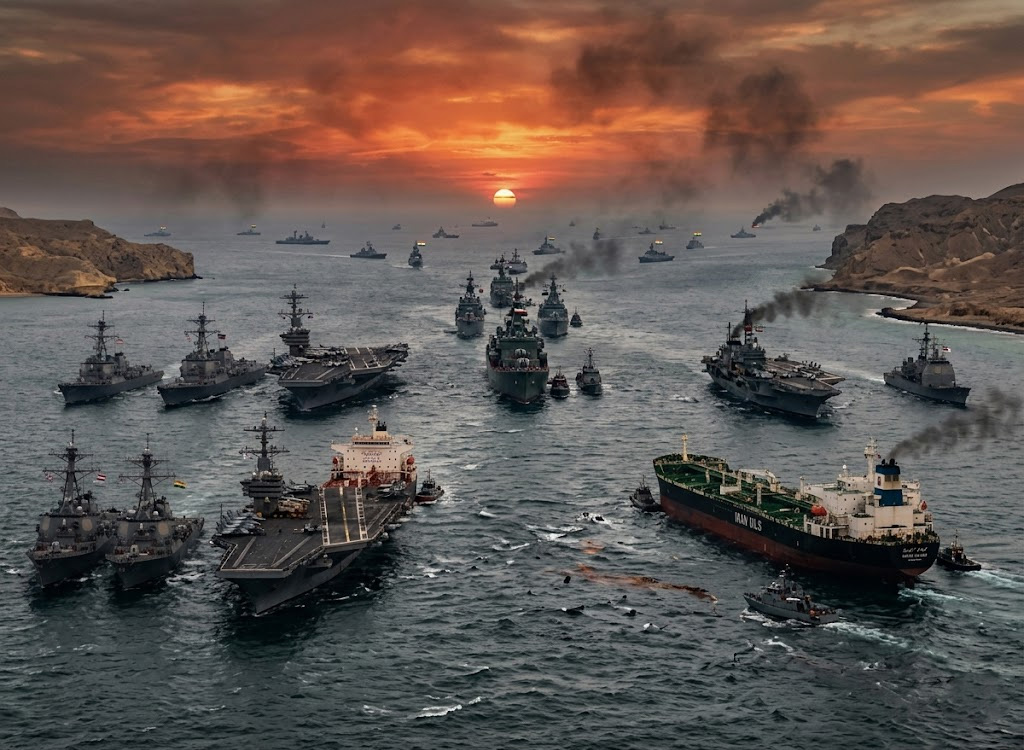
Hours after the negotiations ended in Pakistan, the U.S. President announced a complete naval blockade of the Strait of Hormuz. This followed previous comments by the U.S. President in which he downplayed the significance of the talks, choosing to repeat his rhetoric that the U.S. has won.
The decision by the President, which has since been clarified to indicate that the blockade only applies to Iranian ports and vessels, has once again challenged the very principles that in the past America has professed to defend. In 2023/24, when Houthi Rebels attacked shipping vessels transiting the Red Sea, it was the U.S. who led a multinational security mission (Operation Prosperity Guardian) to safeguard the region and ensure the Freedom of Navigation.
Upholding IOZP
Nations such as Sri Lanka, under the Presidency of Ranil Wickremesinghe, also joined the efforts in an attempt to safeguard the very principles and laws that are not only essential for the country’s economy, but also have originated from Sri Lanka.
As per the United Nations Declaration of the Indian Ocean as a Zone of Peace (IOZP), it clearly states that all nations must have unimpeded access to the Indian Ocean. In this case the blockade of the Iranian vessels, alongside the previously enforced closure of the Strait of Hormuz by Iran, have been in violation of this declaration.
- (b) “Subject to the foregoing and to the norms and principles of international law, the right to free and unimpeded use of the zone by all vessels of all nations is unaffected.”
While the U.S. is neither a signatory of the IOZP, nor an active supporter of the declaration, Iran was one of the original signatories back in 1971.
Despite the IOZP being adopted by 61 nations, with no nations voting against it, the failure for the Indian Ocean to truly become such a zone lies at the feet of the proponents and signatories and their failure to push back against the nations who opposed this initiative. The irony being that the very declaration which sought to oppose the expansion of Big Power rivalry was in fact hamstrung by the influences of the Big Powers.
While the IOZP alone is incapable of restraining the expansion of the war in West Asia, questions are now emerging over practicality of the United Nations Convention on the Law of the Sea (UNCLOS).
The closure and blockades of the Strait of Hormuz by Iran and the U.S. have fallen under grey areas as per international law. Maritime experts have draw attention to Article 37 in UNCLOS, which provides for the right of transit. Yet once again the international community is faced with issues over the fact that while Iran is a signatory of (though not a party to) the convention, the U.S. has failed to ratify it through their Senate. So how do these conventions and declarations be enforced?
For the littoral and mainland States in the Indian Ocean, the continued disregard of international laws and norms has become a growing threat to their economies. Considered to be the growth corridor for Asia, the Indian Ocean has found itself worst impacted by the fallout of the war in Iran.
With an estimated 2/3rds of the region’s fuel and gas requirements originating from the Strait of Hormuz, countries such as India, Bangladesh, Sri Lanka and even Indonesia are facing shortages. Economic activity has slowed down in many of these countries, due to not only fuel and energy shortages, but due to reduction in foreign travel.
It is here that the absence of leadership in the Indian Ocean, capable of pushing back against the blatant disregard of the laws and norms by belligerent states, has come to the forefront.
As the war in West Asia has surpassed a month, the theatre of conflict has expanded beyond the Gulf and entered the Indian Ocean. Enforced closures and blockades of a vital maritime choke point, in the form of the Strait of Hormuz, is further escalation of actions that had previously seen the sinking of an Iranian naval vessel in the Exclusive Economic Zone in Sri Lanka.
Similarly following the military action taken by the U.S. submarine in the Indian Ocean, once again there is an absence of opinion from the regional players to the latest escalation. Tough questions are now being directed towards New Delhi, and their continued silence over actions which are threatening the safety and sovereignty of the Indian Ocean. As the regionally accepted net security provider, the onus is on the world’s 4th largest military power (and 5th largest economy), to voice the region’s concerns over these developments.
Rules Based Order
For a country like Sri Lanka, who was not only the architect of the IOZP, but through Hamilton Shirley Amerasinghe, former Permanent Representative of Ceylon to the UN, played an integral role in the drafting of UNCLOS, the onus is on them to uphold these principles. Through the country’s close relationship with India, driven through both economic and geographic considerations, Sri Lanka is in prime position to encourage India to awaken from its slumber.
Sri Lanka, like India, was a firm advocate of non-alignment during the Cold War. As part of the founding members of the Non-Aligned Movement (NAM), both India and Sri Lanka consented to the belief that neutrality meant maintaining the principles of a Rules Based Order. Unfortunately, today the notion of neutrality suggests simply turning a blind eye to the actions of others in the hope of extricating oneself from conflict.
As the attention remains firmly on Iran and the U.S. and their future courses of action in this war, the Indian Ocean continues to have laid at its feet an opportunity to influence proceedings. While the fallout to the Rules Based Order following this conflict remains to be seen, it is certain that the power structure governing the Indian Ocean will certainly come under scrutiny. The failure of India to take a leading role in unifying calls to bring an acceptable settlement to the conflict will only raise the necessity for a regional bloc, which includes India, to govern the affairs of the region. As the rest of the global power structure turns away from a unipolar anatomy to one of multi-polarity, the Indian Ocean will almost certainly face a similar choice. The question is who will lead this charge?
(The writer previously served as the Director of International Affairs to President Ranil Wickremesinghe, and is the current Chief Research Officer for the Geopolitical Cartographer)
Disclaimer: The views and opinions expressed in this article are those of the writer and do not necessarily reflect the official position of this publication.












Leave a comment