
By Dinouk Colombage
As Sri Lanka’s economy faces yet another downward spiral, brought on by a host of domestic and international obstacles, the country is in urgent need of a new approach to it’s economic path forward.
Before Sri Lanka proceeds with pursuing, or rejecting, such connectivity projects, we must understand what is in the national interest of the country. Since 1977, when Sri Lanka embraced an open economy, the country has pursued greater economic engagement with the global markets, continued non-alignment amidst Big Power rivalry and a sense of economic independence. However, the achievement of these goals has continually been pushed down the road due to shifting global interests and a changing international system. As the country faces the 21st century, it is becoming increasingly clear that Sri Lanka’s economic prosperity is reliant on the nation’s economy integrating with the Asian giants.
It is at this point that the conversation turns to India, and essentially the Southern Indian States of Tamil Nadu and Karnataka. As India’s economy is poised to overtake the U.S and emerge as the second largest economy in 2050 ($44.1 trillion GDP PPP), it makes sense that Sri Lanka ensures not only that it is linked to India’s expansion but also positioned to provide a stepping for other countries who are attempting to enter the Indian market.
Connectivity with India
Currently India’s nominal GDP stands at $4.2 trillion and is expected to grow to an estimated $35 trillion by 2050. The southern Indian state of Tamil Nadu alone has a current GDP of $420 billion and is expected to grow to $3 trillion by 2050. In contrast, Sri Lanka’s current GDP is $98.9 billion with forecasters struggling to project future growth levels due to economic uncertainty in the country. However, with both India, and its closest state to Sri Lanka, predicted to enjoy immense economic growth in the next twenty-four years, it would be of great benefit for the country to integrate its economy and grow alongside them.
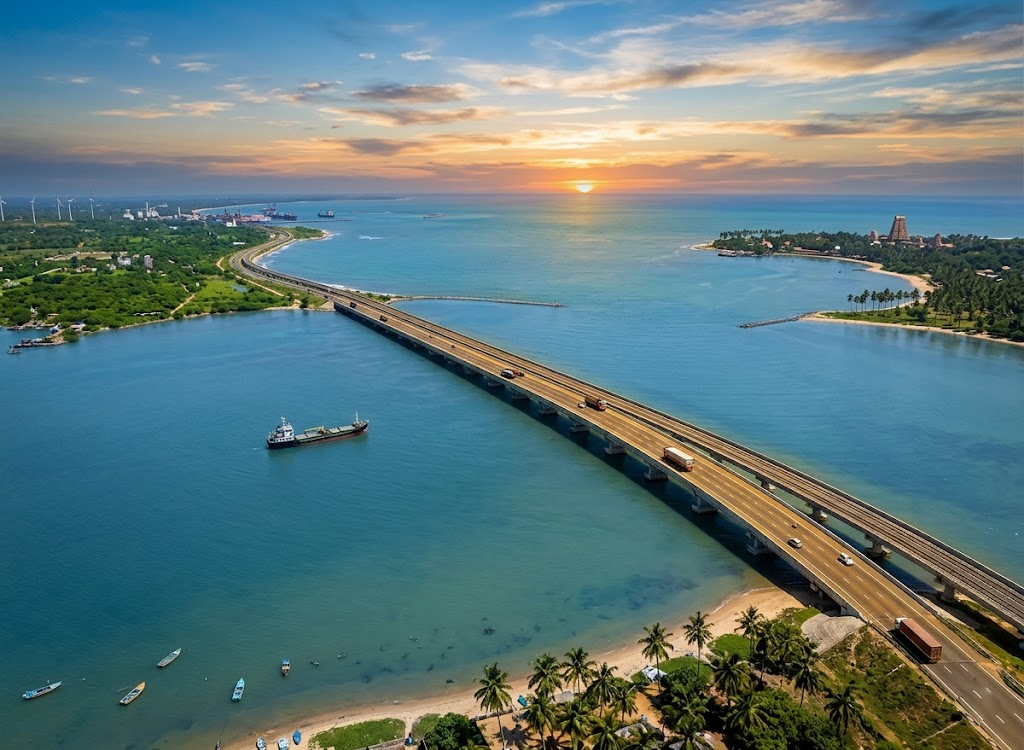
To achieve this end, it is essential that the country pursues greater connectivity with India, through sea, air and land. It is here that the much talked about land bridge connecting Sri Lanka with India comes into focus. The Palk Strait land bridge was first proposed in 2002 by then Prime Minister Ranil Wickremesinghe during the peace talks with the LTTE. It was envisioned as a road and rail bridge spanning 23 kilometres running from Mannar via Talaimannar to Dhanushkodi in Tamil Nadu. However, discussions between the two countries regarding the land bridge have faced a stop-start progression since its initial proposal. In 2023 during a visit to India by President Wickremesinghe both countries agreed to conduct an in-depth feasibility study on the viability of the project.
Since the change of Sri Lanka’s government in 2024, the project has once again stalled with the National People’s Power hesitant to explore this opportunity. During a recent summit held in Colombo, India’s High Commissioner to Sri Lanka was vocal in his support for the land connectivity bridge, stating that “the time for wavering is over”. Yet unaddressed concerns and falsities continue to surround this initiative.
Opponents to the project have suggested that proceeding with the land bridge between Sri Lanka and India would harm the country on several front including national security, economic independence, embolden separatist aspirations, cause environmental damage as well as infringe on the country’s geopolitical stance.
The arguments put forth by these commentators remain encased in ideals from the late 20th Century and have failed to appreciate the developments over the preceding 3 decades.
National security
National security has been a continual argument put forth by those opposing further integration with India. However, historical events have demonstrated that were India to pursue military action against Sri Lanka, the absence of a land bridge would not dissuade them. In 1987, during the Sri Lankan Government’s military operations against the LTTE in the Northern Province, the Indian government had attempted to intervene and seek a halt to the advances by the government’s forces into the Jaffna peninsula. This was ignored by Sri Lanka, which resulted in the India attempting to dispatch a naval flotilla with food items, which was intercepted by the Sri Lankan navy. However, within several days the Sri Lankan High Commissioner in New Delhi was informed that Indian planes would be entering Sri Lankan airspace to drop food into the peninsula, and while they would not be armed, but they would be escorted by military jets. While no direct military action took place, this demonstrated the alternative avenues that existed if India were to pursue military action. Separately, military experts have concluded that the defence of a single land bridge connecting two points is feasible due to the bottleneck it creates for an advancing army. As such, any unlikely attempts by foreign military or proxy groups to enter the country via the land bridge appears unviable.
Arguments have also been put forth that increased connectivity with India via a land bridge would result in a resurgence of separatist sentiments. Once again, our attention is drawn to the 1970s and 80s when the LTTE were supported by political blocs within India including South India. The growth and development of the LTTE from a fringe group to one of the world’s most feared terrorist organisations was all orchestrated remotely. Which begs the question how, in today’s world of advanced communications and remote connectivity, a single land bridge will fuel the flames of separatism.
While the national security and separatist arguments are being recycled in an effort to halt efforts to pursue this connectivity project, misrepresentation of the economic impact have also been utilised.
Accordingly, it has been argued that a land connectivity bridge would result in an “economic over-dependence on India”. While Sri Lanka should not be overly-dependant on any single country, it was the close ties enjoyed by Sri Lanka with India in 2022/23 that allowed for the country to emerge from its period of bankruptcy. In-fact, when no other countries were willing to support Sri Lanka, economically, it was India who provided the country with over $4 billion in financial assistance. It can be argued that until the IMF stepped in in 2023, Sri Lanka was overly dependent on India. This was a result of the close ties enjoyed between the two countries, and a relationship that should be further strengthened through greater connectivity.
Opportunities for Sri Lanka
Currently, India is Sri Lanka’s largest trading partner, with Sri Lanka’s exports to India in 2025 being valued at $1.1bn while imports were valued at $6.4bn. With increasing competition and demand to access India’s markets, the potential of reducing transport costs for trade by an estimated 50% will certainly be a boost to Sri Lanka’s export industry. Increased connectivity, coupled with reduced costs, will allow for new and emerging industries in Sri Lanka to explore the South Indian markets. The movement of goods and services between the two countries will serve to encourage greater investment in Sri Lanka with the purpose of catering to the Southern Indian markets that account for nearly 30% of India’s entire GDP.
Moving beyond the bilateral economic engagement, the provision of low-cost connectivity to India’s Southern States such as Tamil Nadu and Karnataka will raise the country’s profile as a potential access point to the sub-Continental giant. This will enable the country to expand its commercial engagements with other economies including those in Asia.
The pivot undertaken by Sri Lanka, post the 2022 economic crisis, was an Asia-centric one, which aimed to see Sri Lanka’s economy undergo far greater integration with Asia. With India being the country’s closest neighbour and largest trading partner, along with being the third largest economy, it would certainly make sense to expand connectivity. Beyond the Indo-Lanka bilateral relations, the increased connectivity between the two countries will be of interest to the rest of the growing Asian region, including ASEAN.
Regional integration
The ASEAN – India Comprehensive Strategic Partnership (2026-2030) focuses on the region’s strategic integration with India. Efforts such as Thailand’s attempts to integrating its supply chains with India’s electronics and vehicle industry will benefit from low-cost connectivity via Sri Lanka. In turn Sri Lanka will reap the rewards from foreign industries establishing operations in the country, with the advantage of readily available connectivity to the fast-growing Southern States of India.
While gaining access to the Indian markets is one key point of the project, the bridge will also provide for greater access for Indian tourists to Sri Lanka. In 2025 over 530,000 tourists visited the island from India, making up 23% of total arrivals. Yet the full potential of the Indian tourism market is still to be captured, with Indian visitors opting for short stays in the country. Greater accessibility to lower costs of connectivity, through ventures such as land bridges, will certainly expand this market base. Aside from the ferry service between Nagapattinam and Kankesanthurai, air travel is the only mode of connectivity between India and Sri Lanka. A pursuance of a land bridge will significantly reduce the cost of travel, while also opening the North-West, North and North-East of Sri Lanka to greater tourism opportunities and in turn increased economic activity. Sri Lanka has also provided the platform for niche tourism for India, including destination weddings and cultural & religious tourism, a potential that would further grow through increased connectivity. Alongside the increased tourist arrivals from India, the indirect benefit through the creation of employment opportunities in the tourism sector is untold.
With concerns having been raised by opponents of this initiative, claiming that such a connectivity project would result in uncontrolled migration, it deems reminding that access to the country via officials Ports of Access is under the jurisdiction of the Sri Lankan government. Upon entering the country, regardless of the port of entry, foreign nationals are under the purview of the laws of the country.
While financially the benefits to the country are clear, the strategic value of Sri Lanka’s maritime location will be reaffirmed.
As India continues to increase its connectivity hubs, the expansion of the V.O. Chidambaranar Port will be of concern to Sri Lanka. While currently operating on a smaller scale than the Colombo Port, efforts are underway to increase its capacity, thereby reducing India’s dependence on foreign ports. If Sri Lanka wishes to maintain its strategic advantages on the transshipment stage, the country must explore added benefits. One such benefit will certainly be derided from a land bridge connecting Sri Lanka with the world’s fastest growing economy. An opportunity for shipments to be unloaded in Colombo and then proceed to the South Indian markets via the less expensive road route will boost the country’s profile as a transshipment and logistics hub.
While geopolitically such a venture may spark the interest of other nations, Sri Lanka has traditionally played the role of non-participant in big power rivalry. As such investments in the country’s connectivity infrastructure should not be decided solely on the concerns of the larger powers in the newly emerging multilateral structure.
The development of the bridge will open Sri Lanka to India’s markets, however, the effectiveness of access to this market will only be enhanced by the swift implementation of the Economic and Technological Corporation Agreement (ETCA). More importantly, the possibility of foreign investments in Sri Lanka being provided with preferential access to the Indian markets, alongside greater connectivity, will most certainly propel Sri Lanka up the ladder of potential investment destinations.
If Sri Lanka continues to delay proceeding with the land bridge project, it is conceivable that India will choose to once again re-visit the Sethusamudram Ship Canal Project. The potential 167km channel, linking the Gulf Channel and the Palk Strait would allow vessels to cut across India, no long forcing them to navigate past the southern tip of Sri Lanka. The impact on the country’s ports and shipping industry will be detrimental to the national economy, also resulting in the country losing the benefits of its strategic location.
The continued opposition to expanding connectivity with India, via the land bridge, remains based on assumptions and fears without a viable foundation. If coupled with the proper legislation, and effective implementation, the addition of land bridge connecting Sri Lanka and India will provide for an economic boom, while safeguarding and building on the country’s strategic positioning in international maritime trade.
While opposition continues to exist around the project, the question must then be posed. If not this, then what is the alternative to ensure Sri Lanka benefits from India’s rapid economic growth as well as ensuring the country’s role in the Indian Ocean is not made insignificant.
(The writer previously served as the Director of International Affairs to former President Ranil Wickremesinghe and is the current Chief Research Officer of the Geopolitical Cartographer)
Disclaimer: The views and opinions expressed in this article are those of the writer and do not necessarily reflect the official position of this publication.












Leave a comment