
By The Pulseline News Desk
The legal battle over the Government’s proposed 22nd Amendment to the Constitution intensified yesterday (1), with leading President’s Counsel raising fundamental questions over judicial independence, the proposed changes to judges’ retirement ages, and whether the Supreme Court itself can determine the constitutionality of an amendment that directly affects its judges.
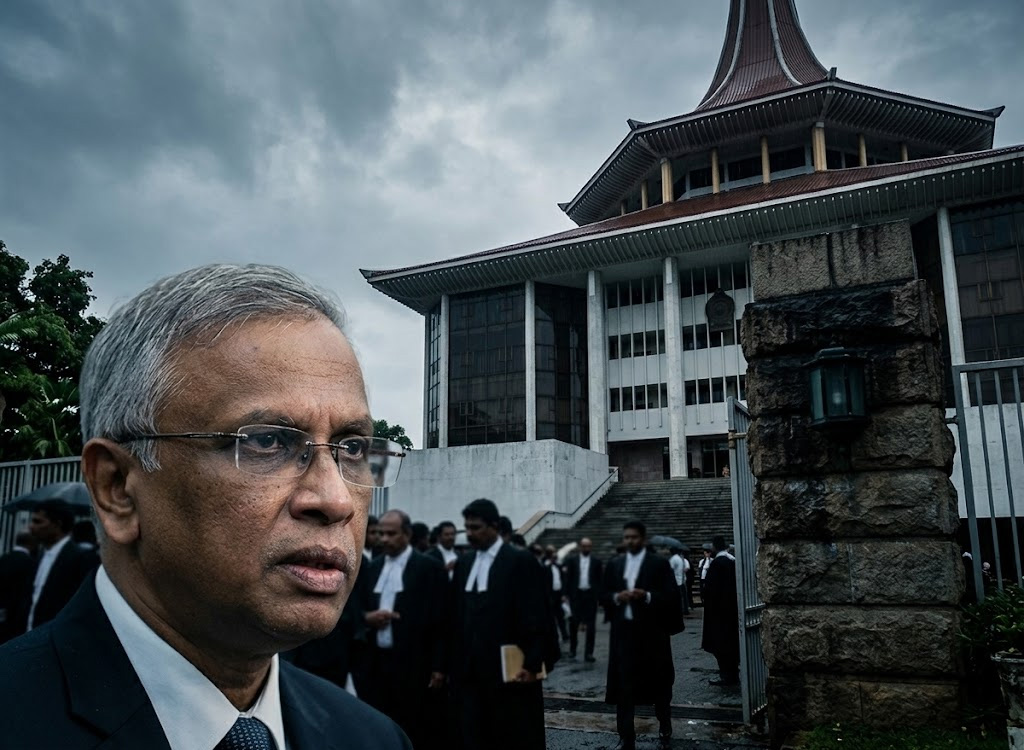
The development came as the Supreme Court commenced considering 67 petitions challenging the proposed amendment, with proceedings moving from Court No. 502 to the larger Ceremonial Court, Court No. 501, after the original courtroom was packed beyond capacity.
The five-judge bench, presided over by the Chief Justice, eventually commenced proceedings close to 11 a.m.
The scale of the legal challenge was evident, with more than 100 lawyers appearing for the Bar Association of Sri Lanka (BASL), including more than 80 junior counsel appearing with President’s Counsel M.A. Sumanthiran.
BASL seeks Full Court hearing
When SC/SD/28/2026 was called, M.A. Sumanthiran PC had requested that the matter be heard by the Full Court of the Supreme Court, rather than the existing five-judge bench.
There are currently 13 sitting judges in the Supreme Court, meaning the present bench comprises fewer than half of the Court.
Sumanthiran had argued that the issue went to the very architecture of the Constitution and the independence of the Judiciary.
“Judicial independence is part of sovereignty,” he had submitted.
He had pointed to Article 107, which governs the retirement age of judges and falls under the constitutional provisions dealing with the “Independence of the Judiciary.”
He had also referred to Article 41C and the limitations placed on presidential power in relation to judicial appointments.
According to Sumanthiran, certainty of tenure is a fundamental element of judicial independence.
He had warned that changing the retirement age at this stage could result in the Executive and Legislature effectively “locking in” a particular composition of the Supreme Court.
“When the Legislature and Executive think that the composition of the Court should not change — ‘now it’s good, so let’s lock in the Court for two years’ — that is interference with the independence of the Judiciary,” he had argued.
He had stressed that the separation of powers has particular significance in relation to the Judiciary because it is intended to remain institutionally separate from the political branches.
‘Why now?’
Sumanthiran had also questioned the timing of the proposed amendment.
He had said the BASL had written to the Executive in July raising concerns about the proposal, but had received neither an acknowledgment nor a response.
Six judges had retired, he had noted, without the issue being brought forward previously.
This, he had argued, could create a perception that the amendment was intended to preserve a particular composition of the Court.
“Why now?” he had asked.
He had maintained that such suspicion did not have to be based on fact to cause institutional damage.
“Mere suspicion of that nature is sufficient to destroy this institution,” he had submitted.
Sumanthiran had stressed that his argument was not intended as an attack on individual judges.
“This is not mudslinging,” he had said.
Basic structure argument
Sumanthiran had further argued that an independent Judiciary forms part of the basic structure or basic features of the Constitution.
He had questioned whether even a referendum could be used to undermine such a fundamental constitutional principle.
Referring to Sri Lanka’s constitutional history, he had cited the 1982 referendum that had extended the life of Parliament, describing the episode as “horrendous” despite having been approved through the constitutional process.
He had also referred to the Indian constitutional experience and Sri Lanka’s entrenched constitutional provisions.
His argument was that constitutional safeguards exist because certain principles are considered too fundamental to be altered simply through the exercise of political power.
“Even through a referendum, the independence of the Judiciary cannot be messed around with because that is so fundamental,” he had submitted.
Sumanthiran had identified security of tenure as a central guarantee of judicial independence, while acknowledging that increased life expectancy could be a legitimate consideration in determining retirement ages.
However, he had said such a change should only be pursued following extensive consultation with stakeholders.
Raising conflict issue
A separate constitutional concern had emerged in SC/SD/33/2026, where Srinath Perera PC had commenced his submissions.
Perera had pointed out that the Supreme Court ordinarily has the authority to determine whether a constitutional amendment requires only a two-thirds majority in Parliament or must also be approved by the people at a referendum.
However, he had argued that the present case raises a special difficulty because the amendment directly affects Supreme Court judges.
“As far as constitutional amendments are concerned, Supreme Court has the authority to determine whether it is enough to pass by Parliament with 2/3rd or needed a referendum. But, in this case Supreme Court judges are impacted by this Amendment,” he had noted.
“There is going to [be a] conflict of interest,” Perera had argued.
He had submitted that if the judges were unable to determine the issue because of that conflict, there would be no alternative but to refer the matter to the “sovereign people.”
The submission had introduced a fundamental question into the constitutional challenge: how should a court determine the validity of legislation when the judges themselves may be affected by the legislation?
Ambiguity over two categories of judges
In SC/SD/35/2026 and SC/SD/36/2026, Boopathy Kahathuduwa PC had concluded his submissions, raising concerns over what he had described as ambiguity in the language of the proposed amendment.
He had argued that the wording could potentially create two categories of judges with different retirement ages.
Two judges appointed on the same day, he had submitted, could face different tenure arrangements if one subsequently becomes Chief Justice.
A judge who assumes the office of Chief Justice would be required to retire after completing six years in that office, potentially creating a different retirement outcome from another judge appointed to the Supreme Court on the same date.
The argument had raised questions over whether the proposed amendment establishes a clear and consistent framework for judicial tenure.
Questioning Govt’s justification
Constitutional lawyer Dr. Jayampathy Wickramaratne PC, had meanwhile challenged the process through which the proposal to increase the retirement age was developed.
According to Wickramaratne:
- The proposal has not been considered by any Parliamentary Committee.
- It was not contained in the Government’s Statement of Policy.
- It had not previously been announced as part of the Government’s policy programme.
- There had been no prior discussion, consultation, evaluation or assessment concerning the proposed change.
Wickramaratne had argued that the Government must therefore demonstrate a compelling State interest to justify the constitutional amendment.
He had also warned that constitutional amendments cannot be approached merely as exercises in satisfying the formal requirements for amendment.
There must, he had argued, be an ethical commitment to uphold the spirit of the Constitution.
And what constitutes that spirit?
According to Wickramaratne, it is reflected in the Preamble to the Constitution.
His argument had added a broader constitutional dimension to the challenge: that formal compliance with the amendment procedure alone should not determine whether a constitutional change is legitimate.
Civil society dimension
Meanwhile, appearing for SC/SD/50/2026, filed by the Centre for Policy Alternatives (CPA) and Dr. Paikiasothy Saravanamuttu, Suren Fernando PC had commenced his submissions.
The case had added a significant civil society dimension to the legal challenge, alongside the objections being advanced by the BASL and individual petitioners.
The petitions are therefore raising challenges on several fronts — the independence of the Judiciary, judicial tenure, the constitutional amendment process, the wording of the proposed provisions and the potential impact on the composition of the Supreme Court.
Courtroom drama mirrors constitutional battle
The intensity of the legal battle was reflected in the courtroom itself.
The proceedings were initially scheduled to take place in Court No. 502, but the courtroom was filled beyond capacity, leaving lawyers, petitioners and other attendees unable to enter.
Sumanthiran had requested that the proceedings be moved to the larger Ceremonial Court, a request supported by Saliya Peiris PC and Geoffrey Alagaratnam PC.
Following a brief consultation, the bench had agreed to relocate.
The move resulted in a further delay as lawyers, petitioners, members of the public and court staff moved into Court No. 501. The proceedings had subsequently continued, with the Court also considering the application for a Full Court hearing.
The unusually large legal presence underscores the significance of the amendment, which has already become one of the most closely watched constitutional disputes since the new Government came to power.
At stake is not simply the retirement age of judges.
The wider question is whether constitutional changes affecting the Judiciary can be introduced without extensive consultation, whether the proposed provisions sufficiently protect judicial independence, and whether the Supreme Court can determine the constitutionality of changes that directly affect its own members.
The Supreme Court will ultimately determine whether the provisions of the Bill are consistent with the Constitution and whether the amendment requires only parliamentary approval or must also be submitted to the people.
But as yesterday’s submissions demonstrate, the legal battle over the 22ndAmendment is increasingly becoming a broader test of the balance between political power, constitutional limits and the independence of Sri Lanka’s Judiciary.










Leave a comment