
By The Pulseline News Desk
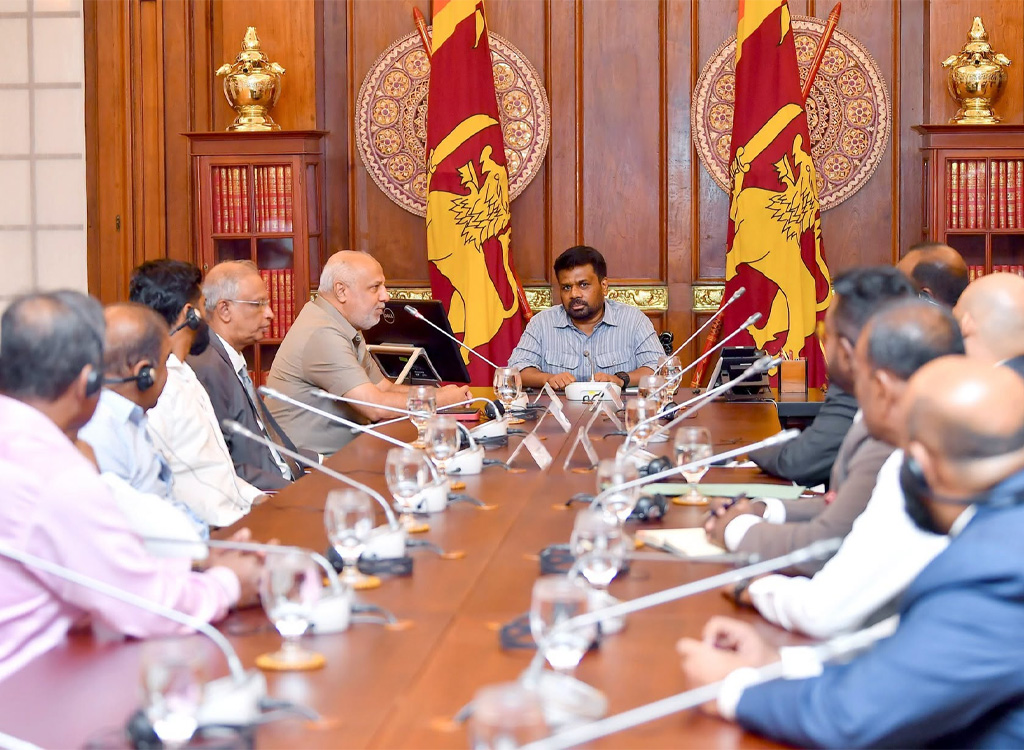
President Anura Kumara Dissanayake (AKD) on Monday (3) held his first formal round of talks with representatives of six Tamil and Muslim political parties, signalling a renewed effort to engage minority communities on long-standing political and socio-economic issues ranging from constitutional reform and devolution to land ownership and post-war housing.
The meeting at the Presidential Secretariat brought together representatives of the All Ceylon Makkal Congress (ACMC), Ceylon Workers’ Congress (CWC), Democratic Tamil National Alliance (DTNA), Ilankai Tamil Arasu Kachchi (ITAK), Sri Lanka Muslim Congress (SLMC) and Tamil Progressive Alliance (TPA).
According to the President’s Office, discussions focused on constitutional reform, Provincial Council elections, land disputes affecting the Northern, Eastern and plantation communities, and housing for war-displaced families.
A key issue was the government’s proposal to introduce a new Constitution and abolish the Executive Presidency.
ITAK General Secretary M.A. Sumanthiran has urged the government to avoid repeating Sri Lanka’s history of one-sided constitutional reforms, arguing that any new Constitution must emerge through broad public consultation and consensus rather than being imposed by the governing party.
President AKD has agreed that constitutional reform required public participation, saying the immediate priority was not merely drafting amendments but creating a new national consensus that would enable all communities to move forward together as Sri Lankans.
Reiterating the National People’s Power (NPP) government’s commitment to abolishing the Executive Presidency, he has also stressed the need for a governance model that is more accountable to Parliament.
The President has noted that a Delimitation Commission had already been appointed, with further discussions expected on the future of Provincial Council elections and the electoral system.
Land ownership emerged as another major theme of the talks.
The President has said the government was working to resolve longstanding land disputes in the North and Central Highlands, while reviewing issues involving state institutions such as the Department of Archaeology, the Forest Conservation Department and the Mahaweli Authority, whose policies have long been criticised by minority communities as obstacles to land access and development.
On plantation sector reforms, TPA leader V. Radhakrishnan has welcomed the government’s proposal to grant estate workers legal ownership of 10-perch land plots, describing it as a long-awaited measure that had previously failed due to opposition from plantation companies.
President AKD has said plantation lease agreements due for renewal before 2042 would provide an opportunity to introduce new provisions guaranteeing legal land ownership for estate communities.
Housing also featured prominently in the discussions.
The President has announced that the government plans to construct 13,000 houses for war-displaced families in two phases under the 2027 and 2028 Budgets. Families displaced by natural disasters will meanwhile receive temporary housing and rental assistance until permanent homes are completed.
CWC General Secretary Jeevan Thondaman has highlighted difficulties faced by beneficiaries of Indian-funded housing schemes, particularly in meeting utility costs despite owning their homes. He has said proposals had been submitted to involve the Thondaman Foundation and Nevida Foundation in providing economic assistance to affected families.
President AKD has said increased funding would be allocated to the Ministry of Plantation and Community Infrastructure in the 2027 Budget to address long-standing issues in the plantation sector.
The meeting comes as the government seeks to revive dialogue on constitutional and governance reforms while addressing unresolved grievances over land, housing and political representation in minority-majority areas.










Leave a comment