
By The Pulseline News Desk
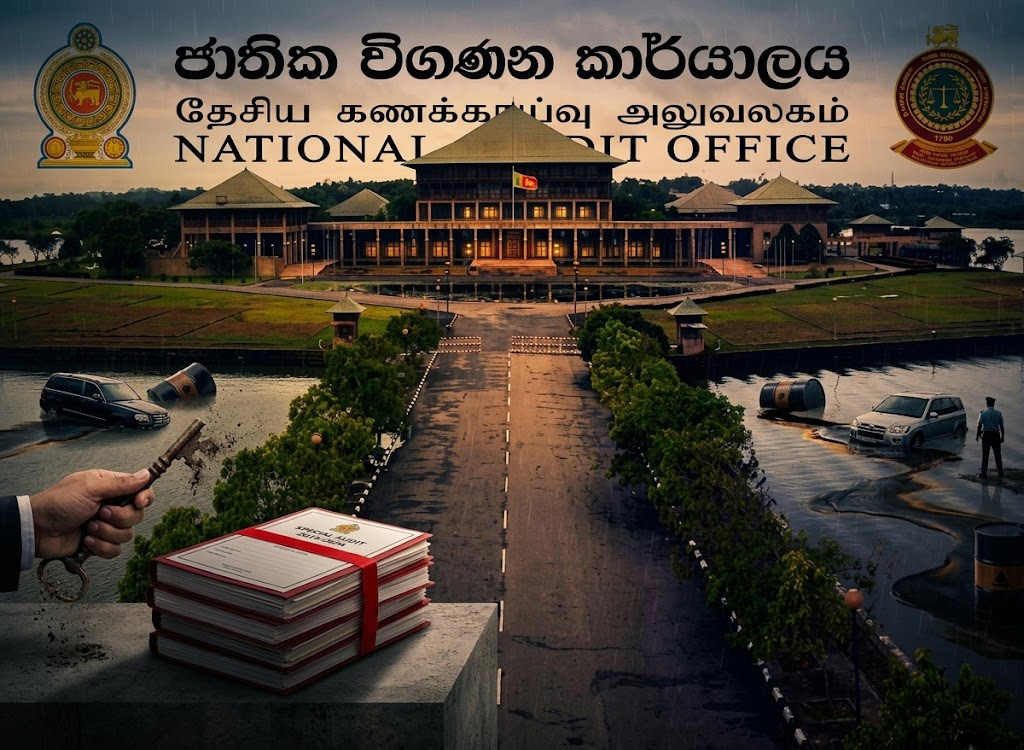
A damning special audit by the Auditor General’s Department has exposed a system of weak financial controls and unchecked privileges at Parliament, including unlimited fuel allocations for senior officials, questionable vehicle use and a Secretary General’s salary that has risen by around 800% without fresh parliamentary approval for more than two decades.
The special audit report, tabled in Parliament on August 21, examined the financial management of Parliament during the Eighth and Ninth Parliaments from September 2015 to November 2024.
The report, the 10th special audit report issued by the Auditor General under Article 154(6) of the Constitution, raises serious questions about the manner in which public funds have been managed within an institution constitutionally responsible for scrutinising government expenditure.
Among the most striking findings was the provision of unlimited fuel to the Speaker, Deputy Speaker, Deputy Chairperson of Committees and Secretary General, despite comparable public officials being subject to prescribed fuel limits.
The Speaker of the Ninth Parliament had consumed an average of 3,994 litres of fuel a month in 2023. That figure had risen sharply to 6,122 litres a month in 2024.
The resulting expenditure had amounted to Rs. 19.37 million in 2023 and Rs. 26.05 million in 2024 alone.
The Deputy Speaker was also provided fuel beyond established limits. According to the audit, 21,299 litres of fuel worth Rs. 8.55 million were drawn for a private vehicle used by the Deputy Speaker during 2023 and 2024.
This was in addition to fuel provided for three official vehicles assigned to the post.
Those three vehicles themselves had exceeded their allocated fuel limits by 6,980 litres in 2023 and a further 1,515 litres in 2024.
The audit had also found that the Chairman of Committees had been provided with three official vehicles and unlimited fuel despite there being no formal decision determining such an entitlement.
Salary increase and constitutional questions
Perhaps the most serious issue identified in the report concerns the remuneration of Parliament’s Secretary General.
Article 65(2) of the Constitution provides that the salary of the Secretary General of Parliament must be fixed by Parliament.
The salary was fixed at Rs. 274,920 with effect from January 2004 and recorded in Hansard in November that year.
However, the Auditor General has found that no fresh parliamentary approval had been obtained since then, despite the basic salary increasing by approximately 800% over the intervening years.
The report has warned that this had resulted in a significant charge on the Consolidated Fund without the constitutional approval required under Article 65(2).
The finding could potentially place a fresh spotlight on the legal and financial basis under which remuneration for the country’s highest parliamentary administrative office has been paid over the past two decades.
The Secretary General’s office has also come under scrutiny over vehicle use.
Two official vehicles, KY 5555 and CAN 8753, had been operated simultaneously during 2022 and 2023.
Together, the vehicles had consumed 15,063 litres of fuel between 2022 and 2024 at a cost of Rs. 6.07 million.
The Auditor General has calculated that this had amounted to approximately 2,300 litres a year above the entitlement applicable to a Ministry Secretary, the highest-fuelled comparable category within the public service.
Privileges extended beyond senior posts
The report has found that the Deputy Secretary General, Assistant Secretary General and other heads of departments had also been provided unlimited fuel for official duties.
They had additionally been permitted private travel allowances of up to 1,200 kilometres per month, compared with 960 kilometres for officials of comparable rank elsewhere in the public service.
The audit has noted that no formal review had been undertaken to bring these privileges into line with those applicable to other public officials.
The financial impact of excessive private mileage was also highlighted.
Until June 2022, senior officials who had exceeded their permitted private mileage were charged only Rs. 8 per kilometre.
The Auditor General has estimated that this had resulted in a loss of approximately Rs. 2.71 million to the State between September 2015 and June 2022.
Following a revision of the rate in July 2022 to reflect prevailing market fuel prices, the report has noted that excess use declined sharply.
Rs. 335 million bus service without written agreement
Another long-running arrangement questioned by the audit involves transport provided to Parliament employees.
Nine buses have been used to transport around 1,500 non-staff grade employees along nine routes under an arrangement with the Sri Lanka Transport Board dating back to 1984.
Yet despite Parliament spending Rs. 335.66 million on the service since 2016, the audit has found that no written agreement had been entered into.
A further Rs. 5.89 million had been spent on drivers and conductors since mid-2021.
The cost of the service had also increased significantly over the period examined.
The average expenditure per travel pass had increased from around Rs. 27,662 in 2016 to more than Rs. 95,000 in 2023.
The absence of a formal agreement after decades of expenditure had raised questions over the contractual, financial and accountability mechanisms governing the service.
Millions spent on overseas travel
The audit has also examined expenditure incurred on foreign travel by Members of Parliament (MPs) and parliamentary staff.
Between 2016 and 2024, Parliament had spent Rs. 208.9 million to send 451 MPs overseas through the Commonwealth Parliamentary Association, Inter-Parliamentary Union and SAARC Parliamentary Association.
A further Rs. 56.9 million was spent on 115 staff members who undertook 83 foreign trips.
However, the audit has found that there was no formal requirement for MPs or staff returning from such programmes to submit reports detailing the knowledge, experience or other benefits gained from their overseas visits.
The finding has raised questions about how Parliament measures the value derived from public funds spent on international parliamentary engagements.
Library figures, vehicle permits also questioned
The special audit has identified several other administrative discrepancies.
Parliament’s library register had recorded 25,103 books, while its website claimed that the library contained around 34,000 books.
The audit has also found that concessionary vehicle import permits worth Rs. 10.8 million had been granted to three employees before they had completed the required six years of service.
In addition, 159 approved posts remained vacant as of December 2025, with no formal review having been carried out to determine whether those positions were still required.
Outdated law blamed for weaknesses
The Auditor General has attributed many of the shortcomings to Parliament continuing to operate under the Parliamentary Staff Act of 1953, which was last amended in 1959.
The report has noted that the legislation had not been brought into line with the Public Financial Management Act No. 44 of 2024.
It has recommended that the outdated legislation be reviewed and either amended or repealed.
It has also called for stronger controls over fuel and vehicle privileges and for the Secretary General’s remuneration to receive formal parliamentary approval in accordance with the Constitution.
The findings are particularly significant given the scale of public funding allocated to Parliament.
With the Treasury providing nearly Rs. 3.5 billion annually to operate the legislature, the audit has exposed a striking accountability gap: an institution entrusted with scrutinising public expenditure has itself operated for years under financial arrangements that the Auditor General says lacked adequate controls, formal approvals and proper review.
The report has therefore gone beyond questions of excessive fuel consumption or administrative irregularities.
It has raised a broader question over whether Parliament’s own financial governance has kept pace with the standards of accountability it demands from the rest of the public sector.










Leave a comment