
By The Pulseline News Desk
Sri Lanka is turning increasingly to seawater desalination and deep groundwater extraction as prolonged dry weather puts pressure on water sources across the country, with more than 115,000 people currently affected by water shortages.
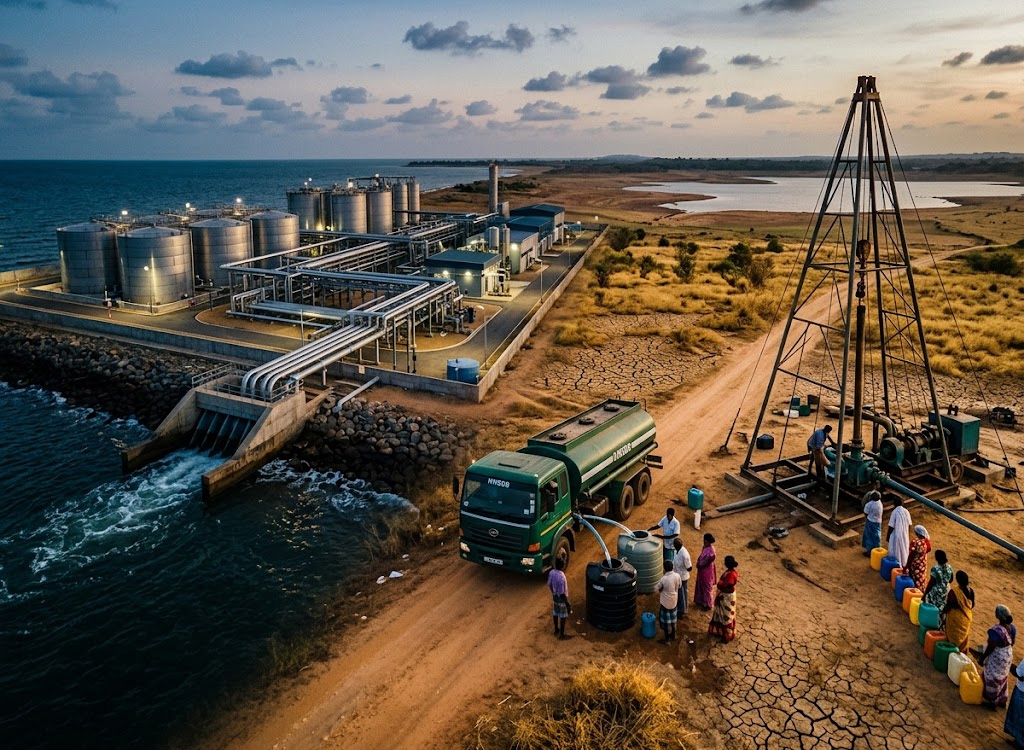
The National Water Supply and Drainage Board (NWSDB) is advancing three seawater desalination projects in the Jaffna Peninsula, where the scarcity of natural freshwater resources has made conventional water supply increasingly difficult.
The move comes as dry conditions affect 35,169 families, comprising 115,586 people, across seven districts, according to figures presented to Parliament.
Jaffna leads the desalination push
The largest of the three projects is the Jaffna city desalination scheme, estimated to cost $220 million and financed through an Asian Development Bank (ADB) loan.
NWSDB Chairman Chandana Bandara has told the media that the other two projects, aimed mainly at islands in the Northern Province, are smaller and are estimated to cost between $20 million and $50 million each.
Jaffna’s geography has made the search for freshwater particularly challenging. Lagoon water and shallow groundwater sources are highly vulnerable to salinity, limiting their suitability for large-scale public water supply.
The NWSDB is therefore reportedly relying on Reverse Osmosis (RO) technology, which removes salt and other impurities from seawater before it is treated and distributed to consumers.
A central RO desalination plant with a capacity of 24,000 cubic metres per day has already been installed to serve Jaffna city.
“RO technology is not new to Sri Lanka, as it has previously been used on a small scale. However, this is the first time we are using it on such a large scale,” Bandara has said.
The NWSDB has already provided around 100,000 water connections covering a significant share of Jaffna’s population, with further expansion planned.
Smaller desalination plants previously installed on several northern islands are also being upgraded and brought back into operation.
Water security becomes a national concern
The desalination projects, however, are only one component of the Government’s response to the worsening dry conditions.
The NWSDB has simultaneously launched a deep groundwater exploration programme, anticipating that prolonged drought could further deplete surface water sources.
According to Bandara, extended dry weather first reduces water levels in rivers and reservoirs, increasing the importance of deeper underground aquifers as an alternative source.
The groundwater programme is already operational in the North Western and Southern Provinces, while work is being expanded to the Eastern, Central, Sabaragamuwa, Uva and North Central Provinces.
Areas including Anuradhapura, Polonnaruwa and Puttalam are among those being targeted.
The programme includes the construction of new deep tube wells as well as the cleaning and rehabilitation of abandoned wells.
In Monaragala alone, 57 abandoned tube wells have already been restored, providing an additional layer of protection for communities facing shortages.
1,897 community schemes under threat
The scale of the problem is particularly evident at community level.
Of Sri Lanka’s 5,464 community water schemes, 1,897 are either under threat or have already dried up, according to the Minister of Water Supply Susil Ranasinghe.
These schemes often depend on small wells, tube wells and local streams and typically serve communities of between 100 and 150 families.
The Government has consequently deployed water bowsers to areas facing acute shortages and increased the official daily drinking-water allocation from six litres to 15 litres per person.
Local disaster management mechanisms, led by divisional secretaries and supported by local authorities, the armed forces and community organisations, are coordinating bowser operations, fuel subsidies and other emergency measures.
Reservoirs under pressure
Groundwater sources are also feeling the impact of the dry weather.
The NWSDB currently draws groundwater from 59 sources, producing between 7,000 and 10,000 cubic metres of water a day. The Minister has said these sources were already being affected to some degree by the prevailing conditions.
A further 59 reservoir sources provide around 1.2 million cubic metres daily.
Major reservoirs managed by the Irrigation Department are currently at around 34% capacity. However, with agricultural water releases for the season completed, authorities expect existing stocks to be sufficient to maintain drinking-water supplies until rains arrive towards the end of September.
Mahaweli Authority reservoirs remain above 50% capacity, with no immediate supply problems anticipated.
The Senanayake Samudraya in Ampara has also recorded declining water levels, although the suspension of agricultural releases is expected to preserve sufficient water until the anticipated late-September rainfall.
Western Province remains relatively secure
Not all parts of the country are facing the same degree of pressure.
Rivers and streams currently provide approximately 2.2 million cubic metres of water a day to the national supply system.
Recent rainfall in the Kalu Ganga and Kelani Ganga basins has helped maintain water levels in the Western Province, where supplies remain relatively stable.
The two river basins provide water to around 1.3 million consumers, with authorities expecting supplies to remain secure through late September.
The three major seawater desalination facilities are also operating without reported disruptions.
Batticaloa and Monaragala feel the squeeze
The situation is more difficult in parts of the Eastern and Uva Provinces.
In Batticaloa, declining water levels at Unnichchai Wewa have forced authorities to reduce water supply to around 75,000 families, from 24 hours a day to 20 hours.
Three alternative wells are being prepared should further restrictions become necessary.
In Monaragala, NWSDB water supplies have been disrupted in Bibile, Medagama, Madulla and Monaragala town, highlighting the vulnerability of communities dependent on local groundwater and surface-water sources.
Preparing for 2027
While the immediate crisis could ease with expected rainfall from late September and through October, November and December, authorities are already looking beyond the next few months.
Weather forecasts indicate the possibility of an unusually severe dry period during February, March and April 2027, associated with El Niño conditions.
That prospect is forcing the Government to move beyond emergency water distribution towards longer-term water security measures.
The rehabilitation of abandoned wells, expansion of deep groundwater infrastructure and development of large-scale desalination capacity are therefore becoming increasingly important elements of Sri Lanka’s water policy.
The challenge is particularly significant because the country’s water supply system depends on a combination of rivers, reservoirs, groundwater and community schemes, all of which can be affected differently by prolonged drought.
For Jaffna, desalination is already emerging as a major part of the solution. For the rest of the country, however, the coming months will test whether existing reservoirs, groundwater reserves and emergency supply mechanisms can carry communities through another potentially severe dry season.
With climate variability increasing the uncertainty around rainfall, Sri Lanka’s current water shortage may ultimately serve as a warning that water security can no longer depend solely on waiting for the next rains.












Leave a comment