
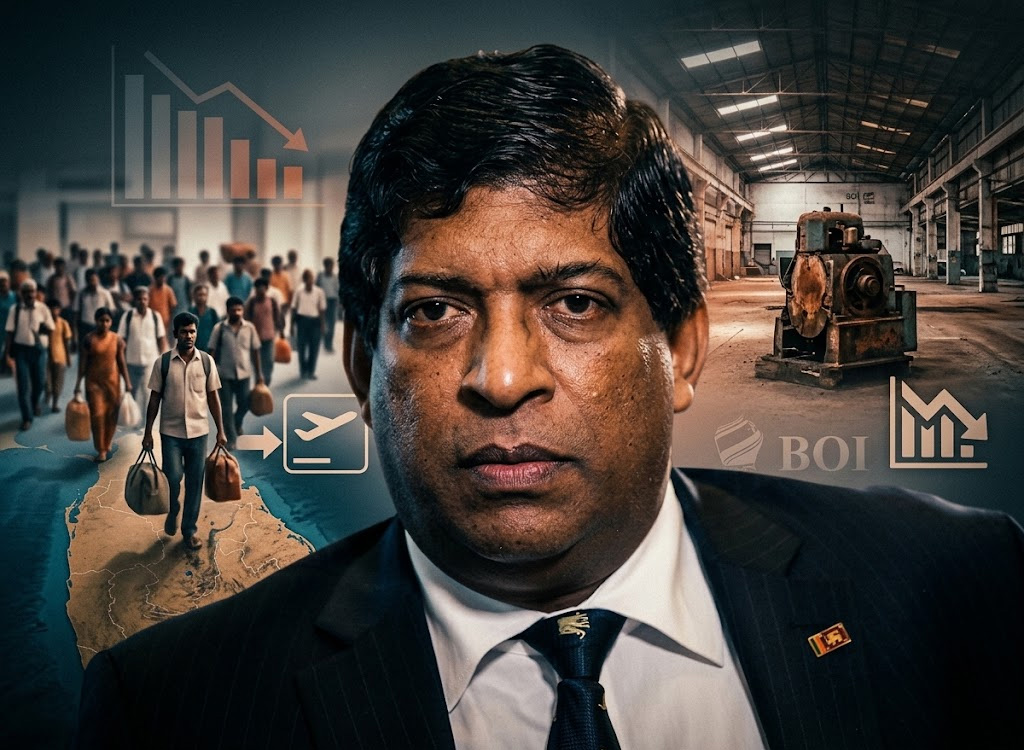
Opposition member of parliament (MP) Ravi Karunanayake has warned that the continued migration of Sri Lankan workers could create a new challenge for the country’s efforts to attract much-needed foreign investment, as businesses face growing concerns over the availability of skilled labour.
Karunanayake speaking has said around 300,000 Sri Lankan workers had migrated overseas in recent years, a trend he argued could increasingly affect the domestic economy.
He has said the issue had also been highlighted by Board of Investment (BOI) Chairman and senior BOI officials, who had pointed to high labour migration as a potential obstacle to attracting new investments.
“High labour migration will prevent much-needed foreign investments coming into Sri Lanka,” Karunanayake has said, arguing that the Government needed to address the issue as a priority.
According to the Opposition MP, Sri Lanka’s economic recovery cannot be sustained without a strong flow of foreign investment, particularly at a time when the country is attempting to expand production, exports and employment.
The warning comes as Sri Lanka continues to promote itself as an investment destination while simultaneously experiencing significant outward migration of workers seeking employment opportunities overseas.
For investors, particularly in labour-intensive sectors, the availability of an adequately skilled workforce is a key consideration. A sustained reduction in the domestic labour pool could therefore add another layer of difficulty to investment decisions, especially in sectors already facing skills shortages.
Fuel subsidy comes under fire
Karunanayake has also criticised the Government’s decision to provide a Rs. 2.5 billion subsidy to private-sector fuel suppliers, arguing that the policy should be reconsidered.
He noted that four foreign companies had been permitted to enter Sri Lanka’s fuel market as part of efforts to introduce competition and attract private investment.
“If four foreign players were allowed to get into the local fuel market for them to invest and earn a profit, the Sri Lankan Government should not pay subsidies to these foreign players,” he has said.
His comments highlight a broader debate over the role of Government support in the liberalised fuel market, particularly at a time when the authorities are under pressure to contain public expenditure and strengthen fiscal discipline.
The Government has previously promoted the entry of private-sector fuel suppliers as a means of increasing competition and improving efficiency in the petroleum market.
However, the question of whether private operators should receive public funds has become increasingly contentious, particularly as the Government seeks to manage expenditure while meeting fiscal targets under its economic reform programme.
Warning over another downturn
Karunanayake has also urged the Government to take seriously former President Ranil Wickremesinghe’s recent warning that Sri Lanka could be heading towards another economic downturn.
He has argued that Wickremesinghe’s assessment should not be dismissed given his role in steering the country through the economic crisis that culminated in sovereign default in 2022.
“It was Ranil Wickremesinghe who helped the Sri Lankan economy rebound after the bankruptcy in 2022. Therefore, a remark made by such a person should not be taken lightly,” Karunanayake has said.
The remarks come as policymakers attempt to maintain the economic recovery achieved since the 2022 crisis while dealing with pressures including employment migration, investment requirements, public expenditure and the need to sustain fiscal reforms.
For the Government, the challenge is increasingly one of balancing short-term economic stability with longer-term growth. Attracting foreign investment will require not only macroeconomic stability and policy certainty, but also a workforce capable of meeting the demands of new industries.
At the same time, the continued departure of Sri Lankan workers reflects another side of the country’s economic recovery: while overseas employment remains a major source of foreign exchange, the loss of workers from the domestic economy could become a constraint on investment and production if the trend continues.










Leave a comment